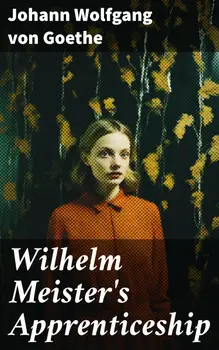
Wilhelm Meister's Apprenticeship : German Literature Classic

In "Wilhelm Meister's Apprenticeship," Johann Wolfgang von Goethe embarks on a profound exploration of self-discovery and societal roles through the journey of its titular character, Wilhelm. Written in the early 18th century, this seminal work encapsulates elements of the Bildungsroman genre, elucidating the intricacies of personal and artistic development as Wilhelm navigates love, ambition, and morality against the backdrop of Enlightenment ideals. Goethe's rich narrative style intertwines philosophical reflections with vibrant descriptions, creating a tapestry that reflects the complexities of human experience while addressing the tensions between individual aspirations and societal expectations. Goethe, a leading figure of the Sturm und Drang literary movement, was influenced by his own experiences in the realms of art, theater, and politics. His deep appreciation for the transformative power of art and intellectual pursuit is palpable in the novel, which mirrors his quest for a harmonious balance between passion and rationality. This journey reflects Goethe's own struggles to reconcile personal desires with the demands of his time, offering insight into the universal search for identity. "Wilhelm Meister's Apprenticeship" is an essential read for anyone seeking to understand the intricacies of personal growth and the philosophical currents of the late Enlightenment. Its timeless themes resonate with contemporary readers, making it a vital addition to the library of any admirer of literary mastery and self-exploration.
À propos de ce livre

In "Wilhelm Meister's Apprenticeship," Johann Wolfgang von Goethe embarks on a profound exploration of self-discovery and societal roles through the journey of its titular character, Wilhelm. Written in the early 18th century, this seminal work encapsulates elements of the Bildungsroman genre, elucidating the intricacies of personal and artistic development as Wilhelm navigates love, ambition, and morality against the backdrop of Enlightenment ideals. Goethe's rich narrative style intertwines philosophical reflections with vibrant descriptions, creating a tapestry that reflects the complexities of human experience while addressing the tensions between individual aspirations and societal expectations. Goethe, a leading figure of the Sturm und Drang literary movement, was influenced by his own experiences in the realms of art, theater, and politics. His deep appreciation for the transformative power of art and intellectual pursuit is palpable in the novel, which mirrors his quest for a harmonious balance between passion and rationality. This journey reflects Goethe's own struggles to reconcile personal desires with the demands of his time, offering insight into the universal search for identity. "Wilhelm Meister's Apprenticeship" is an essential read for anyone seeking to understand the intricacies of personal growth and the philosophical currents of the late Enlightenment. Its timeless themes resonate with contemporary readers, making it a vital addition to the library of any admirer of literary mastery and self-exploration.

Commencez ce livre dès aujourd'hui pour 0 €

  • Accédez à tous les livres de l'app pendant la période d'essai
  • Sans engagement, annulez à tout moment
Essayer gratuitement
Plus de 52 000 personnes ont noté Nextory 5 étoiles sur l'App Store et Google Play.

  1. 3.7

    Les souffrances du jeune Werther : Enregistrement historique de 1959

    Johann Wolfgang von Goethe

  2. Faust

    Johann Wolfgang von Goethe

  3. Faust : A Timeless Drama of Knowledge, Temptation, and Redemption

    Johann Wolfgang von Goethe

  4. 100 Klassiker der Romantik - Meisterwerke, die man kennen muss : Epische Liebesdramen und große Erwartungen in zeitlosen Geschichten

    Jane Austen, Louisa May Alcott, D. H. Lawrence, Fjodor Dostojewski, William Shakespeare, Hedwig Courths-Mahler, Frances Burney, Charlotte Brontë, Alexandre Dumas, Margaret Mitchell, Charles Dickens, L.M. Montgomery, Eugenie Marlitt, Wilhelmine Heimburg, Elisabeth Bürstenbinder, Stendhal, Johann Wolfgang von Goethe, Walter Scott, Guy De Maupassant, Victor Hugo, George Sand, Leo Tolstoi, Gabriele D’Annunzio, Rudyard Kipling, Gustave Flaubert, Nathaniel Hawthorne, Jean-Jacques Rousseau, Bernardin de Saint-Pierre, F. Scott Fitzgerald, Prosper Mérimée, Edith Wharton, Lena Christ, François-René de Chateaubriand, Stefan Zweig, Alexander Sergejewitsch Puschkin, Ida Boy-Ed, Arthur Schnitzler, Anatole France, Johanna Spyri, George Eliot, Gaston Leroux, Nataly von Eschstruth, Gottfried von Straßburg, Sophie Mereau, Caroline von Wolzogen, Benedikte Naubert, Henry De Vere Stacpoole, Levin Schücking

  5. 3.0
    #2

    Die Leiden des jungen Werther - Hörbuch Klassiker

    Johann Wolfgang von Goethe, Hörbuch Klassiker

  6. Trois Contes Initiatiques : Le Serpent Vert, Le Nouveau Pâris et La Nouvelle Mélusine

    Johann Wolfgang von Goethe, Oswald Wirth, Rudolf Steiner

  7. 100 Obras Maestras de la Literatura Universal : Edición enriquecida. Viaje intertemporal por iconos mundiales y el diálogo cultural histórico

    Johann Wolfgang von Goethe, Gustave Flaubert, Franz Kafka, Lewis Carroll, Sigmund Freud, Henrik Ibsen, Charles Dickens, Honoré de Balzac, Mark Twain, Immanuel Kant, Friedrich Schiller, Harriet Beecher Stowe, Oscar Wilde, Robert Louis Stevenson, Edgar Allan Poe, William Shakespeare, Dante Alighieri, Giovanni Boccaccio, Bram Stoker, Charlotte Brontë, Emily Brontë, Jack London, Henry James, Louisa May Alcott, Victor Hugo, Arthur Conan Doyle, Joseph Conrad, Jane Austen, José Rizal, Edgar Rice Burroughs, Herman Melville, Jonathan Swift, Gustavo Adolfo Bécquer, Vicente Blasco Ibáñez, Benito Pérez Galdós, Jean-Jacques Rousseau, Daniel Defoe, Pedro Calderón de la Barca, Virginia Woolf, Washington Irving, Juan Valera, Horacio Quiroga, Nathaniel Hawthorne, Charles Baudelaire, Wilkie Collins, William Makepeace Thackeray, Voltaire, Apuleius, Leopoldo Alas, John Milton, José Martí, Lope de Vega, Emilio Salgari, Francisco de Quevedo, Rubén Darío, Antonio Machado, José Zorrilla, Tirso de Molina, Emilia Pardo Bazán, Fernando de Rojas, L. Frank Baum, H.G. Wells, J.M. Barrie, H. Rider Haggard, H.P. Lovecraft, Seneca, Hans Christian Andersen, Friedrich Nietzsche, Mary Shelley, Baltasar Gracián, Sófocles, Sun Tzu, Fiódor Dostoyevski, Antón Chéjov, León Tolstoi, Tomás Moro, San Agustín, Nikolái Gógol, Julio Verne, Homero, Platón, Alejandro Dumas, Aristóteles, Hermanos Grimm, Jorge Isaacs, Ignacio De Loyola, Nicolás Maquiavelo, Miguel Cervantes, Teresa de Jesús, Alejandro Dumas hijo, Mijaíl Bakunin, Miguel De Unamuno, Duque de Rivas, Ramón María del Valle-Inclán, Federico García Lorca, Gibrán Jalil Gibrán

  8. Faust : Première partie

    Johann Wolfgang von Goethe

  9. Les Souffrances du jeune Werther

    Johann Wolfgang von Goethe

  10. Faust

    Johann Wolfgang von Goethe

  11. 50 Clásicos que debes leer antes de morir

    Dante Alighieri, Aristóteles, Jane Austen, Charles Baudelaire, Giovanni Boccaccio, Anne Brontë, C. Collodi, James Fenimore Cooper, Fedor Mikhaïlovitch Dostoïevski, Arthur Conan Doyle, Alexandre Dumas, José de Espronceda, Gustave Flaubert, Sigmund Freud, Benito Pérez Galdós, Kahlil Gibran, Johann Wolfgang Goethe, Johann Wolfgang von Goethe, Victor Hugo, Thomas Hardy, Nathaniel Hawthorne, Vicente Blasco Ibáñez, Washington Irving, James Joyce, Mariano José de Larra, Jack London, Federico García Lorca, H.P. Lovecraft, Antonio Machado, Gustav Meyrink, John Stuart Mill, Amado Nervo, Friedrich Nietzsche, Solomon Northup, Alexander Sergeyevich Pushkin, Francisco de Quevedo, Walter Scott, William Shakespeare, Robert Louis Stevenson, Harriet Beecher Stowe, Jonathan Swift, Mark Twain, Miguel De Unamuno, Ramón María del Valle-Inclán, Julio Verne, Virginia Woolf

  12. Faust : une pièce de théâtre de Johann Wolfgang von Goethe inspirée de la vie de Johann Georg Faust, alchimiste allemand du xvie siècle

    Johann Wolfgang von Goethe