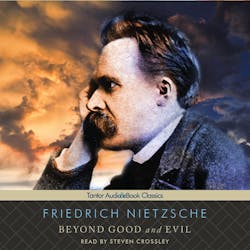
Beyond Good and Evil

Beyond Good and Evil is a book by philosopher Friedrich Nietzsche that expands the ideas of his previous work, Thus Spoke Zarathustra, with a more critical and polemical approach.

In Beyond Good and Evil, Nietzsche accuses past philosophers of lacking critical sense and blindly accepting dogmatic premises in their consideration of morality. Specifically, he accuses them of founding grand metaphysical systems upon the faith that the good man is the opposite of the evil man, rather than just a different expression of the same basic impulses that find more direct expression in the evil man. The work moves into the realm "beyond good and evil" in the sense of leaving behind the traditional morality which Nietzsche subjects to a destructive critique in favour of what he regards as an affirmative approach that fearlessly confronts the perspectival nature of knowledge and the perilous condition of the modern individual.

Of the four "late-period" writings of Nietzsche, Beyond Good and Evil most closely resembles the aphoristic style of his middle period. In it he exposes the deficiencies of those usually called "philosophers" and identifies the qualities of the "new philosophers": imagination, self-assertion, danger, originality, and the "creation of values." He then contests some of the key presuppositions of the old philosophic tradition like "self-consciousness," "knowledge," "truth," and "free will," explaining them as inventions of the moral consciousness. In their place, he offers the "will to power" as an explanation of all behavior; this ties into his "perspective of life," which he regards as "beyond good and evil," denying a universal morality for all human beings. Religion and the master and slave moralities feature prominently as Nietzsche re-evaluates deeply held humanistic beliefs, portraying even domination, appropriation and injury to the weak as not universally objectionable.

Begin vandaag nog met dit boek voor € 0

  • Krijg volledige toegang tot alle boeken in de app tijdens de proefperiode
  • Geen verplichtingen, op elk moment annuleren
Probeer nu gratis
Meer dan 52.000 mensen hebben Nextory 5 sterren gegeven in de App store en op Google Play.

  1. Existentialism: Philosophical and Literary Works : Notes from Underground. Fear and Trembling. Ecce Homo. The Metamorphosis and others

    Fyodor Dostoevsky, Soren Kierkegaard, Friedrich Nietzsche, Rainer Maria Rilke, Franz Kafka

  2. 4.0
    #9

    Zo sprak Zarathoestra : Een boek voor iedereen en niemand

    Friedrich Nietzsche

  3. 50 Clásicos que Debes Leer Antes de Morir : Un viaje literario por los tesoros de la literatura universal

    Dante Alighieri, Aristóteles, Jane Austen, Charles Baudelaire, Giovanni Boccaccio, Anne Brontë, C. Collodi, James Fenimore Cooper, Fedor Mikhaïlovitch Dostoïevski, Arthur Conan Doyle, Alexandre Dumas, José de Espronceda, Gustave Flaubert, Sigmund Freud, Benito Pérez Galdós, Kahlil Gibran, Johann Wolfgang Goethe, Johann Wolfgang von Goethe, Victor Hugo, Thomas Hardy, Nathaniel Hawthorne, Vicente Blasco Ibáñez, Washington Irving, James Joyce, Mariano José de Larra, Jack London, Federico García Lorca, H.P. Lovecraft, Antonio Machado, Gustav Meyrink, John Stuart Mill, Amado Nervo, Friedrich Nietzsche, Solomon Northup, Alexander Sergeyevich Pushkin, Francisco de Quevedo, Walter Scott, William Shakespeare, Robert Louis Stevenson, Harriet Beecher Stowe, Jonathan Swift, Mark Twain, Miguel De Unamuno, Ramón María del Valle-Inclán, Julio Verne, Virginia Woolf

  4. 4.5

    Thus Spoke Zarathustra

    Friedrich Nietzsche

  5. The Antichrist

    Friedrich Nietzsche

  6. Nietzsche’s The Birth of Tragedy: From the Spirit of Music

    Friedrich Nietzsche

  7. 3.0

    Classic Philosophical Works (Thus Spoke Zarathustra, The Apology of Socrates, Tao Te Ching...)

    Plato, Friedrich Nietzsche, Herman Hesse, Leo Tolstoy, Immanuel Kant, Sun Tzu

  8. 4.4

    Beyond Good and Evil

    Friedrich Nietzsche

  9. 3.5

    Beyond Good and Evil

    Friedrich Nietzsche

  10. The Portable Nietzsche (Portable Library)

    Friedrich Nietzsche

  11. 3.5

    The Antichrist

    Friedrich Nietzsche

  12. Nietzsche's The Birth of Tragedy

    Friedrich Nietzsche