3.0(1)

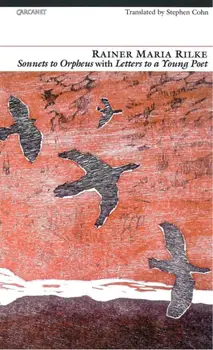
Sonnets to Orpheus and Letters To a Young Poet

'They are perhaps most mysterious, even to me,' wrote Rainer Maria Rilke of the Sonnets to Orpheus, 'in the manner in which they arrived and imposed themselves on me - the most puzzling dictation I have ever received and taken down.' Rilke, born in Prague in 1875, died at Valmont near Montreux in the last days of 1926. His Sonnets to Orpheus may appear comparatively simple, even casual, at first reading, but they are crammed with content which resonates far beyond the familiar legend of Orpheus and Eurydice. The Sonnets have an astonishing range which takes in the Singing God and his beloved Eurydice; legend in general, along with time, flight and change; architecture, music and dance; animals, plants, flowers and fruits. They ask to be read by the ear and by the inner eye as much as by the intellect. The Sonnets were 'taken down' during a very few weeks in 1922 - weeks in which the poet also brought his Duino Elegies to completion. In them, Rilke partly identifies himself with Orpheus. The young dancer Vera, for whom the Sonnets are inscribed, taken so young into the Underworld, becomes Eurydice. A tension which adds life to Rilke's Sonnets to Orpheus comes through a paradox. Rilke's was a deeply inward, introspective nature, but in the Sonnets he succeeds brilliantly in looking out from his isolation: in making poetry from material which lies in an important sense 'outside'. Rilke's ten letters to the young officer-cadet Franz Xavier Kappus, written between 1903 and 1908, were later published as Letters to a Young Poet. By now the letters have become a part of literary folklore. They contain insights which are as profound today as when they were written, almost a century ago.
Begin vandaag nog met dit boek voor € 0

  • Krijg volledige toegang tot alle boeken in de app tijdens de proefperiode
  • Geen verplichtingen, op elk moment annuleren
Probeer nu gratis
Meer dan 52.000 mensen hebben Nextory 5 sterren gegeven in de App store en op Google Play.

Anderen hebben ook gelezen

Sla de lijst over
  1. Eugene Onegin

    Alexander Pushkin

  2. 101 Great American Poems : To My Dear and Loving Husband, The Planting of the Apple-Tree, Concord Hymn, The Arrow and the Song, Alone, Annabel Lee and others

    Anne Bradstreet, Phillis Wheatley, William Cullen Bryant, Ralph Waldo Emerson, Henry Wadsworth Longfellow, Edgar Allan Poe, Abraham Lincoln, Oliver Wendell Holmes Holmes, Herman Melville, Walt Whitman, Frances E. W. W Harper, Emily Dickinson, Ella Wheeler Wilcox, Ernest Lawrence Thayer, Edwin Arlington Robinson, Stephen Crane, James Weldon Johnson, Paul Laurence Dunbar, Gertrude Stein, Vachel Lindsay, Claude Mckay, Countee Cullen, Amy Lowell, James Oppenheim, Elizabeth Barrett Browning, Emma Lazarus, Louisa May Alcott, Ellis Parker Butler, Hugh Henry Brackenridge, Matthew Arnold, William Butler Yeats, William Blake, Sara Teasdale, William Barnes

  3. 4 mei
    4.3

    We Did Ok, Kid : A Memoir

    Anthony Hopkins

  4. 4.0
    #2

    Frankenstein (1831 version) by Mary Shelley - Delphi Classics (Illustrated)

    Mary Shelley

  5. Crime and Punishment

    Fyodor Dostoyevsky

  6. 4.6

    The Iliad

    Homer Homer

  7. 3.0

    Zijde van Alessandro Baricco (Boekanalyse) : Volledige analyse en gedetailleerde samenvatting van het werk

    Catherine Bourguignon

  8. 4.0

    Dante's Inferno : illustrated by Gustave Doré

    Dante Alighieri

  9. 4.0

    Notes from the Underground : "Illustrated"

    Fyodor Dostoyevsky

  10. 4.0

    A Poem for Every Day of the Year : A magnificent poetry collection for the whole family to share

    Allie Esiri

  11. 3.0

    Swimming in a Sea of Death: A Son's Memoir

    David Rieff

  12. Darling, I'm Going to Charlie: A Memoir

    Maryse Wolinski