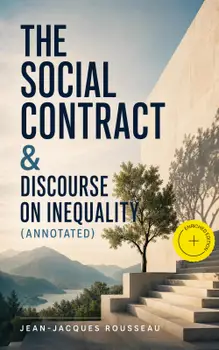




Bringing together two of Jean-Jacques Rousseau's most influential political writings, The Social Contract & Discourse on Inequality traces a radical inquiry into freedom, authority, and the origins of social corruption. In the Discourse, Rousseau anatomizes the passage from natural independence to civil inequality with a prose at once speculative, polemical, and anthropological. The Social Contract then offers its famous counterproposal: legitimate political order founded on popular sovereignty and the general will, written in aphoristic, rigorous, and revolutionary style within the ferment of Enlightenment debate. Rousseau, born in Geneva in 1712, was both a product and a critic of the Enlightenment. His uneasy relations with Parisian philosophes, his Calvinist republican inheritance, and his sensitivity to exclusion, dependency, and vanity shaped his suspicion of modern civilization. Personal experience of social marginality and intellectual conflict helped sharpen his conviction that political institutions must be judged by whether they preserve moral freedom rather than merely administer power. This volume is essential for readers of political theory, philosophy, history, and literature. It rewards close reading, not only as a foundational text for modern democracy and revolution, but as a profound challenge to complacent assumptions about progress, property, citizenship, and liberty.
This enriched edition has been carefully crafted to add value to your reading experience.
- A comprehensive Introduction outlines these selected works' unifying features, themes, or stylistic evolutions.
- The Author Biography highlights personal milestones and literary influences that shape the entire body of writing.
- A Historical Context section situates the works in their broader era—social currents, cultural trends, and key events that underpin their creation.
- A concise Synopsis (Selection) offers an accessible overview of the included texts, helping readers navigate plotlines and main ideas without revealing critical twists.
- A unified Analysis examines recurring motifs and stylistic hallmarks across the collection, tying the stories together while spotlighting the different work's strengths.
- Reflection questions inspire deeper contemplation of the author's overarching message, inviting readers to draw connections among different texts and relate them to modern contexts.
- Lastly, our hand‐picked Memorable Quotes distill pivotal lines and turning points, serving as touchstones for the collection's central themes.