A Treatise of Human Nature

A Treatise of Human Nature is a book by Scottish philosopher David Hume, considered by many to be Hume's most important work and one of the most influential works in the history of philosophy. The Treatise is a classic statement of philosophical empiricism, skepticism, and naturalism. In the introduction Hume presents the idea of placing all science and philosophy on a novel foundation: namely, an empirical investigation into human nature. Impressed by Isaac Newton's achievements in the physical sciences, Hume sought to introduce the same experimental method of reasoning into the study of human psychology, with the aim of discovering the "extent and force of human understanding". Against the philosophical rationalists, Hume argues that passion rather than reason governs human behaviour. He introduces the famous problem of induction, arguing that inductive reasoning and our beliefs regarding cause and effect cannot be justified by reason; instead, our faith in induction and causation is the result of mental habit and custom. Hume defends a sentimentalist account of morality, arguing that ethics is based on sentiment and passion rather than reason, and famously declaring that "reason is, and ought only to be the slave to the passions". Hume also offers a skeptical theory of personal identity and a compatibilist account of free will.
Kom i gang med denne boken i dag for 0 kr

  • Få full tilgang til alle bøkene i appen i prøveperioden
  • Ingen forpliktelser, si opp når du vil
Prøv gratis nå
Mer enn 52 000 personer har gitt Nextory 5 stjerner på App Store og Google Play.

  1. #4

    The History of England Volume 4 : The Reign of Queen Elizabeth I

    David Hume

  2. 33 Masterpieces of Philosophy and Science to Read Before You Die (Illustrated) : Utopia, The Meditations, The Art of War, The Kama Sutra, Candide

    Thomas More, Marcus Aurelius Antoninus, Sun Tzu, Vatsyayana, Voltaire, Edwin A. Abbott, Aristotle, Dale Carnegie, Gilbert Keith Chesterton, René Descartes, Epictetus, Sigmund Freud, Hermann Hesse, David Hume, Lao Tzu, David Herbert Lawrence, Niccolò Machiavelli, John Mill, Prentice Mulford, Friedrich Nietzsche, Plato, Bertrand Russell, H.G. Wells, Frances Bacon

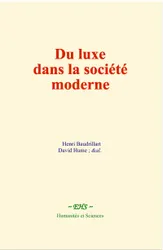
  3. Du luxe dans la société moderne

    Henri Baudrillart, David Hume, E. de Laveleye

  4. Ensayos morales [Selección]

    David Hume

  5. 1800 Citations de philosophes

    Aristote, Épicure, Platon, Thalès de Milet, – Socrate, Protagoras, Anaximandre, Épictète, Héraclite, Marc Aurèle, René Descartes, Michel de Montaigne, Alexis de Tocqueville, Voltaire, Charles De Montesquieu, Jean-Jacques Rousseau, Emmanuel Kant, Hannah Arendt, Gottfried Wilhelm Leibniz, Georg Wilhelm Friedrich Hegel, Friedrich Nietzsche, Arthur Schopenhauer, David Hume, John Locke, Francis Bacon, Thomas Hobbes, Thomas More, Confucius, Érasme, Lao Tseu, Baruch Spinoza, Søren Kierkegaard, Nicolas Machiavel, Thomas d'Aquin, Henry David Thoreau

  6. 250 citations de philosophes anglais

    David Hume, John Locke, Francis Bacon, Thomas Hobbes, Thomas More

  7. 4.0

    Comprendre David Hume

    David Hume

  8. 4.0

    50 citations de David Hume

    David Hume

  9. #6

    The History of England Volume 6 : Containing the Commonwealth, Charles II and James II

    David Hume

  10. The Dark Ages Collection : Chronicles of a Transformative Era

    John Bagnell Bury, Edward Creasy, Henry Bradley, Edward Gibbon, David Hume

  11. Ensayos morales, políticos y literarios

    David Hume

  12. #5

    The History of England Volume 5 : James I and Charles I

    David Hume