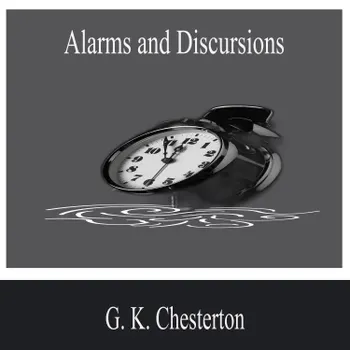
Alarms and Discursion

"Alarms and Discursions" is a collection of essays by the brilliant English writer G. K. Chesterton. Let's explore some of the intriguing pieces within this work: Introductory: On Gargoyles: Chesterton begins with a contemplation of a gargoyle—one of those grotesque stone figures that adorned the water-spouts in medieval cathedrals. He reflects on the meaning of the grotesque and embarks on a symbolic reverie about the three great stages of art. The essay takes us on a journey through the ages, exploring the transition from innocence to sophistication, from primitive sun-worship to the intricate craftsmanship of cathedrals. The Surrender of a Cockney: Chesterton humorously dissects the transformation of a Cockney (a Londoner) who moves to the countryside. The Cockney's surrender to the charms of rural life leads to delightful observations about human nature. The Nightmare: In this piece, Chesterton delves into the realm of dreams and nightmares. He muses on the significance of nightmares and their connection to our waking lives. The Appetite of Earth: Chesterton explores the insatiable hunger of the earth itself—the way it consumes and renews life. He weaves together themes of nature, desire, and eternity. The Philosophy of Sight-seeing: Chesterton playfully critiques the modern obsession with sight-seeing. He questions whether travelers truly see what they behold or merely collect superficial experiences. These essays are a delightful blend of wit, wisdom, and whimsy, showcasing Chesterton's unique perspective on life, art, and human existence. "
Kom i gang med denne boken i dag for 0 kr

  • Få full tilgang til alle bøkene i appen i prøveperioden
  • Ingen forpliktelser, si opp når du vil
Prøv gratis nå
Mer enn 52 000 personer har gitt Nextory 5 stjerner på App Store og Google Play.

  1. 3.0

    50 Masterpieces you have to read before you die vol: 1 (2020 Edition) : Included: Little Women, The Richest Man in Babylon Emma, The Call Of The Wild ....

    Louisa May Alcott, Dante Alighieri, Marcus Aurelius, Jane Austen, L. Frank Baum, Charlotte Brontë, Emily Brontë, Anne Brontë, Miguel de Cervantes, Agatha Christie, George S. Clason, Arthur Conan Doyle, Joseph Conrad, Charles Dickens, Fyodor Dostoyevsky, Alexandre Dumas, George Eliot, G.K. Chesterton, G.K. Chesterton, Zane Grey, Nathaniel Hawthorne, Napoleon Hill, Homer, Victor Hugo, Frances Hodgson Burnett, Washington Irving, Henry James, Franz Kafka, Rudyard Kipling, Jack London, Leo Tolstoy, H.P. Lovecraft, Lucy Maud Montgomery, Joseph Murphy, Robert Louis Stevenson, Edgar Allan Poe, Marcel Proust, Publius, Mary Shelley, Bram Stoker, Mark Twain, Sun Tzu, Lew Wallace, Wallace D. Wattles, H.G. Wells

  2. 50 Short Story Masterpieces you have to listen before you die (Golden Deer Classics)

    F. Scott Fitzgerald, O.Henry, Mark Twain, Kahlil Gibran, W. W. Jacobs, Anonymous, Thomas Jefferson, Founding Fathers, Plato, Lord Alfred Tennyson, T. S. Eliot, William Dean Howells, Karl Marx, Friedrich Engels, Leo Tolstoy, Washington Irving, Samuel Taylor Coleridge, Bram Stoker, Sun Tzu, Edgar Allan Poe, Lao Tzu, Oscar Wilde, William Blake, Patrick Henry, H.G. Wells, Saki, Herman Melville, Clement Clarke Moore, Bret Harte, Immanuel Kant, Jack London, Henry Ford, G.K. Chesterton, Charles Perrault, Anton Chekhov, D. H. Lawrence, Fyodor Dostoevsky, Franz Kafka, James Joyce, John Muir

  3. #24

    The Fairy Tale of Father Brown (The Father Brown Classics, Episode 24)

    G.K. Chesterton

  4. 4.0

    The Everlasting Man

    G.K. Chesterton

  5. The Man Who Knew Too Much: And Other Stories : 8 Detective Short Stories

    G.K. Chesterton

  6. St. Francis of Assisi

    G.K. Chesterton

  7. The Ball and the Cross : A Novel

    G.K. Chesterton

  8. Heretics

    G.K. Chesterton

  9. Eugenics and Other Evils

    G.K. Chesterton

  10. Saint Thomas Aquinas

    G.K. Chesterton

  11. The Flying Inn : A Novel

    G.K. Chesterton

  12. 12 Masterpieces You Have to Read Before You Die. Philosophy

    Niccolo Machiavelli, Tommaso Campanella, Francis Bacon, Thomas More, John Stuart Mill, Immanuel Kant, Kahlil Gibran, Leo Tolstoy, G.K. Chesterton, Henry David Thoreau


Relaterte kategorier