Om denne boken

Goethe's *Faust; a Tragedy, Translated from the German of Goethe* presents the learned Faust's desperate wager with Mephistopheles, tracing his pursuit of limitless knowledge, sensual experience, and spiritual fulfillment. Combining philosophical drama, lyrical poetry, satire, romance, religious allegory, and elements of medieval legend, the work resists the conventions of a unified stage tragedy. Its shifting registers—from colloquial speech and popular song to learned allusion and visionary symbolism—embody the intellectual restlessness of German Romanticism while engaging the older Faust tradition and the moral questions of the Enlightenment. The Gretchen episode, in particular, gives the metaphysical contest a profoundly human dimension, exposing the consequences of desire, social judgment, and moral evasion. Johann Wolfgang von Goethe (1749–1832), one of the central figures of European literature, developed *Faust* over nearly six decades, from his youthful *Urfaust* to the completed second part published shortly before his death. His wide-ranging interests in law, science, classical antiquity, theology, politics, and the arts shaped the drama's encyclopedic ambition. The work also reflects Goethe's evolving understanding of individuality, nature, cultural inheritance, and redemption, as well as his sustained engagement with German intellectual life after the Enlightenment. This translation is essential reading for anyone interested in the formation of modern literature and the dramatic possibilities of philosophical poetry. It rewards readers drawn to epic ideas and vivid theatrical scenes alike, offering a work whose questions about knowledge, freedom, love, responsibility, and salvation remain as urgent as its language is imaginative.

This enriched edition has been carefully crafted to add value to your reading experience.

- A succinct Introduction situates the work's timeless appeal and themes.

- The Synopsis outlines the central plot, highlighting key developments without spoiling critical twists.

- A detailed Historical Context immerses you in the era's events and influences that shaped the writing.

- An Author Biography reveals milestones in the author's life, illuminating the personal insights behind the text.

- A thorough Analysis dissects symbols, motifs, and character arcs to unearth underlying meanings.

- Reflection questions prompt you to engage personally with the work's messages, connecting them to modern life.

- Hand‐picked Memorable Quotes shine a spotlight on moments of literary brilliance.

- Interactive footnotes clarify unusual references, historical allusions, and archaic phrases for an effortless, more informed read.

Kom i gang med denne boken i dag for 0 kr

  • Få full tilgang til alle bøkene i appen i prøveperioden
  • Ingen forpliktelser, si opp når du vil
Prøv gratis nå
Mer enn 52 000 personer har gitt Nextory 5 stjerner på App Store og Google Play.

  1. Harvard Classics : The Five-Foot Shelf of Books

    Aesop, Dante Alighieri, Hans Christian Andersen, Augustine of Hippo, Marcus Aurelius, Jane Austen, Francis Bacon, Honoré de Balzac, Francis Beaumont, Bjørnstjerne Bjørnson, Thomas Browne, Robert Browning, John Bunyan, EDMUND BURKE, Robert Burns, Lord Byron, Thomas Carlyle, Benvenuto Cellini, Miguel de Cervantes, Marcus Tullius Cicero, Richard Henry Jr., Charles Darwin, Alphonse Daudet, Thomas Dekker, Charles Dickens, Fyodor Dostoevsky, John Dryden, Charles W. Eliot, George Eliot, Ralph Waldo Emerson, Epictetus, John Fletcher, Theodor Fontane, Benjamin Franklin, Johann Wolfgang Goethe, Oliver Goldsmith, Jacob Grimm, Edward Everett Hale, Bret Harte, Nathaniel Hawthorne, Homer, Victor Hugo, Washington Irving, Henry James, Ben Jonson, Gottfried Keller, Thomas à Kempis, Alexander L. Kielland, Martin Luther, Niccolò Machiavelli, Alessandro Manzoni, Christopher Marlowe, Philip Massinger, Guy De Maupassant, John Stuart Mill, John Milton, Thomas More, William Morris, Alfred de Musset, William Allan Neilson, William Penn, Plato, Pliny the Younger, Plutarch, George Sand, Percy Bysshe Shelley, Richard Brinsley Sheridan, Adam Smith, Laurence Sterne, Theodor Storm, William Makepeace Thackeray, Leo Tolstoy, Ivan Turgenev, Mark Twain, Juan Valera, Virgil, Izaak Walton, John Webster, John Woolman

  2. Ny

    50 Clásicos que debes leer antes de morir

    Dante Alighieri, - Aristoteles, Jane Austen, Charles Baudelaire, Giovanni Boccaccio, Anne Brontë, C. Collodi, James Fenimore Cooper, Fédor Mikhaïlovitch Dostoïevski, Arthur Conan Doyle, Alexandre Dumas, José de Espronceda, Gustave Flaubert, Sigmund Freud, Benito Pérez Galdós, Kahlil Gibran, Johann Wolfgang Goethe, Victor Hugo, Thomas Hardy, Nathaniel Hawthorne, Vicente Blasco Ibáñez, Washington Irving, James Joyce

  3. Ny

    Die Wahlverwandtschaften : Roman

    Johann Wolfgang Goethe

  4. 4.0

    Faust

    Johann Wolfgang Goethe

  5. 2.0

    Unge Werthers lidelser

    Johann Wolfgang Goethe

  6. 4.0

    The Sorrows Young Werther

    Johann Wolfgang Goethe

  7. 8. jan.

    100 Minuten Weltliteratur : Balladen, Gedichte und Szenen

    Ludwig Uhland, Börries Freiherr Münchhausen, Friedrich Schiller, Theodor Storm, Hugo von Hofmannsthal, Heinrich Heine, Theodor Fontane, Gustav Falke, Johann Wolfgang Goethe, Lulu von Torney, Adelbert von Chamisso, Eduard Mörike

  8. Ny

    Faust. Der Tragödie erster Teil : Drama in Versen

    Johann Wolfgang Goethe

  9. Die Leiden des jungen Werther : Roman in Briefen

    Johann Wolfgang Goethe

  10. Forkortet

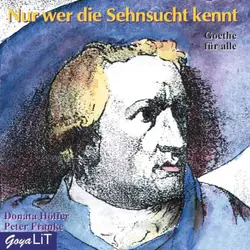
    Nur wer die Sehnsucht kennt : Goethe für alle

    Peter Franke, Armin Giese, Johann Wolfgang Goethe

  11. Faust : The First Part of the Tragedy

    Johann Wolfgang Goethe

  12. Faust : The First Part of the Tragedy

    Johann Wolfgang Goethe