Om denne boken

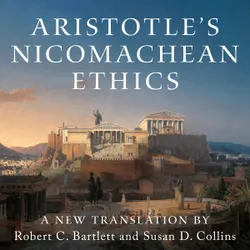
Aristotle's Nicomachean Ethics is a foundational inquiry into the nature of human flourishing, or eudaimonia, and the disciplined cultivation of virtue. Written in a lucid yet compressed philosophical prose, the work proceeds by careful distinctions, practical examples, and teleological reasoning. Set within the intellectual world of classical Greek ethics after Socrates and Plato, it shifts moral philosophy from abstract idealism toward lived character, habit, friendship, pleasure, justice, and contemplative wisdom. Aristotle, born in Stagira in 384 BCE, studied in Plato's Academy before founding his own school, the Lyceum, in Athens. His wide-ranging investigations in logic, biology, politics, rhetoric, and metaphysics shaped his ethical thought: human beings, for him, must be understood according to their distinctive capacities and social nature. The Nicomachean Ethics likely reflects lectures edited or preserved within his school, perhaps associated with his son Nicomachus. This book is indispensable for readers interested in moral philosophy, political thought, classical literature, or the art of living well. It rewards slow reading, inviting reflection not merely on rules or outcomes, but on the formation of a noble, balanced, and intellectually serious life.

This enriched edition has been carefully crafted to add value to your reading experience.

- A succinct Introduction situates the work's timeless appeal and themes.

- The Synopsis outlines the central plot, highlighting key developments without spoiling critical twists.

- A detailed Historical Context immerses you in the era's events and influences that shaped the writing.

- An Author Biography reveals milestones in the author's life, illuminating the personal insights behind the text.

- A thorough Analysis dissects symbols, motifs, and character arcs to unearth underlying meanings.

- Reflection questions prompt you to engage personally with the work's messages, connecting them to modern life.

- Hand‐picked Memorable Quotes shine a spotlight on moments of literary brilliance.

- Interactive footnotes clarify unusual references, historical allusions, and archaic phrases for an effortless, more informed read.

Kom i gang med denne boken i dag for 0 kr

  • Få full tilgang til alle bøkene i appen i prøveperioden
  • Ingen forpliktelser, si opp når du vil
Prøv gratis nå
Mer enn 52 000 personer har gitt Nextory 5 stjerner på App Store og Google Play.

Mer av Aristotle

  1. 4.3

    500 Quotes to Learn Wisdom from Classical Greek Philosophers

    Aristotle, Epictetus, – Heraclitus Ephesus, Plato, Socrates

  2. On the Motion of Animals

    Aristotle, Theodorus Gaza

  3. Aristotle's Nicomachean Ethics

    Aristotle

  4. Rhetoric : The Art of Persuasion and Public Speaking

    Aristotle, Tim Zengerink

  5. Aristotle’s Complete Works on the Mind, Dreams, and the Nature of Thought : On Memory and Reminiscence, On Dreams & On Sleep and Sleeplessness

    Aristotle, Tim Zengerink

  6. 10 Masterpieces You Have to Read Before You Die, Vol.5 : The Odyssey, The Republic, Meditations, The Divine Comedy, Faust and others

    Homer, Plato, Aristotle, Marcus Aurelius, Niccolo Machiavelli, Dante Alighieri, Johann Wolfgang von Goethe, Leo Tolstoy

  7. 25+ The Big Book of Ancient Classics : The Odyssey by Homer, Meditations by Marcus Aurelius, The Republic by Plato, Poetics by Aristotle and others

    Aristotle, Aeschylus, Marcus Aurelius, Euripides, Hesiod, Homer, Plato, Sappho -, Sophocles

  8. 4.3

    Learn Wisdom with Classical Greek Philosophers: Plato, Socrates, Aristotle

    Aristotle, Plato, Socratess

  9. 33 Human Science Masterpieces You Must Read Before You Die. Illustrated : The Art of Public Speaking, The Meditations, The Kama Sutra and other masterpieces

    Edwin A. Abbott, Aristotle, Dale Carnegie, Gilbert Chesterton, René Descartes, Epictetus, Marcus Aurelius Antoninus, Sigmund Freud, Hermann Hesse, David Hume, Lao Tzu, Confucius, Swami Abhedananda, Anonimous, David Herbert Lawrence, Niccolò Machiavelli, Benedictus de Spinoza, John Mill, Prentice Mulford, Thomas More, Friedrich Nietzsche, J. Allanson Picton, Plato, Sun Tzu, Vatsyayana, Voltaire, H.G. Wells, Frances Bacon

  10. 33 Masterpieces of Philosophy and Science to Read Before You Die (Illustrated) : Utopia, The Meditations, The Art of War, The Kama Sutra, Candide

    Thomas More, Marcus Aurelius Antoninus, Sun Tzu, Vatsyayana, Voltaire, Edwin A. Abbott, Aristotle, Dale Carnegie, Gilbert Keith Chesterton, René Descartes, Epictetus, Sigmund Freud, Hermann Hesse, David Hume, Lao Tzu, David Herbert Lawrence, Niccolò Machiavelli, John Mill, Prentice Mulford, Friedrich Nietzsche, Plato, Bertrand Russell, H.G. Wells, Frances Bacon

  11. Aristotle: Poetics, Ethics, Politics, and Categories

    Aristotle