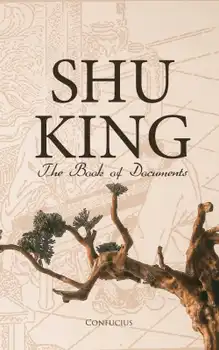
Shu King : Enriched Edition. Sage-King Teachings, Zhou Governance, and the Moral Foundations of Chinese Political Philosophy

The Shu King, or Book of Documents, is one of the foundational classics of ancient Chinese civilization, gathering speeches, proclamations, counsels, and political narratives attributed to sage-kings and early dynastic rulers. Its style is austere, ceremonial, and morally charged, fusing archival record with exemplary rhetoric. Set within the classical canon, it presents government as an ethical vocation rooted in ritual order, historical memory, and the Mandate of Heaven. Traditionally associated with Confucius, who is said to have edited and transmitted ancient texts rather than authored them in the modern sense, the work reflects the concerns central to his thought: proper rule, filial responsibility, reverence for antiquity, and moral cultivation. Living amid the political fragmentation of the late Zhou world, Confucius looked to earlier ages for models of humane authority and principled governance. This book is recommended to readers seeking the intellectual foundations of Confucian political philosophy and early Chinese historiography. Though demanding in tone and form, it rewards patient reading with a profound vision of leadership, legitimacy, and moral responsibility that shaped East Asian thought for millennia.

This enriched edition has been carefully crafted to add value to your reading experience.

- A succinct Introduction situates the work's timeless appeal and themes.

- The Synopsis outlines the central plot, highlighting key developments without spoiling critical twists.

- A detailed Historical Context immerses you in the era's events and influences that shaped the writing.

- An Author Biography reveals milestones in the author's life, illuminating the personal insights behind the text.

- A thorough Analysis dissects symbols, motifs, and character arcs to unearth underlying meanings.

- Reflection questions prompt you to engage personally with the work's messages, connecting them to modern life.

- Hand‐picked Memorable Quotes shine a spotlight on moments of literary brilliance.

- Interactive footnotes clarify unusual references, historical allusions, and archaic phrases for an effortless, more informed read.

Om denne boken

The Shu King, or Book of Documents, is one of the foundational classics of ancient Chinese civilization, gathering speeches, proclamations, counsels, and political narratives attributed to sage-kings and early dynastic rulers. Its style is austere, ceremonial, and morally charged, fusing archival record with exemplary rhetoric. Set within the classical canon, it presents government as an ethical vocation rooted in ritual order, historical memory, and the Mandate of Heaven. Traditionally associated with Confucius, who is said to have edited and transmitted ancient texts rather than authored them in the modern sense, the work reflects the concerns central to his thought: proper rule, filial responsibility, reverence for antiquity, and moral cultivation. Living amid the political fragmentation of the late Zhou world, Confucius looked to earlier ages for models of humane authority and principled governance. This book is recommended to readers seeking the intellectual foundations of Confucian political philosophy and early Chinese historiography. Though demanding in tone and form, it rewards patient reading with a profound vision of leadership, legitimacy, and moral responsibility that shaped East Asian thought for millennia.

This enriched edition has been carefully crafted to add value to your reading experience.

- A succinct Introduction situates the work's timeless appeal and themes.

- The Synopsis outlines the central plot, highlighting key developments without spoiling critical twists.

- A detailed Historical Context immerses you in the era's events and influences that shaped the writing.

- An Author Biography reveals milestones in the author's life, illuminating the personal insights behind the text.

- A thorough Analysis dissects symbols, motifs, and character arcs to unearth underlying meanings.

- Reflection questions prompt you to engage personally with the work's messages, connecting them to modern life.

- Hand‐picked Memorable Quotes shine a spotlight on moments of literary brilliance.

- Interactive footnotes clarify unusual references, historical allusions, and archaic phrases for an effortless, more informed read.
Kom i gang med denne boken i dag for 0 kr

  • Få full tilgang til alle bøkene i appen i prøveperioden
  • Ingen forpliktelser, si opp når du vil
Prøv gratis nå
Mer enn 52 000 personer har gitt Nextory 5 stjerner på App Store og Google Play.

  1. 4.0

    3500 Final Quotes

    Marcus Aurelius, Jane Austen, Beaumarchais, Napoleon Bonaparte, Buddha, Winston Churchill, Cicero, Confucius, Nicolas de Chamfort, Charles de Gaulle, Antoine de Saint-Exupéry, Denis Diderot, Fyodor Dostoevsky, Albert Einstein, Ralph Waldo Emerson, Anne Frank, Mahatma Gandhi, Immanuel Kant, Søren Kierkegaard, Martin Luther King, Georg Christoph Lichtenberg, Abraham Lincoln, Montesquieu, Friedrich Nietzsche, Plato, Marcel Proust, Arthur Schopenhauer, William Shakespeare, Socrates, Baruch Spinoza, Henry David Thoreau, Leonardo da Vinci, Voltaire, Oscar Wilde, Laozi

  2. 50+ Self-Help Classics Collection

    Napoleon Hill, James Allen, Kahlil Gibran, Sun Tzu, Lao Tzu, Confucius, Benjamin Franklin, Marcus Aurelius Antoninus, Russell H. Conwell, Ralph Waldo Emerson, Florence Scovel Shinn, Charles F. Haanel, Wallace D. Wattles, Orison Swett Marden, George Samuel Clason, William Walker Atkinson, P.T. Barnum, G.K. Chesterton, Leo Tolstoy

  3. 600 Mystical and Spiritual Quotations

    Buddha, Confucius, Mahatma Gandhi, Martin Luther King, Dalai-lama, Mother Teresa

  4. 33 Human Science Masterpieces You Must Read Before You Die. Illustrated : The Art of Public Speaking, The Meditations, The Kama Sutra and other masterpieces

    Edwin A. Abbott, Aristotle, Dale Carnegie, Gilbert Chesterton, René Descartes, Epictetus, Marcus Aurelius Antoninus, Sigmund Freud, Hermann Hesse, David Hume, Lao Tzu, Confucius, Swami Abhedananda, Anonimous, David Herbert Lawrence, Niccolò Machiavelli, Benedictus de Spinoza, John Mill, Prentice Mulford, Thomas More, Friedrich Nietzsche, J. Allanson Picton, Plato, Sun Tzu, Vatsyayana, Voltaire, H.G. Wells, Frances Bacon

  5. The Complete Confucius: The Analects, The Doctrine Of The Mean, and The Great Learning

    Confucius

  6. Ny

    The Confucius Collection

    Confucius

  7. The Analects of Confucius

    Confucius

  8. Ny

    The Doctrine of the Mean

    Confucius

  9. The Confucius Collection

    Confucius

  10. The Doctrine of the Mean

    Confucius

  11. The Analects of Confucius

    Confucius

  12. The Confucius Collection

    Confucius