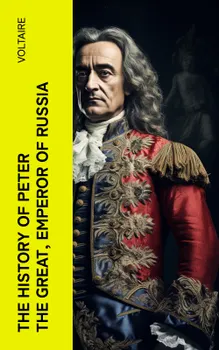
The History of Peter the Great, Emperor of Russia (Annotated) : Enriched Edition. Enlightened Monarchy, Russian Reform, and the Making of an Empire

Voltaire's The History of Peter the Great, Emperor of Russia is at once a political biography, a work of Enlightenment historiography, and a meditation on civilization's progress through reform. Written in a lucid, elegant prose characteristic of Voltaire's historical method, the book presents Peter not merely as a conqueror, but as a transformative sovereign who forced Russia into dialogue with Europe. Its literary context lies among eighteenth-century histories that sought moral, philosophical, and institutional lessons rather than antiquarian detail alone. Voltaire, the great French philosophe, brought to the subject his enduring fascination with enlightened monarchy, religious tolerance, administrative rationality, and the advancement of arts and sciences. His correspondence with Russian authorities and access to state-sponsored materials shaped the work's admiring tone, though his critical intelligence remains visible in his attention to power, violence, and reform. Peter's reign offered Voltaire an ideal case study in the possibilities and contradictions of progress imposed from above. This book is recommended to readers interested in Russian history, Enlightenment thought, and the evolution of modern historical writing. It rewards those seeking not only a portrait of Peter the Great, but also Voltaire's vision of how nations are remade.

This enriched edition has been carefully crafted to add value to your reading experience.

- A succinct Introduction situates the work's timeless appeal and themes.

- The Synopsis outlines the central plot, highlighting key developments without spoiling critical twists.

- A detailed Historical Context immerses you in the era's events and influences that shaped the writing.

- A thorough Analysis dissects symbols, motifs, and character arcs to unearth underlying meanings.

- Reflection questions prompt you to engage personally with the work's messages, connecting them to modern life.

- Hand‐picked Memorable Quotes shine a spotlight on moments of literary brilliance.

- Interactive footnotes clarify unusual references, historical allusions, and archaic phrases for an effortless, more informed read.
Om denne boken

Voltaire's The History of Peter the Great, Emperor of Russia is at once a political biography, a work of Enlightenment historiography, and a meditation on civilization's progress through reform. Written in a lucid, elegant prose characteristic of Voltaire's historical method, the book presents Peter not merely as a conqueror, but as a transformative sovereign who forced Russia into dialogue with Europe. Its literary context lies among eighteenth-century histories that sought moral, philosophical, and institutional lessons rather than antiquarian detail alone. Voltaire, the great French philosophe, brought to the subject his enduring fascination with enlightened monarchy, religious tolerance, administrative rationality, and the advancement of arts and sciences. His correspondence with Russian authorities and access to state-sponsored materials shaped the work's admiring tone, though his critical intelligence remains visible in his attention to power, violence, and reform. Peter's reign offered Voltaire an ideal case study in the possibilities and contradictions of progress imposed from above. This book is recommended to readers interested in Russian history, Enlightenment thought, and the evolution of modern historical writing. It rewards those seeking not only a portrait of Peter the Great, but also Voltaire's vision of how nations are remade.

This enriched edition has been carefully crafted to add value to your reading experience.

- A succinct Introduction situates the work's timeless appeal and themes.

- The Synopsis outlines the central plot, highlighting key developments without spoiling critical twists.

- A detailed Historical Context immerses you in the era's events and influences that shaped the writing.

- A thorough Analysis dissects symbols, motifs, and character arcs to unearth underlying meanings.

- Reflection questions prompt you to engage personally with the work's messages, connecting them to modern life.

- Hand‐picked Memorable Quotes shine a spotlight on moments of literary brilliance.

- Interactive footnotes clarify unusual references, historical allusions, and archaic phrases for an effortless, more informed read.
Kom i gang med denne boken i dag for 0 kr

  • Få full tilgang til alle bøkene i appen i prøveperioden
  • Ingen forpliktelser, si opp når du vil
Prøv gratis nå
Mer enn 52 000 personer har gitt Nextory 5 stjerner på App Store og Google Play.

  1. 4.0

    3500 Final Quotes

    Marcus Aurelius, Jane Austen, Beaumarchais, Napoleon Bonaparte, Buddha, Winston Churchill, Cicero, Confucius, Nicolas de Chamfort, Charles de Gaulle, Antoine de Saint-Exupéry, Denis Diderot, Fyodor Dostoevsky, Albert Einstein, Ralph Waldo Emerson, Anne Frank, Mahatma Gandhi, Immanuel Kant, Søren Kierkegaard, Martin Luther King, Georg Christoph Lichtenberg, Abraham Lincoln, Montesquieu, Friedrich Nietzsche, Plato, Marcel Proust, Arthur Schopenhauer, William Shakespeare, Socrates, Baruch Spinoza, Henry David Thoreau, Leonardo da Vinci, Voltaire, Oscar Wilde, Laozi

  2. 4.1

    Candide

    Voltaire

  3. 4.4

    Candide

    Voltaire

  4. Candide

    Voltaire

  5. French Literature Classics - Ultimate Collection : Enriched edition. Exploring the Depths of French Literary Classics

    Stendhal, Jules Verne, Gustave Flaubert, Émile Zola, Victor Hugo, Guy De Maupassant, Jean-Jacques Rousseau, François Rabelais, George Sand, Marcel Proust, Gaston Leroux, Charles Baudelaire, Molière, Pierre Corneille, Jean Racine, Voltaire, Pierre Choderlos Laclos, Alexandre Dumas pere, Alexandre Dumas fils

  6. 3.5

    Candide

    Voltaire

  7. International Short Stories : Enriched edition. An Anthology of French Literary Brilliance

    Honoré de Balzac, Émile Zola, Victor Hugo, Alphonse Daudet, Guy De Maupassant, Alexandre Dumas, Voltaire

  8. 4.3

    Candide

    Voltaire

  9. 3.0

    Candide : The Classic Tale

    Voltaire

  10. 33 Human Science Masterpieces You Must Read Before You Die. Illustrated : The Art of Public Speaking, The Meditations, The Kama Sutra and other masterpieces

    Edwin A. Abbott, Aristotle, Dale Carnegie, Gilbert Chesterton, René Descartes, Epictetus, Marcus Aurelius Antoninus, Sigmund Freud, Hermann Hesse, David Hume, Lao Tzu, Confucius, Swami Abhedananda, Anonimous, David Herbert Lawrence, Niccolò Machiavelli, Benedictus de Spinoza, John Mill, Prentice Mulford, Thomas More, Friedrich Nietzsche, J. Allanson Picton, Plato, Sun Tzu, Vatsyayana, Voltaire, H.G. Wells, Frances Bacon

  11. 33 Masterpieces of Philosophy and Science to Read Before You Die (Illustrated) : Utopia, The Meditations, The Art of War, The Kama Sutra, Candide

    Thomas More, Marcus Aurelius Antoninus, Sun Tzu, Vatsyayana, Voltaire, Edwin A. Abbott, Aristotle, Dale Carnegie, Gilbert Keith Chesterton, René Descartes, Epictetus, Sigmund Freud, Hermann Hesse, David Hume, Lao Tzu, David Herbert Lawrence, Niccolò Machiavelli, John Mill, Prentice Mulford, Friedrich Nietzsche, Plato, Bertrand Russell, H.G. Wells, Frances Bacon

  12. Ny
    5.0

    Candide : Adapted for French learners - In useful French words for conversation - French Intermediate

    Voltaire