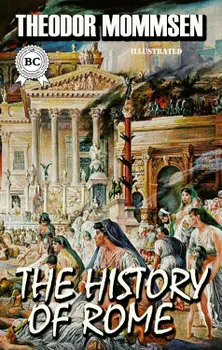
The History of Rome. Illustrated

In 1902 Mommsen was awarded the Nobel Prize for Literature and acclaimed as 'the greatest living master of the art of historical writing'. Mommsen rejected traditional Enlightenment accounts, which glorified ancient Rome; instead, guided by a new and rigorous criticism of sources, Mommsen began the demythologisation of Roman history. In a vivacious and engaging style, Mommsen drew bold parallels between the nineteenth century and classical Rome. Mommsen wrote his history with the pressing political and national issues facing both pre-unification Germany and the rest of the mid-nineteenth century Europe directly in mind.

With exceptions, Mommsen in his Römische Geschichte (1854–1856) narrates a straight chronology of historic events and circumstances. Often strongly worded, he carefully describes the political acts taken by the protagonists, demonstrates the immediate results, draws implications for the future, while shedding light on the evolving society that surround them. The chronology of the contents of his five 'books' (in his first three volumes) are in brief:

Book I, Roman origins and the Monarchy;

Book II, the Republic until the Union of Italy;

Book III, the Punic Wars and the East;

Book IV, the Gracchi, Marius, Drusus, and Sulla;

Book V, the Civil Wars and Julius Caesar.
Om denne boken

In 1902 Mommsen was awarded the Nobel Prize for Literature and acclaimed as 'the greatest living master of the art of historical writing'. Mommsen rejected traditional Enlightenment accounts, which glorified ancient Rome; instead, guided by a new and rigorous criticism of sources, Mommsen began the demythologisation of Roman history. In a vivacious and engaging style, Mommsen drew bold parallels between the nineteenth century and classical Rome. Mommsen wrote his history with the pressing political and national issues facing both pre-unification Germany and the rest of the mid-nineteenth century Europe directly in mind.

With exceptions, Mommsen in his Römische Geschichte (1854–1856) narrates a straight chronology of historic events and circumstances. Often strongly worded, he carefully describes the political acts taken by the protagonists, demonstrates the immediate results, draws implications for the future, while shedding light on the evolving society that surround them. The chronology of the contents of his five 'books' (in his first three volumes) are in brief:

Book I, Roman origins and the Monarchy;

Book II, the Republic until the Union of Italy;

Book III, the Punic Wars and the East;

Book IV, the Gracchi, Marius, Drusus, and Sulla;

Book V, the Civil Wars and Julius Caesar.

Kom i gang med denne boken i dag for 0 kr

  • Få full tilgang til alle bøkene i appen i prøveperioden
  • Ingen forpliktelser, si opp når du vil
Prøv gratis nå
Mer enn 52 000 personer har gitt Nextory 5 stjerner på App Store og Google Play.

  1. History of Rome. Classic Collection. Illustrated : The Gallic Wars, The Histories, Roman History and The Civil Wars, The History of the Decline and Fall of the Roman Empire, The History of Rome

    Julius Caesar, Tacitus, Appian, Edward Gibbon, Theodor Mommsen

  2. Ny

    100 Klassiker der Geschichtsschreibung : Die Geschichte des Alten Ägypten, Der Alexanderzug, Römische Geschichte, Herbst des Mittelalters, Die russische Revolution, Der Kampf um Europa

    Edward Gibbon, Leopold von Ranke, J. B. Bury, Theodor Mommsen, Herodot, Thukydides, Xenophon, Arrian, Titus Livius, Tacitus, Gaius Iulius Caesar, Sueton, Polybios, Ammianus Marcellinus, Plutarch, Diogenes Laërtios, Eusebius, Prokop von Cäsarea, Anna Komnena, Agathias, Marc Bloch, L. W. King, George Rawlinson, Edward Bulwer-Lytton, Jacob Burckhardt, Joseph François Michaud, Johan Huizinga, Arthur Middleton Reeves, Niccolò Machiavelli, G.K. Chesterton, Voltaire, Friedrich Schiller, Ricarda Huch, Thomas Carlyle, Charles Downer Hazen, Egon Friedell, Walter Benjamin

  3. 100 Große Geschichtsbücher - Klassiker, die man kennen muss : Der Peloponnesische Krieg, Der Alexanderzug, Ab Urbe Condita, Napoleonische Kriege, Geschichte des Ersten und Zweiten Weltkriegs

    Tacitus, Thukydides, Plutarch, Theodor Mommsen, Edward Gibbon, Leopold von Ranke, Ricarda Huch, Helmuth von Moltke, Xenophon, Arrian, Titus Livius, Gaius Iulius Caesar, Sueton, Polybios, Ammianus Marcellinus, Diogenes Laërtios, Eusebius, Prokop von Cäsarea, Anna Komnena, Agathias, Marc Bloch, George Rawlinson, Edward Bulwer-Lytton, Jacob Burckhardt, Joseph François Michaud, Johan Huizinga, Niccolò Machiavelli, G.K. Chesterton, Voltaire, Friedrich Schiller, Thomas Carlyle, Charles Downer Hazen, Egon Friedell, Walter Benjamin

  4. Nobelprisen

    El mundo de los Césares

    Theodor Mommsen

  5. Nobelprisen

    Die Familie des Germanicus : Bereicherte Ausgabe. Intrigen und Schicksal in der Welt des antiken Roms

    Theodor Mommsen

  6. Das Römische Imperium der Caesaren

    Theodor Mommsen

  7. Nobelprisen

    Das Römische Imperium der Caesaren

    Theodor Mommsen

  8. Deutsche Sagen und Märchen

    Jacob Grimm, Wilhelm Grimm, Theodor Mommsen, Rosalie Koch, Jodocus Temme, Benedikte Naubert, Theodor Storm, Josef Müller, Ignaz Zingerle, Clemens Brentano, Bernhard Baader, Ernst Moritz Arndt, Ludwig Tieck, Richard von Volkmann, Heinrich Seidel, Heinrich Pröhle, Ludwig Bechstein, Lothar Meggendorfer, Gerdt von Bassewitz, Luise Büchner, E. T. Hoffmann

  9. Die schönsten deutschen Märchen und Sagen : Zwerg-Berge, Nussknacker und Mausekönig, Der Berg-Geist, Die Wasser-Nixe und der Mühlknappe, Des Teufels Tanzplatz, Der Jungferstein

    Theodor Mommsen, Jacob Grimm, Wilhelm Grimm, E. T. Hoffmann, Rosalie Koch, Jodocus Temme, Benedikte Naubert, heodor Storm, Josef Müller, Ignaz Zingerle, Clemens Brentano, Bernhard Baader, Ernst Moritz Arndt, Ludwig Tieck, Richard von Volkmann, Heinrich Seidel, Heinrich Pröhle, Ludwig Bechstein, Lothar Meggendorfer, Gerdt von Bassewitz, Luise Büchner

  10. Die größten Klassiker der Geschichtswissenschaft : Der Peloponnesische Krieg, Römische Geschichte, Aus Zwei Jahrtausenden Deutscher Geschichte, Die Französische Revolution

    Theodor Mommsen, Herodot, Thukydides, Titus Livius, Sueton, Tacitus, Jacob Burckhardt, Niccolò Machiavelli, Ricarda Huch, Thomas Carlyle, Leopold von Ranke, Egon Friedell, Felix Salten

  11. Die größten Geschichtsbücher - Klassiker, die man kennen muss : Der Peloponnesische Krieg, Römische Geschichte, Aus Zwei Jahrtausenden Deutscher Geschichte, Die Französische Revolution

    Tacitus, Leopold von Ranke, Theodor Mommsen, Herodot, Thukydides, Titus Livius, Sueton, Jacob Burckhardt, Niccolò Machiavelli, Ricarda Huch, Thomas Carlyle, Egon Friedell, Felix Salten

  12. Deutsche Mythologie : Fantastische Kreaturen und Götter in mystischen Bergen und sagenhaften Wäldern

    Jacob Grimm, Jodocus Temme, Theodor Mommsen, Rosalie Koch, Benedikte Naubert, Theodor Storm, Josef Müller, Ignaz Zingerle, Clemens Brentano, Bernhard Baader, Ernst Moritz Arndt