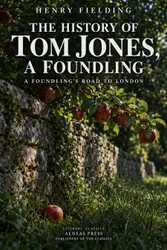
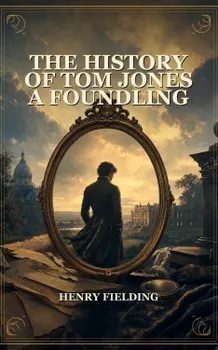
The History Of Tom Jones A Foundling

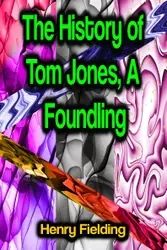
A baby is deposited in the bed of Squire Allworthy, a wealthy widower in Georgian England. The baby is given the name of Tom Jones and given to Allworthy's live-in sister to raise. She soon marries and has her own son, and the two boys are raised together, with the usual household rivalries and jealousies. As Tom reaches his late teenage years, he discovers the several young ladies that surround, but especially the one that lives next door. Circumstances eventually lead to Tom being thrown out of Allworthy's house, and the bulk of the novel is about the resulting adventures and pursuit of his beloved Sophia. Tom Jones is many things: a coming-of-age story, a romance, a picaresque, but it is first and foremost a comedy. It is also one of the earliest English novels, and was hugely popular when it was released, going through four printings in its first year. Fielding used the first chapter of each of its eighteen "books" to weigh in on a wide-range of topics, from critics to religion, and his narrator is as important a character in the novel as Tom himself. Highly regarded and highly popular, it is still in print over three-and-a-half centuries after its initial success. Henry Fielding (died 1754) was one of the foundational figures of Western literary tradition. Their work has endured across generations and continues to be read and studied worldwide. As a work of classic literary fiction, The History Of Tom Jones A Foundling exemplifies the narrative craft and social insight that defined great storytelling of its era. Literary fiction of this period was characterized by careful attention to character psychology, social milieu, and the moral questions that animated public discourse.

Om denne boken

A baby is deposited in the bed of Squire Allworthy, a wealthy widower in Georgian England. The baby is given the name of Tom Jones and given to Allworthy's live-in sister to raise. She soon marries and has her own son, and the two boys are raised together, with the usual household rivalries and jealousies. As Tom reaches his late teenage years, he discovers the several young ladies that surround, but especially the one that lives next door. Circumstances eventually lead to Tom being thrown out of Allworthy's house, and the bulk of the novel is about the resulting adventures and pursuit of his beloved Sophia. Tom Jones is many things: a coming-of-age story, a romance, a picaresque, but it is first and foremost a comedy. It is also one of the earliest English novels, and was hugely popular when it was released, going through four printings in its first year. Fielding used the first chapter of each of its eighteen "books" to weigh in on a wide-range of topics, from critics to religion, and his narrator is as important a character in the novel as Tom himself. Highly regarded and highly popular, it is still in print over three-and-a-half centuries after its initial success. Henry Fielding (died 1754) was one of the foundational figures of Western literary tradition. Their work has endured across generations and continues to be read and studied worldwide. As a work of classic literary fiction, The History Of Tom Jones A Foundling exemplifies the narrative craft and social insight that defined great storytelling of its era. Literary fiction of this period was characterized by careful attention to character psychology, social milieu, and the moral questions that animated public discourse.

Kom i gang med denne boken i dag for 0 kr

  • Få full tilgang til alle bøkene i appen i prøveperioden
  • Ingen forpliktelser, si opp når du vil
Prøv gratis nå
Mer enn 52 000 personer har gitt Nextory 5 stjerner på App Store og Google Play.

  1. 4.0

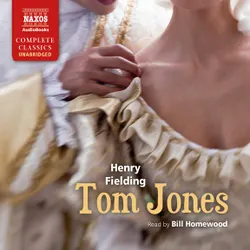
    Tom Jones

    Henry Fielding

  2. 50 Masterpieces you have to read before you die

    Frances Hodgson Burnett, Homer, Charles Dickens, Lyman Frank Baum, Nathaniel Hawthorne, Thomas Hardy, Robert Louis Stevenson, Henry Haggard, Wilkie Collins, H.G. Wells, Sir Walter Scott, Lucy Maud Montgomery, Louisa May Alcott, Henry Fielding, Mary Shelley, Arthur Conan Doyle, Leo Tolstoy, Euripides, Fyodor Dostoevsky, Alexander Pushkin, James Fenimore Cooper, Daniel Defoe, Joseph Conrad, Jonathan Swift, William Shakespeare, Oscar Wilde, John Bunyan, Charles Darwin, Alfred Tennyson, Bram Stoker, James Joyce, Dante Alighieri, Howard Pyle, Jane Austen, Emily Bronte, Giovanni Boccaccio, Rudyard Kipling

  3. Amelia

    Henry Fielding, Sheba Blake

  4. History of Tom Jones, a Foundling - Audiobook

    Henry Fielding, Classic Audiobooks

  5. 2.0

    Die Geschichte des Tom Jones - Hörbuch Klassiker

    Henry Fielding, Hörbuch Klassiker

  6. 100 Meisterwerke der englischen Literatur - Klassiker, die man kennen muss : Hamlet, 1984, Ulysses...

    George Orwell, Charles Dickens, Jane Austen, Katherine Mansfield, H.P. Lovecraft, William Wordsworth, John Keats, Percy Bysshe Shelley, Robert Burns, John Milton, William Shakespeare, Christopher Marlowe, Geoffrey Chaucer, Laurence Sterne, Henry Fielding, Mary Shelley, Emily Brontë, Charlotte Brontë, Anne Brontë, William Makepeace Thackeray, George Eliot, D. H. Lawrence, Herman Melville, Thomas Wolfe, Virginia Woolf, Joseph Conrad, Sinclair Lewis, Walt Whitman, Edgar Allan Poe, Oscar Wilde, Jerome K Jerome, Washington Irving, Bram Stoker, H.G. Wells, Daniel Defoe, Lew Wallace, James Fenimore Cooper, Jonathan Swift, Robert Louis Stevenson, Mark Twain, Lewis Carrol, Edward Bulwer-Lytton, F. Scott Fitzgerald, Arthur Conan Doyle, Jack London, Henry David Thoreau, G.K. Chesterton, Edith Wharton, Henry James, Thomas Hardy, Margaret Mitchell, Kate Chopin, Willa Cather, Charlotte Perkins Gilman, James Joyce, John Galsworthy, Francis Hodgson Burnett, Lucy Maud Montgomery, Louisa May Alcott, Rudyard Kipling

  7. Joseph Andrews

    Henry Fielding

  8. Tom Jones

    Henry Fielding

  9. The history of Tom Jones, a founding

    Henry Fielding

  10. Von Jungen zu Männern : Der Grüne Heinrich, Tom Jones, Die Verwirrungen des Zöglings Törleß, Martin Eden, Rot und Schwarz, Kandid, Der Graf von Monte Christo

    Jack London, Gottfried Keller, Voltaire, Jean-Jacques Rousseau, Johann Wolfgang Goethe, Christoph Martin Wieland, Laurence Sterne, Charles Dickens, Selma Lagerlöf, Frances Hodgson Burnett, Mark Twain, Rudyard Kipling, Henry Fielding, Fjodor Michailowitsch Dostojewski, Gustave Flaubert, Paul Scheerbart, Andre Gide, Adalbert Stifter, Robert Musil, Alexandre Dumas

  11. Auf dem Weg zum Mannsein : Martin Eden, Schuld und Sühne, Der Grüne Heinrich, Tom Jones, Die Verwirrungen des Zöglings Törleß, Die Abenteuer des Huckleberry Finn

    Fjodor Michailowitsch Dostojewski, Charles Dickens, Henry Fielding, Jack London, Gottfried Keller, Voltaire, Jean-Jacques Rousseau, Johann Wolfgang Goethe, Christoph Martin Wieland, Laurence Sterne, Selma Lagerlöf, Frances Hodgson Burnett, Mark Twain, Rudyard Kipling, Gustave Flaubert, Paul Scheerbart, Andre Gide, Adalbert Stifter, Robert Musil