Om denne boken

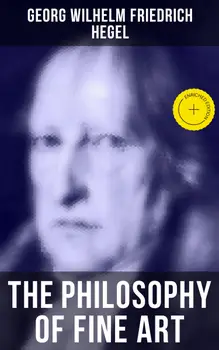
Georg Wilhelm Friedrich Hegel's 'The Philosophy of Fine Art' is a seminal work that delves into the intricate relationship between art and philosophy. Written with Hegel's characteristic dialectical style, this book examines the essence of beauty, the evolution of art throughout history, and the significance of artistic expression in the human experience. Hegel's exploration of the subjective nature of art, its relation to the Absolute, and its role in shaping society makes this book a must-read for anyone interested in aesthetics and intellectual culture. His dense prose and complex arguments reflect his deep understanding of art and philosophy, making this work a challenging but rewarding read for those willing to engage with Hegel's philosophical ideas. The intricate connections Hegel draws between art, history, and thought showcase his profound insights into the nature of artistic creativity and its impact on the human spirit. 'The Philosophy of Fine Art' is a timeless masterpiece that continues to inspire scholars and art lovers alike, reaffirming Hegel's enduring influence on aesthetics and philosophical thought.

In this enriched edition, we have carefully created added value for your reading experience:

- A succinct Introduction situates the work's timeless appeal and themes.

- The Synopsis outlines the central plot, highlighting key developments without spoiling critical twists.

- A detailed Historical Context immerses you in the era's events and influences that shaped the writing.

- An Author Biography reveals milestones in the author's life, illuminating the personal insights behind the text.

- A thorough Analysis dissects symbols, motifs, and character arcs to unearth underlying meanings.

- Reflection questions prompt you to engage personally with the work's messages, connecting them to modern life.

- Hand‐picked Memorable Quotes shine a spotlight on moments of literary brilliance.

- Interactive footnotes clarify unusual references, historical allusions, and archaic phrases for an effortless, more informed read.
Kom i gang med denne boken i dag for 0 kr

  • Få full tilgang til alle bøkene i appen i prøveperioden
  • Ingen forpliktelser, si opp når du vil
Prøv gratis nå
Mer enn 52 000 personer har gitt Nextory 5 stjerner på App Store og Google Play.

  1. Phänomenologie des geistes

    Georg Wilhelm Hegel

  2. Vorlesung über die Philosophie der Weltgeschichte : Nach der Mitschrift von Friedrich Wilhelm Karl Hegel

    Georg Wilhelm Hegel

  3. Wissenschaft der Logik (Kommentiert) : Erweiterte Ausgabe. Dialektische Kategorien von Sein, Wesen und Begriff als spekulative Metaphysik des reinen Denkens

    Georg Wilhelm Hegel

  4. 50 Meisterwerke der Philosophie : Metaphysik, Das Gastmahl, Bhagavadgita, Tractatus logico-philosophicus, Kritik der reinen Vernunft, Also sprach Zarathustra, Selbstbetrachtungen von Marcus Aurelius

    Ludwig Wittgenstein, Edmund Husserl, Karl Marx, Søren Kierkegaard, Friedrich Nietzsche, Ralph Waldo Emerson, John Stuart Mill, Georg Wilhelm Hegel, Friedrich Schelling, Johann Gottlieb Fichte, Immanuel Kant, John Locke, Montesquieu, Jean-Jacques Rousseau, David Hume, Gottfried Wilhelm Leibniz, Baruch Spinoza, - Konfuzius, Lao Tse, Platon, Xenophon, - Aristoteles, Marcus Tullius Cicero, Seneca, Epiktet, Marc Aurel, Plotin, Thomas von Aquin, Nicolaus von Cues, - Erasmus von Rotterdam, Niccolò Machiavelli, Tommaso Campanella, Martin Luther, Giordano Bruno, Samuel von Pufendorf, Abbé Castel Saint-Pierre, Michel de Montaigne, René Descartes, Francis Bacon, Blaise Pascal

  5. Die größten Philosophen des Deutschen Idealismus (Kommentiert) : Erweiterte Ausgabe. Die wichtigsten Werke von Kant, Hegel, Schelling, Jacobi, Fichte und Schleiermacher

    Immanuel Kant, Johann Gottlieb Fichte, Georg Wilhelm Hegel, Friedrich Schelling, Friedrich Schleiermacher

  6. Philosophie des Deutschen Idealismus (Kommentiert) : Erweiterte Ausgabe. Die Quelle der ewigen Wahrheiten, Kritik der reinen Vernunft, Wissenschaft der Logik, Grundlage der gesamten Wissenschaftslehre

    Georg Wilhelm Hegel, Johann Gottlieb Fichte, Immanuel Kant, Friedrich Schelling, Friedrich Schleiermacher

  7. The Collected Works of Georg Wilhelm Friedrich Hegel : Enriched edition.

    Georg Wilhelm Hegel

  8. Hegel : Enriched edition. The Philosophy of History, The History of Philosophy, The Proofs of the Existence of God

    Georg Wilhelm Hegel

  9. Die vergängliche Wahrheit in der Metaphysik : Erweiterte Ausgabe. Metaphysische Anfangsgründe der Naturwissenschaft, Träume eines Geistersehers, Grundzüge der Philosophie, Götzen-Dämmerung

    Platon, - Aristoteles, Plotin, Thomas von Aquin, René Descartes, Baruch Spinoza, Thomas Hobbes, Immanuel Kant, Gottfried Wilhelm Leibniz, Friedrich Wilhelm Schelling, Georg Wilhelm Hegel, Arthur Schopenhauer, Moses Mendelssohn, Friedrich Nietzsche, Rudolf Steiner

  10. Metaphysik : Erweiterte Ausgabe. Entdeckungsreise durch Existenz und Realität: Von klassischen Ontologien zu ethischen Paradigmen

    Platon, - Aristoteles, Plotin, Thomas von Aquin, René Descartes, Baruch Spinoza, Thomas Hobbes, Immanuel Kant, Gottfried Wilhelm Leibniz, Friedrich Wilhelm Schelling, Georg Wilhelm Hegel, Arthur Schopenhauer, Moses Mendelssohn, Friedrich Nietzsche, Rudolf Steiner

  11. Meisterwerke der Weltphilosophie (Kommentiert) : Erweiterte Ausgabe. Das Gastmahl, Nikomachische Ethik, Also sprach Zarathustra, Utopia, Phänomenologie des Geistes, Neues Organon, Selbstbetrachtungen

    Immanuel Kant, Søren Kierkegaard, Edmund Husserl, Ludwig Wittgenstein, Friedrich Nietzsche, - Konfuzius, Platon, Xenophon, - Aristoteles, Lao Tse, Marcus Tullius Cicero, Marcus Aurelius, Plotin, Thomas von Aquin, Niccolò Machiavelli, Thomas Morus, Giordano Bruno, Michel de Montaigne, René Descartes, Francis Bacon, Blaise Pascal, Baruch Spinoza, Gottfried Wilhelm Leibniz, David Hume, Jean-Jacques Rousseau, Friedrich Schelling, John Locke, Georg Wilhelm Hegel, John Stuart Mill, Karl Marx

  12. Die größten Klassiker der Philosophie (Kommentiert) : Erweiterte Ausgabe. Also sprach Zarathustra, Utopia, Phänomenologie des Geistes, Neues Organon, Selbstbetrachtungen, Das Gastmahl, Nikomachische Ethik

    Immanuel Kant, Søren Kierkegaard, Edmund Husserl, Ludwig Wittgenstein, Friedrich Nietzsche, - Konfuzius, Platon, Xenophon, - Aristoteles, Lao Tse, Marcus Tullius Cicero, Marcus Aurelius, Plotin, Thomas von Aquin, Niccolò Machiavelli, Thomas Morus, Giordano Bruno, Michel de Montaigne, René Descartes, Francis Bacon, Blaise Pascal, Baruch Spinoza, Gottfried Wilhelm Leibniz, David Hume, Jean-Jacques Rousseau, Friedrich Schelling, John Locke, Georg Wilhelm Hegel, John Stuart Mill, Karl Marx