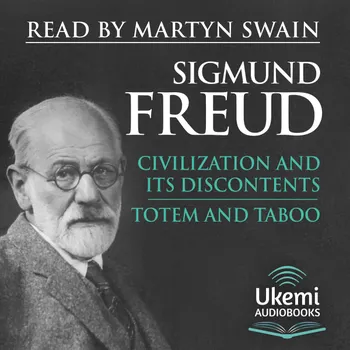

Sigmund Freud (1856-1939) is remembered as the father of psychoanalysis. Civilization and Its Discontents (1930) is one of his key works. In it he considers the conflict between the needs of the individual acting both egotistically and altruistically in the pursuit of happiness and the myriad demands of civilised society and the ensuing tensions this clash of needs and demands generates.
Consequently it remains a key text for anyone wishing to understand the breadth and depth of Freud’s thinking on the human condition. His analysis of the modern human’s situation, forced to repress and sublimate innate natural, sexual drives in order to satisfy society’s seemingly endless requirements, and the conflicts and consequences for mental health inherent in this, make it as relevant today as when it was written.
In Totem and Taboo (1913) Freud made what he called a first attempt at explaining problems of racial psychology and addressing neurotic symptoms as mental and emotional maladjustments to experience and environment. He hoped thereby to deepen the understanding of the mind by investigating its manifestations in primitive, noncivilised humans as documented by a range of writers and investigators in the scientific disciplines of sociology, anthropology and psychology.
The work consists of four essays. This essential text is an ambitious undertaking because in it Freud seeks to unravel the mysteries of myth and religion by investigating the nature and qualities of sacrifice and the sacred, the primal myth and the parts these play in the generation of prohibitions, transgressions, guilt experience and expiation, as states and processes.
Freud delves into the work of the great minds of his day, engaging with J. G. Frazer’s The Golden Bough and Totemism and Exogamy, Reinach’s Code du Totemisme, W. Wundt’s Elements of the Psychology of Race and a host of others.
He considers the nominalistic, sociological and psychological theories they postulated. This was the investigation that led him to conclude that 'the beginnings of religion, ethics, society and art meet in the Oedipus complex’. This work would accelerate the split with his longtime colleague C. J. Jung, partly as result of the states and processes he identifies in primitive religions, belief systems and thought processes which he traces from the earliest times through Greek tragedy and medieval Passion plays up to the 20th century. This led him to articulate the importance of the interplay of the individual psyche with the psyche of the mass, as well as to develop the notion of intergenerational psychic continuity and the linked processes of thinking, doing and inhibition. This would later be refined in Civilization and Its Discontents.
Civilization and Its Discontents is translated by Joan Riviere. Totem and Taboo is translated by A. A. Brill.