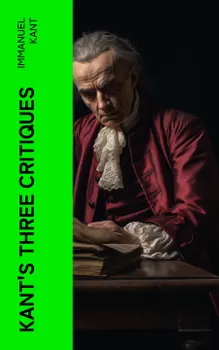
Om den här boken

Kant's Three Critiques brings together the central monuments of critical philosophy: the Critique of Pure Reason, the Critique of Practical Reason, and the Critique of Judgment. Across these works Kant investigates the conditions of knowledge, the authority of moral law, and the mediating powers of aesthetic and teleological judgment. Dense, architectonic, and rigorously analytical, the volumes stand at the turning point between Enlightenment rationalism and German Idealism, recasting metaphysics as a critique of reason's own powers and limits. Immanuel Kant (1724–1804), the Königsberg philosopher, wrote from within the intellectual tensions of eighteenth-century Europe: Newtonian science, Leibnizian metaphysics, British empiricism, and Rousseau's moral vision. His famous "Copernican revolution" in philosophy arose from the conviction that objects of experience must conform to the structures of human cognition, while freedom and morality require a rational foundation beyond mere inclination. This collection is indispensable for readers seeking the foundations of modern philosophy. Though demanding, it rewards careful study with a profound account of truth, duty, beauty, and human autonomy.

This enriched edition has been carefully crafted to add value to your reading experience.

- A comprehensive Introduction outlines these selected works' unifying features, themes, or stylistic evolutions.

- The Author Biography highlights personal milestones and literary influences that shape the entire body of writing.

- A Historical Context section situates the works in their broader era—social currents, cultural trends, and key events that underpin their creation.

- A concise Synopsis (Selection) offers an accessible overview of the included texts, helping readers navigate plotlines and main ideas without revealing critical twists.

- A unified Analysis examines recurring motifs and stylistic hallmarks across the collection, tying the stories together while spotlighting the different work's strengths.

- Reflection questions inspire deeper contemplation of the author's overarching message, inviting readers to draw connections among different texts and relate them to modern contexts.

- Lastly, our hand‐picked Memorable Quotes distill pivotal lines and turning points, serving as touchstones for the collection's central themes.
Kom igång med den här boken idag för 0 kr

  • Få full tillgång till alla böcker i appen under provperioden
  • Ingen bindningstid, avsluta när du vill
Prova gratis nu
Mer än 52 000 personer har gett Nextory 5 stjärnor i App Store och på Google Play.

  1. 4.0

    3500 Final Quotes

    Marcus Aurelius, Jane Austen, Beaumarchais, Napoleon Bonaparte, Buddha, Winston Churchill, Cicero, Confucius, Nicolas de Chamfort, Charles de Gaulle, Antoine de Saint-Exupéry, Denis Diderot, Fyodor Dostoevsky, Albert Einstein, Ralph Waldo Emerson, Anne Frank, Mahatma Gandhi, Immanuel Kant, Søren Kierkegaard, Martin Luther King, Georg Christoph Lichtenberg, Abraham Lincoln, Montesquieu, Friedrich Nietzsche, Plato, Marcel Proust, Arthur Schopenhauer, William Shakespeare, Socrates, Baruch Spinoza, Henry David Thoreau, Leonardo da Vinci, Voltaire, Oscar Wilde, Laozi

  2. Teoría y praxis : Estudio preliminar: Eduardo García Belsunce

    Immanuel Kant

  3. The Critique of Pure Reason

    Immanuel Kant

  4. 12 Masterpieces You Have to Read Before You Die. Philosophy

    Niccolo Machiavelli, Tommaso Campanella, Francis Bacon, Thomas More, John Stuart Mill, Immanuel Kant, Kahlil Gibran, Leo Tolstoy, G.K. Chesterton, Henry David Thoreau

  5. 3.0

    2000 Final Quotations

    Marcus Aurelius, Jane Austen, Buddha, Anton Chekhov, Cicero, Emil Cioran, Confucius, Albert Einstein, Anne Frank, Mahatma Gandhi, Johann Wolfgang Goethe, Carl Jung, Immanuel Kant, Friedrich Nietzsche, Marcel Proust, Arthur Schopenhauer, William Shakespeare, Baruch Spinoza, Leonardo da Vinci, Laozi

  6. Critique of Pure Reason

    Immanuel Kant

  7. Groundwork of the Metaphysics of Morals

    Immanuel Kant

  8. The Critique of Pure Reason

    Immanuel Kant

  9. Lo Bello y Lo Sublime : Ensayo de Estética y Moral

    Immanuel Kant

  10. 100 Clásicos de la Literatura Universal

    Francis Scott Fitzgerald, Mary Shelley, Lyman Frank Baum, Louisa May Alcott, Dante Alighieri, Jane Austen, Ambrose Bierce, Emily Brontë, Edgar Rice Burroughs, Lewis Carroll, Wilkie Collins, René Descartes, Charles Dickens, Emily Dickinson, Alexandre Dumas, Gustave Flaubert, Benito Pérez Galdós, Johann Wolfgang von Goethe, Thomas Hardy, E T A Hoffmann, Washington Irving, Henry James, James Joyce, Franz Kafka, Gaston Leroux, Federico García Lorca, H.P. Lovecraft, Publio Virgilio Marón, Lucy Maud Montgomery, John William Polidori, Marco Polo, Antoine de Saint-Exupéry, Emilio Salgari, Walter Scott, Mark Twain, Jules Verne, Julio Verne, H.G. Wells, Edith Wharton, Mary Wollstonecraft, Stefan Zweig, Sun Tzu, Bram Stoker, - Aristoteles, George Bernard Shaw, Henryk Sienkiewicz, Concepción Arenal, Charlotte Brontë, Miguel de Cervantes, G.K. Chesterton, Daniel Defoe, Fyodor Mikhailovich Dostoyevsky, Arthur Conan Doyle, Sigmund Freud, H. Rider Haggard, Homero, Immanuel Kant, Rudyard Kipling, Molière, Friedrich Nietzsche, Fernando de Rojas, Sófocles, William Makepeace Thackeray, León Tolstói, Voltaire, Ramón María del Valle-Inclán, Oscar Wilde, Virginia Woolf

  11. Hacia la paz perpetua

    Immanuel Kant

  12. Crítica de la Razón Pura

    Immanuel Kant