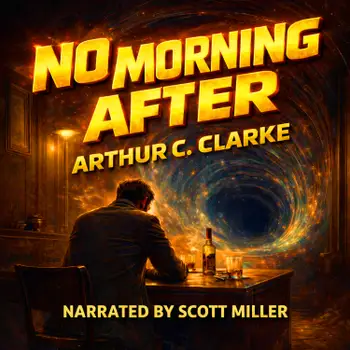
In No Morning After, the survival of Earth depends on an unlikely messenger and a moment that will never come again. Across unimaginable distances, a desperate warning reaches humanity—but the response is far from heroic. What unfolds is not a battle for survival, but a confrontation with apathy, resentment, and the quiet exhaustion of a civilization that may no longer wish to be saved. Arthur C. Clarke delivers a story that is tense, unsettling, and deeply human, blending cosmic scale with intimate failure.
Rather than spectacle, this story thrives on irony and consequence. It challenges the idea that intelligence guarantees wisdom, or that rescue is always welcomed. As the clock silently runs down, Clarke explores disillusionment, responsibility, and the uncomfortable truth that progress does not always lead to hope. The result is a haunting piece of classic science fiction that lingers long after the final line.
Arthur C. Clarke was one of the defining voices of twentieth-century science fiction, renowned for pairing bold scientific ideas with moral clarity. Best known for works such as 2001: A Space Odyssey, Clarke repeatedly examined humanity’s future by questioning its present. No Morning After exemplifies his gift for compression—using a short narrative to deliver a devastating, unforgettable idea.