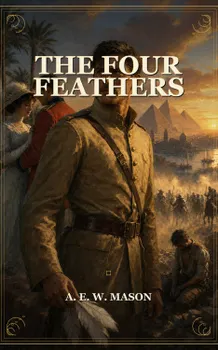
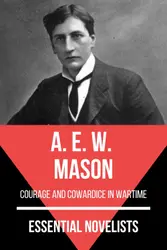
We rely on your support to help us keep producing beautiful, free, and unrestricted editions of literature for the digital age. Will you support our efforts with a donation ? Recently engaged Harry Feversham, son of a soldier and descendant of a long line of soldiers, receives word that his regiment is going overseas. For complex reasons he suddenly resigns rather than be deployed. This action brands him a coward among his fellow officers and his fiancée, who present him with white feathers, a symbol of cowardice. To regain his honor, Feversham sets out for Egypt and Sudan, where he awaits opportunities to redeem himself. His daring adventures are beset with betrayal, torture, and imprisonment. Meanwhile, his fiancée is racked with regret, and tries to convince herself she no longer loves him, while simultaneously becoming romantically entangled with Feversham's friend, a soldier in the regiment. The Four Feathers is recognized for its vivid settings, as well as its characters' complex emotions and motivations. Mason had traveled widely in Egypt and Sudan by camel along caravan routes, visiting the places he describes so clearly in the novel. A. E. W. Mason (died 1948) was an influential writer of the modernist period. Their work has endured across generations and continues to be read and studied worldwide. Adventure literature of the 19th and early 20th centuries captured the imagination of a reading public hungry for tales of exploration, danger, and heroism. The Four Feathers belongs to this tradition of gripping narratives that transported readers beyond the boundaries of their everyday lives.