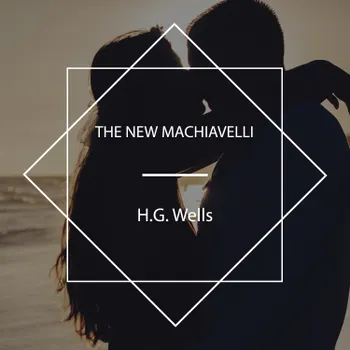
The New Machiavelli

The New Machiavelli is a 1911 novel by H. G. Wells (first serialized in The English Review in 1910).

Because its plot notoriously derived from Wells's affair with Amber Reeves and satirized Beatrice and Sidney Webb, it was "the literary scandal of its day."

The novel tells of a political idealist who changes his colours and engages in a sexual adventure. The novel's principal themes are politics and sex, both abiding preoccupations of the author. Biographer David Smith called The New Machiavelli "Wells's most autobiographical novel.

The novel has had many prestigious admirers. Joseph Conrad called it a "master-work," Upton Sinclair considered it Wells's masterpiece, and D.H. Lawrence called it "awfully interesting."

Total Running Time (TRT): 16 hours, 41 min.

Herbert George "H. G." Wells (1866-1946) was an English writer, now best known for his work in the science fiction genre. He was also a prolific writer in many other genres, including contemporary novels, history, politics and social commentary, even writing textbooks and rules for war games.

Wells is one person sometimes called "The Father of Science Fiction", as are Jules Verne and Hugo Gernsback. His most notable science fiction works include The War of the Worlds, The Time Machine, The Invisible Man and The Island of Doctor Moreau.

Om den här boken

The New Machiavelli is a 1911 novel by H. G. Wells (first serialized in The English Review in 1910).

Because its plot notoriously derived from Wells's affair with Amber Reeves and satirized Beatrice and Sidney Webb, it was "the literary scandal of its day."

The novel tells of a political idealist who changes his colours and engages in a sexual adventure. The novel's principal themes are politics and sex, both abiding preoccupations of the author. Biographer David Smith called The New Machiavelli "Wells's most autobiographical novel.

The novel has had many prestigious admirers. Joseph Conrad called it a "master-work," Upton Sinclair considered it Wells's masterpiece, and D.H. Lawrence called it "awfully interesting."

Total Running Time (TRT): 16 hours, 41 min.

Herbert George "H. G." Wells (1866-1946) was an English writer, now best known for his work in the science fiction genre. He was also a prolific writer in many other genres, including contemporary novels, history, politics and social commentary, even writing textbooks and rules for war games.

Wells is one person sometimes called "The Father of Science Fiction", as are Jules Verne and Hugo Gernsback. His most notable science fiction works include The War of the Worlds, The Time Machine, The Invisible Man and The Island of Doctor Moreau.

Kom igång med den här boken idag för 0 kr

  • Få full tillgång till alla böcker i appen under provperioden
  • Ingen bindningstid, avsluta när du vill
Prova gratis nu
Mer än 52 000 personer har gett Nextory 5 stjärnor i App Store och på Google Play.

  1. 3.4
    #1

    Världarnas krig

    H.G. Wells

  2. 3.0

    50 Masterpieces you have to read before you die vol: 1 (2020 Edition) : Included: Little Women, The Richest Man in Babylon Emma, The Call Of The Wild ....

    Louisa May Alcott, Dante Alighieri, Marcus Aurelius, Jane Austen, L. Frank Baum, Charlotte Brontë, Emily Brontë, Anne Brontë, Miguel de Cervantes, Agatha Christie, George S. Clason, Arthur Conan Doyle, Joseph Conrad, Charles Dickens, Fyodor Dostoyevsky, Alexandre Dumas, George Eliot, G.K. Chesterton, G.K. Chesterton, Zane Grey, Nathaniel Hawthorne, Napoleon Hill, Homer, Victor Hugo, Frances Hodgson Burnett, Washington Irving, Henry James, Franz Kafka, Rudyard Kipling, Jack London, Leo Tolstoy, H.P. Lovecraft, Lucy Maud Montgomery, Joseph Murphy, Robert Louis Stevenson, Edgar Allan Poe, Marcel Proust, Publius, Mary Shelley, Bram Stoker, Mark Twain, Sun Tzu, Lew Wallace, Wallace D. Wattles, H.G. Wells

  3. 50 Masterpieces you have to read before you die

    Frances Hodgson Burnett, Homer, Charles Dickens, Lyman Frank Baum, Nathaniel Hawthorne, Thomas Hardy, Robert Louis Stevenson, Henry Haggard, Wilkie Collins, H.G. Wells, Sir Walter Scott, Lucy Maud Montgomery, Louisa May Alcott, Henry Fielding, Mary Shelley, Arthur Conan Doyle, Leo Tolstoy, Euripides, Fyodor Dostoevsky, Alexander Pushkin, James Fenimore Cooper, Daniel Defoe, Joseph Conrad, Jonathan Swift, William Shakespeare, Oscar Wilde, John Bunyan, Charles Darwin, Alfred Tennyson, Bram Stoker, James Joyce, Dante Alighieri, Howard Pyle, Jane Austen, Emily Bronte, Giovanni Boccaccio, Rudyard Kipling

  4. 3.6
    #3

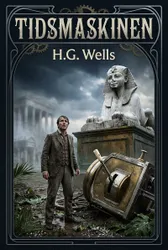
    Tidsmaskinen

    H.G. Wells

  5. 3.4
    #1

    Världarnas krig

    H.G. Wells

  6. Mannen som sov i två sekler

    H.G. Wells

  7. 50 Vintage Sci-Fi Short Stories 10 : Legendary Authors. Timeless Stories. Endless Imagination.

    Arthur C. Clarke, H.G. Wells, H.P. Lovecraft, Mary Shelley, Robert Silverberg, Robert Bloch, Harry Harrison, Fritz Leiber, Alfred Bester, A. E. Vogt, Brian W. Aldiss, Robert E. Howard, Henry Kuttner, Clark Ashton Smith, Frank Belknap Long, Edward Page Mitchell, Jack Williamson, Tom Godwin, Robert Sheckley, Michael Shaara, Francis Stevens, A.H. Gibson, Gene L. Henderson, H. F. Arnold, Richard R. Smith, Frank M. Robinson, Manly Wade Wellman, William Bender Jr., Thomas S. Gardiner, James Bell, Beta McGavin, Alfred Connable, Jack Sharkey, Ron Goulart, Victoria Lincoln, Nelson S. Bond, Ray Cummings, Morton Klass, Elisabeth R. Lewis, John W. Jr., James Blish, Roger D. Aycock

  8. 4.6
    #6

    Stjärnan

  9. 5.0

    The War of the Worlds

    H.G. Wells

  10. 3.5

    The Island of Doctor Moreau :

    H.G. Wells

  11. 60 Gothic Classics : Enriched edition. The Castle of Otranto, The Tell-Tale Heart, The Phantom Ship, The Headless Horseman, The Man-Wolf, The Beetle, The Phantom of the Opera...

    Charles Dickens, Oscar Wilde, Robert Louis Stevenson, Edgar Allan Poe, William Hope Hodgson, Joseph Sheridan Le Fanu, Anna Katharine Green, George MacDonald, Bram Stoker, Charlotte Brontë, Emily Brontë, William Godwin, Henry James, Victor Hugo, Théophile Gautier, Arthur Conan Doyle, Jane Austen, John Meade Falkner, Guy De Maupassant, George Eliot, Robert Hugh Benson, Horace Walpole, Frederick Marryat, Thomas love Peacock, Washington Irving, Nathaniel Hawthorne, Gaston Leroux, Grant Allen, Arthur Machen, Wilkie Collins, Thomas Peckett Prest, James Malcolm Rymer, Charles Brockden Brown, James Hogg, Charlotte Perkins Gilman, Richard Marsh, Charles Robert Maturin, John William Polidori, H.G. Wells, W. Jacobs, William Thomas Beckford, Nikolai Gogol, Mary Shelley, Ann Radcliffe, Matthew Gregory Lewis, Eliza Parsons

  12. 3.6
    #3

    Tidsmaskinen

    H.G. Wells