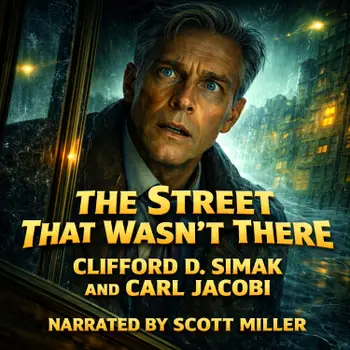

For twenty years, Jonathan Chambers has lived by the clock. Every evening follows the same route, the same timing, the same small comforts, carefully arranged to keep the larger world at bay. But when he arrives home early—and realizes an entire block of his walk no longer exists—his carefully contained life begins to fracture. Streets shorten, buildings warp, and silence takes on a weight that can’t be ignored.
As the boundaries of his neighborhood unravel, Chambers is forced to confront the cost of a life spent refusing to engage with the world beyond his routine. What begins as a missing cigar and a vanished storefront escalates into something far more disturbing: the realization that reality itself may rely on attention, memory, and belief to remain intact. Each step outside his door carries the risk that something else will fail to return.
Written with mounting dread and philosophical urgency, The Street That Wasn’t There traps the listener inside a narrowing space where certainty erodes one detail at a time. This is a story about isolation made literal, about familiar places becoming unreliable, and about one man facing the possibility that his final refuge may not hold forever.
Clifford D. Simak and Carl Jacobi combine their strengths in atmosphere and speculative tension to produce a story that feels intimate even as it gestures toward cosmic threat. Simak, whose work appeared frequently in Astounding Science Fiction and later earned him a reputation for deeply human speculative storytelling, brings emotional restraint and quiet unease. Jacobi, a prolific contributor to Weird Tales known for tightly constructed horror, sharpens the story’s sense of encroaching menace. Together, they deliver a haunting meditation on what happens when the world stops agreeing with itself.