Om den här boken

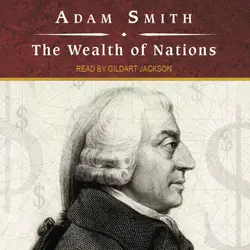
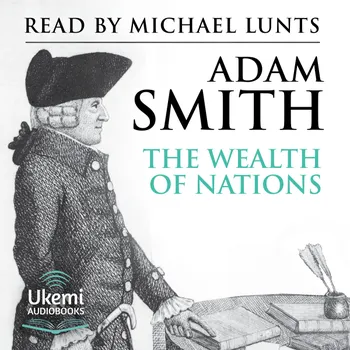
The Wealth of Nations, first published in 1776, is the first book of modern political economy and still provides the foundation for the study of that discipline. An Enquiry into the Nature and Causes of the Wealth of Nations, to give it is full title, was an immediate best seller and has since rightfully claimed its place in the Western intellectual canon. Its author, Adam Smith (1723-1790), was one of the brightest stars of the 18th-century Scottish Enlightenment.

Along with important discussions of economics and political theory, Smith mixed plain common sense with large measures of history, philosophy, psychology, sociology and much else. Few texts remind us so clearly that the Enlightenment was very much a lived experience, a concern with improving them human condition in practical ways for real people.

This recording opens with an informative and helpful introduction by Mark G. Spencer of Brock University, Ontario, Canada, an authority on the period. He places the work and its concepts against the background of Smith’s life and influences, and includes his strong friendships with key figures of the time varying from the philosopher David Hume, the chemist William Cullen and the architect Robert Adam.

The Wealth of Nations is divided into five books. Book I: Of the Causes of Improvement in the Productive Powers of Labour, and of the Order according to which its Produce is Naturally Distributed Among the Different Ranks of the People. Book 2: Of the Nature, Accumulation, and Employment of Stock. Book 3: Of the Different Progress of Opulence in Different Nations. Book 4: Of Systems of Political Economy. Book 5: Of the Revenue of the Sovereign or Commonwealth.

A masterpiece by any measure, The Wealth of Nations remains a classic of world literature to be usefully enjoyed by listeners today. It receives an engaged and clear reading from Michael Lunts.

Kom igång med den här boken idag för 0 kr

  • Få full tillgång till alla böcker i appen under provperioden
  • Ingen bindningstid, avsluta när du vill
Prova gratis nu
Mer än 52 000 personer har gett Nextory 5 stjärnor i App Store och på Google Play.

  1. 4.8

    The Wealth of Nations

    Adam Smith

  2. 4.8

    The Wealth of Nations

    Adam Smith

  3. 600 Quotations from the Great 18th Century Writers

    Beaumarchais, Denis Diderot, Georg Christoph Lichtenberg, Montesquieu, Jean-Jacques Rousseau, Adam Smith

  4. Wealth of Nations

    Adam Smith

  5. 5.0

    La riqueza de las naciones

    Adam Smith

  6. The Harvard Classics & Fiction Collection [180 Books]

    Charles W. Eliot, Golden Deer Classics, John Milton, Plato, Benjamin Franklin, Adam Smith, Charles Darwin, Miguel de Cervantes, Virgil, Anonymous, Grimm Brothers, Hans Christian Andersen, Oliver Goldsmith, Dante Alighieri, Pierre Corneille, Jean Racine, Molière, Michel de Montaigne, Voltaire, Niccolò Machiavelli, Confucius, William Shakespeare, Eireann Press

  7. The Wealth of Nations: The Economics Classic - A Selected Edition for the Contemporary Reader

    Adam Smith

  8. 3.9
    #1

    Doctor Who, Vol. 1: Short Trips (Unabridged)

    George Mann, David A., Jamie Hailstone, Damian Sawyer, Ally Kennen, Colin Baker, Adam Smith, Dorothy Koomson

  9. 4.8

    The Wealth of Nations

    Adam Smith

  10. The Wealth Of Nations

    Adam Smith

  11. Ny

    Harvard Classics : The Five-Foot Shelf of Books

    Aesop, Dante Alighieri, Hans Christian Andersen, Augustine of Hippo, Marcus Aurelius, Jane Austen, Francis Bacon, Honoré de Balzac, Francis Beaumont, Bjørnstjerne Bjørnson, Thomas Browne, Robert Browning, John Bunyan, EDMUND BURKE, Robert Burns, Lord Byron, Thomas Carlyle, Benvenuto Cellini, Miguel de Cervantes, Marcus Tullius Cicero, Richard Henry Jr., Charles Darwin, Alphonse Daudet, Thomas Dekker, Charles Dickens, Fyodor Dostoevsky, John Dryden, Charles W. Eliot, George Eliot, Ralph Waldo Emerson, Epictetus, John Fletcher, Theodor Fontane, Benjamin Franklin, Johann Wolfgang Goethe, Oliver Goldsmith, Jacob Grimm, Edward Everett Hale, Bret Harte, Nathaniel Hawthorne, Homer, Victor Hugo, Washington Irving, Henry James, Ben Jonson, Gottfried Keller, Thomas à Kempis, Alexander L. Kielland, Martin Luther, Niccolò Machiavelli, Alessandro Manzoni, Christopher Marlowe, Philip Massinger, Guy De Maupassant, John Stuart Mill, John Milton, Thomas More, William Morris, Alfred de Musset, William Allan Neilson, William Penn, Plato, Pliny the Younger, Plutarch, George Sand, Percy Bysshe Shelley, Richard Brinsley Sheridan, Adam Smith, Laurence Sterne, Theodor Storm, William Makepeace Thackeray, Leo Tolstoy, Ivan Turgenev, Mark Twain, Juan Valera, Virgil, Izaak Walton, John Webster, John Woolman