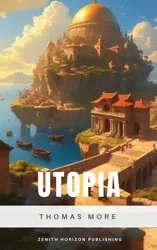
Om den här boken

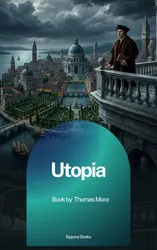
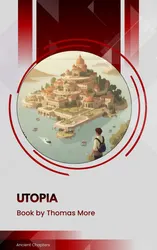
In his seminal work, "Thomas More Premium Edition," the author delves into the intricate tapestry of human thought, morality, and societal structure, encapsulated within the framework of the fictive island of Utopia. More's literary style is marked by a blend of humanism and critical realism, showcasing his profound engagement with Renaissance ideals and the socio-political fervor of his time. Through sharp dialogue and intricate narrative layering, he critiques contemporary European society, exploring themes of governance, equity, and the quest for an ideal state, all while inviting readers into a robust philosophical dialogue that transcends time. Thomas More, a prominent statesman, lawyer, and philosopher, was deeply influenced by the socio-political tumult of 16th-century England. His experiences as a member of the court, alongside his devout Catholic faith, informed his exploration of ethics and governance. More's commitment to his beliefs ultimately led to his martyrdom, underscoring the intersection of personal conviction and public life that shaped his literary output. This work embodies his vision for a harmonious society, reflecting a deep-seated desire for moral integrity that was often at odds with the power structures of his era. "Thomas More Premium Edition" is an essential read for anyone seeking to understand the complexities of human society and moral philosophy. It serves as a rich resource for scholars and casual readers alike, inviting them to reflect on foundational questions about justice, community, and the human condition. The text not only provides historical insight but also remains strikingly relevant in contemporary discourse, encouraging readers to engage with More's vision of a better world.

Kom igång med den här boken idag för 0 kr

  • Få full tillgång till alla böcker i appen under provperioden
  • Ingen bindningstid, avsluta när du vill
Prova gratis nu
Mer än 52 000 personer har gett Nextory 5 stjärnor i App Store och på Google Play.

  1. 15+ Political Science. Classics Collection : The Art of War, Tao Te Ching, The Republic, Meditations, The Prince, Utopia, Utilitarianism, Anarchism and others

    Sun Tzu, Lao Tzu, Plato, Marcus Aurelius, Niccolo Machiavelli, Thomas More, Tommaso Campanella, Francis Bacon, Thomas Paine, John Stuart Mill, Karl Marx, Friedrich Engels, Vladimir Lenin, Rosa Luxemburg, Peter Kropotkin, Emma Goldman, Leon Trotsky

  2. 3.3

    Utopia

    Thomas More

  3. 33 Masterpieces of Philosophy and Science to Read Before You Die (Illustrated) : Utopia, The Meditations, The Art of War, The Kama Sutra, Candide

    Thomas More, Marcus Aurelius Antoninus, Sun Tzu, Vatsyayana, Voltaire, Edwin A. Abbott, Aristotle, Dale Carnegie, Gilbert Keith Chesterton, René Descartes, Epictetus, Sigmund Freud, Hermann Hesse, David Hume, Lao Tzu, David Herbert Lawrence, Niccolò Machiavelli, John Mill, Prentice Mulford, Friedrich Nietzsche, Plato, Bertrand Russell, H.G. Wells, Frances Bacon

  4. Ny

    Harvard Classics : The Five-Foot Shelf of Books

    Aesop, Dante Alighieri, Hans Christian Andersen, Augustine of Hippo, Marcus Aurelius, Jane Austen, Francis Bacon, Honoré de Balzac, Francis Beaumont, Bjørnstjerne Bjørnson, Thomas Browne, Robert Browning, John Bunyan, EDMUND BURKE, Robert Burns, Lord Byron, Thomas Carlyle, Benvenuto Cellini, Miguel de Cervantes, Marcus Tullius Cicero, Richard Henry Jr., Charles Darwin, Alphonse Daudet, Thomas Dekker, Charles Dickens, Fyodor Dostoevsky, John Dryden, Charles W. Eliot, George Eliot, Ralph Waldo Emerson, Epictetus, John Fletcher, Theodor Fontane, Benjamin Franklin, Johann Wolfgang Goethe, Oliver Goldsmith, Jacob Grimm, Edward Everett Hale, Bret Harte, Nathaniel Hawthorne, Homer, Victor Hugo, Washington Irving, Henry James, Ben Jonson, Gottfried Keller, Thomas à Kempis, Alexander L. Kielland, Martin Luther, Niccolò Machiavelli, Alessandro Manzoni, Christopher Marlowe, Philip Massinger, Guy De Maupassant, John Stuart Mill, John Milton, Thomas More, William Morris, Alfred de Musset, William Allan Neilson, William Penn, Plato, Pliny the Younger, Plutarch, George Sand, Percy Bysshe Shelley, Richard Brinsley Sheridan, Adam Smith, Laurence Sterne, Theodor Storm, William Makepeace Thackeray, Leo Tolstoy, Ivan Turgenev, Mark Twain, Juan Valera, Virgil, Izaak Walton, John Webster, John Woolman

  5. Ny
    3.3

    Utopia

    Thomas More

  6. 3.3

    Utopia

    Thomas More

  7. Ny
    3.3

    Utopia

    Thomas More

  8. 3.3

    Utopia

    Thomas More

  9. 3.3

    Utopia

    Thomas More

  10. 3.3

    Utopia

    Thomas More

  11. 3.0

    Utopia

    Thomas More

  12. Utopia : A Visionary Blueprint for Ideal Society

    Thomas More