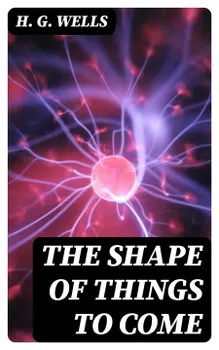
The Shape of Things To Come

In "The Shape of Things To Come," H. G. Wells presents a prescient and often unsettling vision of the future, intertwining speculative fiction with social commentary. Written in a captivating yet accessible style, the book unfolds through a narrative that oscillates between his optimistic perspective on humanity's potential and a stark portrayal of the perils faced by society. Set against the backdrop of the early 20th century's geopolitical turmoil, Wells posits a timeline influenced by technological advancement, war, and ideological transformation, reflecting the anxieties and possibilities of his contemporaries. This work is not merely a tale of what might be; it serves as a cautionary observation on the trajectory of civilization itself, providing keen insights into themes of advancement, government, and human evolution. H. G. Wells, often referred to as the father of science fiction, was deeply influenced by the tumultuous events of his time, such as World War I and rapid industrialization. His fascination with the interplay between technology and society fueled his imagination, compelling him to explore the implications of progress in his works. A relentless thinker and social critic, Wells was driven by a desire to engage his readers in conversations about the future's ethical and moral dimensions, making him a visionary of his age. "The Shape of Things To Come" is essential reading for those intrigued by the intersections of literature, science, and speculation. It invites readers to ponder the consequences of human actions and foresees the challenges of tomorrow while inspiring hope for a harmonious future. A critical read for scholars and casual readers alike, it fosters a dialogue that remains remarkably relevant in today's rapidly changing world.
À propos de ce livre

In "The Shape of Things To Come," H. G. Wells presents a prescient and often unsettling vision of the future, intertwining speculative fiction with social commentary. Written in a captivating yet accessible style, the book unfolds through a narrative that oscillates between his optimistic perspective on humanity's potential and a stark portrayal of the perils faced by society. Set against the backdrop of the early 20th century's geopolitical turmoil, Wells posits a timeline influenced by technological advancement, war, and ideological transformation, reflecting the anxieties and possibilities of his contemporaries. This work is not merely a tale of what might be; it serves as a cautionary observation on the trajectory of civilization itself, providing keen insights into themes of advancement, government, and human evolution. H. G. Wells, often referred to as the father of science fiction, was deeply influenced by the tumultuous events of his time, such as World War I and rapid industrialization. His fascination with the interplay between technology and society fueled his imagination, compelling him to explore the implications of progress in his works. A relentless thinker and social critic, Wells was driven by a desire to engage his readers in conversations about the future's ethical and moral dimensions, making him a visionary of his age. "The Shape of Things To Come" is essential reading for those intrigued by the intersections of literature, science, and speculation. It invites readers to ponder the consequences of human actions and foresees the challenges of tomorrow while inspiring hope for a harmonious future. A critical read for scholars and casual readers alike, it fosters a dialogue that remains remarkably relevant in today's rapidly changing world.

Commencez ce livre dès aujourd'hui pour 0 €

  • Accédez à tous les livres de l'app pendant la période d'essai
  • Sans engagement, annulez à tout moment
Essayer gratuitement
Plus de 52 000 personnes ont noté Nextory 5 étoiles sur l'App Store et Google Play.

  1. 50 Chefs-D'œuvre Que Vous Devez Lire Avant De Mourir: Vol 2

    Honoré de Balzac, Alphonse Daudet, Arthur Conan Doyle, Alexandre Dumas, Gustave Flaubert, Francis Scott Fitzgerald, Nikolai Gogol, Victor Hugo, Maurice Leblanc, Jack London, Madame de La Fayette, Guy De Maupassant, Friedrich Nietzsche, Jean-Jacques Rousseau, Robert Louis Stevenson, Jules Verne, H.G. Wells, Michel de Montaigne, Golden Deer Classics

  2. 12 nov.

    The Empire of the Ants and Other Stories

    H.G. Wells

  3. 1 sept.

    Grandes Novelas : La máquina del tiempo - La isla del doctor Moreau - El hombre invisible - La guerra de los mundos

    H.G. Wells

  4. 26 août

    The New World Order

    H.G. Wells

  5. 31 juil.
    4.2

    The Time Machine

    H.G. Wells

  6. Nouveau

    The Complete Novels of H. G. Wells

    H.G. Wells

  7. Nouveau

    30 Occult and Supernatural masterpieces in one book

    Washington Irving, Mary Shelley, Charles Dickens, Joseph Sheridan Fanu, Elizabeth Cleghorn Gaskell, Louisa May Alcott, Oscar Wilde, Rudyard Kipling, Edith Nesbit, John Meade Falkner, Henry James, H.G. Wells, Montague Rhodes James, Arnold Bennett, Henry Rider Haggard, William Hope Hodgson, Virginia Woolf, Master Hendrick Certain, Pastor Tappau's, Lefebvre, De Lacy

  8. Nouveau

    Tidsmaskinen

    Eric Brown, H.G. Wells

  9. Nouveau

    The Dawn of Science Fiction : The Visionaries Who Imagined Tomorrow First

    H.G. Wells, Mary Shelley, Voltaire, Jack London, Frank R. Stockton, Edgar Allan Poe

  10. Nouveau

    Hugo Award Winning Authors : Fifteen Classic Stories by Hugo Award-Winning Authors

    Philip K Dick, H.G. Wells, Arthur C. Clarke, Clifford D. Simak

  11. Nouveau

    Fallen Worlds 2 : Timeless Stories of Survival, Collapse, and Hope

    Lynn Venable, Donald E. Westlake, Edward W. Ludwig, Dean Evans, Miguel Hidalgo, H.G. Wells, Fritz Leiber, Robert Sheckley, William Oberfield, Philip K Dick

  12. Nouveau

    The Star

    H.G. Wells