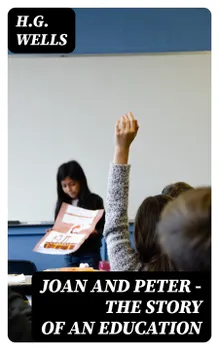
Joan and Peter - The Story of an Education

In "Joan and Peter - The Story of an Education," H.G. Wells explores the intricate interplay of individual growth and societal expectations through the lives of two young protagonists. Set against the backdrop of early 20th-century Britain, Wells employs a vivid narrative style that intertwines realism with insightful psychological depth, capturing the challenges of education, personal development, and the tension between ambition and conformity. The novel delineates the characters' quest for identity, articulating the philosophical debates of the time and reflecting Wells's commitment to social critique, particularly regarding the rigid structures of the educational system. H.G. Wells, a prominent thinker of his era and a pioneering science fiction writer, drew upon his own experiences as an educator in crafting this narrative. His background in social reform and keen observations of class disparities informed the characters' struggles, making this work not merely a coming-of-age story, but also a commentary on the broader societal norms governing education and opportunity. Wells's own educational journey and ideological concerns provide a rich context that enhances the narrative's emotive power. "Joan and Peter" is highly recommended for readers interested in literature that challenges societal norms while exploring the complexities of personal growth. Its blend of engaging storytelling and philosophical reflection offers profound insights into the struggles faced by individuals within prescribed societal frameworks, making it a timeless and thought-provoking read.
Over dit boek

In "Joan and Peter - The Story of an Education," H.G. Wells explores the intricate interplay of individual growth and societal expectations through the lives of two young protagonists. Set against the backdrop of early 20th-century Britain, Wells employs a vivid narrative style that intertwines realism with insightful psychological depth, capturing the challenges of education, personal development, and the tension between ambition and conformity. The novel delineates the characters' quest for identity, articulating the philosophical debates of the time and reflecting Wells's commitment to social critique, particularly regarding the rigid structures of the educational system. H.G. Wells, a prominent thinker of his era and a pioneering science fiction writer, drew upon his own experiences as an educator in crafting this narrative. His background in social reform and keen observations of class disparities informed the characters' struggles, making this work not merely a coming-of-age story, but also a commentary on the broader societal norms governing education and opportunity. Wells's own educational journey and ideological concerns provide a rich context that enhances the narrative's emotive power. "Joan and Peter" is highly recommended for readers interested in literature that challenges societal norms while exploring the complexities of personal growth. Its blend of engaging storytelling and philosophical reflection offers profound insights into the struggles faced by individuals within prescribed societal frameworks, making it a timeless and thought-provoking read.

Begin vandaag nog met dit boek voor € 0

  • Krijg volledige toegang tot alle boeken in de app tijdens de proefperiode
  • Geen verplichtingen, op elk moment annuleren
Probeer nu gratis
Meer dan 52.000 mensen hebben Nextory 5 sterren gegeven in de App store en op Google Play.

  1. 3.0

    50 Masterpieces you have to read before you die vol: 1 (2020 Edition) : Included: Little Women, The Richest Man in Babylon Emma, The Call Of The Wild ....

    Louisa May Alcott, Dante Alighieri, Marcus Aurelius, Jane Austen, L. Frank Baum, Charlotte Brontë, Emily Brontë, Anne Brontë, Miguel de Cervantes, Agatha Christie, George S. Clason, Arthur Conan Doyle, Joseph Conrad, Charles Dickens, Fyodor Dostoyevsky, Alexandre Dumas, George Eliot, G.K. Chesterton, G.K. Chesterton, Zane Grey, Nathaniel Hawthorne, Napoleon Hill, Homer, Victor Hugo, Frances Hodgson Burnett, Washington Irving, Henry James, Franz Kafka, Rudyard Kipling, Jack London, Leo Tolstoy, H.P. Lovecraft, Lucy Maud Montgomery, Joseph Murphy, Robert Louis Stevenson, Edgar Allan Poe, Marcel Proust, Publius, Mary Shelley, Bram Stoker, Mark Twain, Sun Tzu, Lew Wallace, Wallace D. Wattles, H.G. Wells

  2. 5.0

    Kipps

    H.G. Wells

  3. The History of Mr Polly

    H.G. Wells

  4. 4.0

    The Pioneers of Science Fiction

    Kurt Vonnegut, Ray Bradbury, Philip K Dick, Robert Sheckley, Murray Leinster, H.G. Wells

  5. The Invisible Man (Unabridged)

    H.G. Wells, Jonathan Barnes

  6. The Book of Shadows

    Arthur Quiller-Couch, Robert W. Chambers, H.G. Wells, Mary E. Wilkins Freeman, E Nesbit, Barry Pain, E F Benson, D. H. Lawrence, Thomas Burke

  7. The Book of Shadows : A Supernatural Anthology of Witches, Hauntings & Occult Horrors – Chilling Tales by Master Storytellers

    Arthur Quiller-Couch, Robert W. Chambers, H.G. Wells, Mary E. Wilkins Freeman, Edith Nesbit, Barry Pain, E F Benson, D. H. Lawrence, Thomas Burke

  8. Brave New World Time Machine Anthem : A Dystopian Trilogy

    H.G. Wells, Ayn Rand, Aldous Huxley

  9. War Of The Worlds The Time Machine The Discovery Of The Future : A Dystopian Trilogy

    H.G. Wells

  10. 4.0

    The War of the Worlds

    H.G. Wells

  11. The Book of Gothic Tales : Enriched edition. Dark Fantasy Novels, Supernatural Mysteries, Horror Tales & Gothic Romances

    Charles Dickens, Oscar Wilde, Robert Louis Stevenson, Edgar Allan Poe, William Hope Hodgson, Joseph Sheridan Fanu, Anna Katharine Green, George MacDonald, Bram Stoker, Charlotte Brontë, Emily Brontë, William Godwin, Henry James, Victor Hugo, Théophile Gautier, Arthur Conan Doyle, Jane Austen, John Meade Falkner, Guy De Maupassant, George Eliot, Robert Hugh Benson, Horace Walpole, Frederick Marryat, Thomas love Peacock, Washington Irving, Nathaniel Hawthorne, Gaston Leroux, Grant Allen, Arthur Machen, Wilkie Collins, Thomas Peckett Prest, James Malcolm Rymer, Charles Brockden Brown, James Hogg, Charlotte Perkins Gilman, Richard Marsh, Charles Robert Maturin, John William Polidori, H.G. Wells, W. W. Jacobs, William Thomas Beckford, Nikolai Gogol, Mary Shelley, Ann Radcliffe, Matthew Gregory Lewis, Eliza Parsons

  12. The War of the Worlds

    H.G. Wells