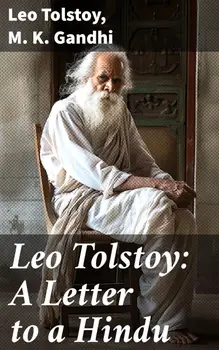
Leo Tolstoy: A Letter to a Hindu : Enriched edition. Including Correspondences with Gandhi & Letter to Ernest Howard Crosby

The anthology 'Leo Tolstoy: A Letter to a Hindu' encapsulates the philosophical and cultural dialogues between two monumental figures across continents'—Leo Tolstoy and M. K. Gandhi. The compendium explores rich themes that interrogate the moral and ethical fibers of civilization, emphasizing non-violence and spiritual resilience. Through its selection of essays and letters, the collection reveals a mosaic of literary styles, ranging from the profound expository prose of Tolstoy to the incisive and reflective commentary that Gandhi provides. This volume is not merely a collection of writings but a catalyst that sparks thought-provoking discussions about the principles of passive resistance and universal love. The anthology is a testament to the enduring legacy of both authors, whose writings have shaped significant socio-political movements. Tolstoy's reflections provide a foundation upon which Gandhi builds his revolutionary ideas, anchoring them in historical and cultural contexts of Russia and India. The intertwining voices are illustrative of a vibrant intellectual exchange that transcends geographic boundaries, enriching the text with cultural reciprocity and philosophical kinship. This dialogue connects Russian pragmatism with Indian spirituality, offering a nuanced perspective on global non-violent resistance movements. For readers and scholars alike, 'Leo Tolstoy: A Letter to a Hindu' offers a unique encounter with timeless teachings, broadening their intellectual vistas through its educational tapestry. This collection presents the ideal avenue for introspection, inviting readers to participate in a larger conversation about peace, harmony, and human dignity. Embarking on this literary journey promises an invaluable exploration of varied insights, rendering the anthology both a critical educational resource and a transcontinental narrative of transformation and hope.

In this enriched edition, we have carefully created added value for your reading experience:

- A succinct Introduction situates the work's timeless appeal and themes.

- The Synopsis outlines the central plot, highlighting key developments without spoiling critical twists.

- A detailed Historical Context immerses you in the era's events and influences that shaped the writing.

- An Author Biography reveals milestones in the author's life, illuminating the personal insights behind the text.

- A thorough Analysis dissects symbols, motifs, and character arcs to unearth underlying meanings.

- Reflection questions prompt you to engage personally with the work's messages, connecting them to modern life.

- Hand‐picked Memorable Quotes shine a spotlight on moments of literary brilliance.

- Interactive footnotes clarify unusual references, historical allusions, and archaic phrases for an effortless, more informed read.

Over dit boek

The anthology 'Leo Tolstoy: A Letter to a Hindu' encapsulates the philosophical and cultural dialogues between two monumental figures across continents'—Leo Tolstoy and M. K. Gandhi. The compendium explores rich themes that interrogate the moral and ethical fibers of civilization, emphasizing non-violence and spiritual resilience. Through its selection of essays and letters, the collection reveals a mosaic of literary styles, ranging from the profound expository prose of Tolstoy to the incisive and reflective commentary that Gandhi provides. This volume is not merely a collection of writings but a catalyst that sparks thought-provoking discussions about the principles of passive resistance and universal love. The anthology is a testament to the enduring legacy of both authors, whose writings have shaped significant socio-political movements. Tolstoy's reflections provide a foundation upon which Gandhi builds his revolutionary ideas, anchoring them in historical and cultural contexts of Russia and India. The intertwining voices are illustrative of a vibrant intellectual exchange that transcends geographic boundaries, enriching the text with cultural reciprocity and philosophical kinship. This dialogue connects Russian pragmatism with Indian spirituality, offering a nuanced perspective on global non-violent resistance movements. For readers and scholars alike, 'Leo Tolstoy: A Letter to a Hindu' offers a unique encounter with timeless teachings, broadening their intellectual vistas through its educational tapestry. This collection presents the ideal avenue for introspection, inviting readers to participate in a larger conversation about peace, harmony, and human dignity. Embarking on this literary journey promises an invaluable exploration of varied insights, rendering the anthology both a critical educational resource and a transcontinental narrative of transformation and hope.

In this enriched edition, we have carefully created added value for your reading experience:

- A succinct Introduction situates the work's timeless appeal and themes.

- The Synopsis outlines the central plot, highlighting key developments without spoiling critical twists.

- A detailed Historical Context immerses you in the era's events and influences that shaped the writing.

- An Author Biography reveals milestones in the author's life, illuminating the personal insights behind the text.

- A thorough Analysis dissects symbols, motifs, and character arcs to unearth underlying meanings.

- Reflection questions prompt you to engage personally with the work's messages, connecting them to modern life.

- Hand‐picked Memorable Quotes shine a spotlight on moments of literary brilliance.

- Interactive footnotes clarify unusual references, historical allusions, and archaic phrases for an effortless, more informed read.
Begin vandaag nog met dit boek voor € 0

  • Krijg volledige toegang tot alle boeken in de app tijdens de proefperiode
  • Geen verplichtingen, op elk moment annuleren
Probeer nu gratis
Meer dan 52.000 mensen hebben Nextory 5 sterren gegeven in de App store en op Google Play.

  1. Anna Karenina (Deel Een) : Dutch Version

    Leo Tolstoy

  2. 3.0

    50 Masterpieces you have to read before you die vol: 1 (2020 Edition) : Included: Little Women, The Richest Man in Babylon Emma, The Call Of The Wild ....

    Louisa May Alcott, Dante Alighieri, Marcus Aurelius, Jane Austen, L. Frank Baum, Charlotte Brontë, Emily Brontë, Anne Brontë, Miguel de Cervantes, Agatha Christie, George S. Clason, Arthur Conan Doyle, Joseph Conrad, Charles Dickens, Fyodor Dostoyevsky, Alexandre Dumas, George Eliot, G.K. Chesterton, G.K. Chesterton, Zane Grey, Nathaniel Hawthorne, Napoleon Hill, Homer, Victor Hugo, Frances Hodgson Burnett, Washington Irving, Henry James, Franz Kafka, Rudyard Kipling, Jack London, Leo Tolstoy, H.P. Lovecraft, Lucy Maud Montgomery, Joseph Murphy, Robert Louis Stevenson, Edgar Allan Poe, Marcel Proust, Publius, Mary Shelley, Bram Stoker, Mark Twain, Sun Tzu, Lew Wallace, Wallace D. Wattles, H.G. Wells

  3. 4.0

    Anna Karenina

    Leo Tolstoy

  4. 3.7

    Anna Karenina

    Leo Tolstoy

  5. 4.3

    Anna Karenina

    Leo Tolstoy

  6. Nieuw

    War & Peace :

    Leo Tolstoy

  7. War and Peace : The Graphic Novel

    Leo Tolstoy

  8. War and Peace : The Graphic Novel

    Leo Tolstoy

  9. War and Peace - Audiobook

    Leo Tolstoy, Classic Audiobooks

  10. 12 Masterpieces You Have to Read Before You Die. Philosophy

    Niccolo Machiavelli, Tommaso Campanella, Francis Bacon, Thomas More, John Stuart Mill, Immanuel Kant, Kahlil Gibran, Leo Tolstoy, G.K. Chesterton, Henry David Thoreau

  11. World's Greatest Short Stories

    Daniel Defoe, Benjamin Franklin, Washington Irving, Mateo Falcone, Charlotte Bronte, Mary Shelley, Nathaniel Hawthorne, Nikolai Gogol, Edgar Allan Poe, Fyodor Dostoyevsky, Charles Dickens, Herman Melville, Mark Twain, Guy De Maupassant, Oscar Wilde, Leo Tolstoy, H.G. Wells, Ambrose Bierce, Stephen Crane, Kate Chopin, Jack London, E. M. Forster

  12. 10 Masterpieces You Have to Read Before You Die, Vol.5 : The Odyssey, The Republic, Meditations, The Divine Comedy, Faust and others

    Homer, Plato, Aristotle, Marcus Aurelius, Niccolo Machiavelli, Dante Alighieri, Johann Wolfgang von Goethe, Leo Tolstoy