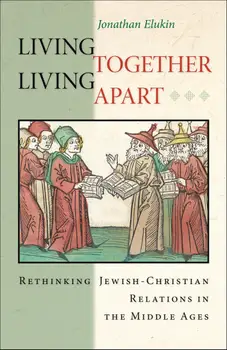
Living Together, Living Apart : Rethinking Jewish-Christian Relations in the Middle Ages

This historical study of Jewish life in Medieval Europe provides "a much-needed corrective" to the popular notion of constant persecution (Ivan G. Marcus, Yale University).

In Living Together, Living Apart, Jonathan Elukin traces the experience of Jews in Europe from late antiquity through the Renaissance and Reformation, revealing how the pluralism of medieval society allowed Jews to feel part of their local communities despite recurrent expressions of hatred against them.

Elukin shows that Jews and Christians coexisted more or less peacefully for much of the Middle Ages, and that antisemitic violence was largely isolated. He reveals an extraordinary picture of Jews living comfortably among their Christian neighbors, working with them, and occasionally cultivating lasting friendships—even as Christian culture often demonized Jews.

As Elukin makes clear, the expulsions of Jews from England, France, Spain, and elsewhere were not the inevitable culmination of persecution, but arose from the religious and political expediencies of particular rulers. He demonstrates that the history of successful Jewish-Christian interaction in the Middle Ages in fact laid the social foundations that gave rise to the Jewish communities of modern Europe.

Over dit boek

This historical study of Jewish life in Medieval Europe provides "a much-needed corrective" to the popular notion of constant persecution (Ivan G. Marcus, Yale University).

In Living Together, Living Apart, Jonathan Elukin traces the experience of Jews in Europe from late antiquity through the Renaissance and Reformation, revealing how the pluralism of medieval society allowed Jews to feel part of their local communities despite recurrent expressions of hatred against them.

Elukin shows that Jews and Christians coexisted more or less peacefully for much of the Middle Ages, and that antisemitic violence was largely isolated. He reveals an extraordinary picture of Jews living comfortably among their Christian neighbors, working with them, and occasionally cultivating lasting friendships—even as Christian culture often demonized Jews.

As Elukin makes clear, the expulsions of Jews from England, France, Spain, and elsewhere were not the inevitable culmination of persecution, but arose from the religious and political expediencies of particular rulers. He demonstrates that the history of successful Jewish-Christian interaction in the Middle Ages in fact laid the social foundations that gave rise to the Jewish communities of modern Europe.

Begin vandaag nog met dit boek voor € 0

  • Krijg volledige toegang tot alle boeken in de app tijdens de proefperiode
  • Geen verplichtingen, op elk moment annuleren
Probeer nu gratis
Meer dan 52.000 mensen hebben Nextory 5 sterren gegeven in de App store en op Google Play.