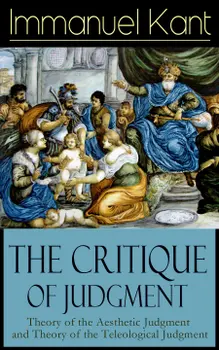
The Critique of Judgment : Aesthetics, Teleology, and the Antinomies of Human Reason

This carefully crafted ebook: "The Critique of Judgment: Theory of the Aesthetic Judgment and Theory of the Teleological Judgment" is formatted for your eReader with a functional and detailed table of contents.

The Critique of Judgment, also translated as the Critique of the Power of Judgment and more commonly referred to as the third Critique, is a philosophical work by Immanuel Kant. Critique of Judgment completes the Critical project begun in the Critique of Pure Reason and the Critique of Practical Reason (the first and second Critiques, respectively). The book is divided into two main sections: the Critique of Aesthetic Judgment and the Critique of Teleological Judgment, and also includes a large overview of the entirety of Kant's Critical system, arranged in its final form. The end result of Kant's Critical Project is that there are certain fundamental antinomies in human Reason, most particularly that there is a complete inability to favor on the one hand the argument that all behavior and thought is determined by external causes, and on the other that there is an actual "spontaneous" causal principle at work in human behavior.

Immanuel Kant (1724-1804) was a German philosopher, who, according to the Stanford Encyclopedia of Philosophy is "the central figure of modern philosophy." Kant argued that fundamental concepts of the human mind structure human experience, that reason is the source of morality, that aesthetics arises from a faculty of disinterested judgment, that space and time are forms of our understanding, and that the world as it is "in-itself" is unknowable. Kant took himself to have effected a Copernican revolution in philosophy, akin to Copernicus' reversal of the age-old belief that the sun revolved around the earth.
Over dit boek

This carefully crafted ebook: "The Critique of Judgment: Theory of the Aesthetic Judgment and Theory of the Teleological Judgment" is formatted for your eReader with a functional and detailed table of contents.

The Critique of Judgment, also translated as the Critique of the Power of Judgment and more commonly referred to as the third Critique, is a philosophical work by Immanuel Kant. Critique of Judgment completes the Critical project begun in the Critique of Pure Reason and the Critique of Practical Reason (the first and second Critiques, respectively). The book is divided into two main sections: the Critique of Aesthetic Judgment and the Critique of Teleological Judgment, and also includes a large overview of the entirety of Kant's Critical system, arranged in its final form. The end result of Kant's Critical Project is that there are certain fundamental antinomies in human Reason, most particularly that there is a complete inability to favor on the one hand the argument that all behavior and thought is determined by external causes, and on the other that there is an actual "spontaneous" causal principle at work in human behavior.

Immanuel Kant (1724-1804) was a German philosopher, who, according to the Stanford Encyclopedia of Philosophy is "the central figure of modern philosophy." Kant argued that fundamental concepts of the human mind structure human experience, that reason is the source of morality, that aesthetics arises from a faculty of disinterested judgment, that space and time are forms of our understanding, and that the world as it is "in-itself" is unknowable. Kant took himself to have effected a Copernican revolution in philosophy, akin to Copernicus' reversal of the age-old belief that the sun revolved around the earth.

Begin vandaag nog met dit boek voor € 0

  • Krijg volledige toegang tot alle boeken in de app tijdens de proefperiode
  • Geen verplichtingen, op elk moment annuleren
Probeer nu gratis
Meer dan 52.000 mensen hebben Nextory 5 sterren gegeven in de App store en op Google Play.

  1. Yaşam Felsefesi

    Immanuel Kant

  2. 4.0

    3500 Final Quotes

    Marcus Aurelius, Jane Austen, Beaumarchais, Napoleon Bonaparte, Buddha, Winston Churchill, Cicero, Confucius, Nicolas de Chamfort, Charles de Gaulle, Antoine de Saint-Exupéry, Denis Diderot, Fyodor Dostoevsky, Albert Einstein, Ralph Waldo Emerson, Anne Frank, Mahatma Gandhi, Immanuel Kant, Søren Kierkegaard, Martin Luther King, Georg Christoph Lichtenberg, Abraham Lincoln, Montesquieu, Friedrich Nietzsche, Plato, Marcel Proust, Arthur Schopenhauer, William Shakespeare, Socrates, Baruch Spinoza, Henry David Thoreau, Leonardo da Vinci, Voltaire, Oscar Wilde, Laozi

  3. Critique of Pure Reason

    Immanuel Kant

  4. 3.8

    Kant's Foundations of Ethics

    Immanuel Kant

  5. 100 Clásicos de la Literatura Universal

    Francis Scott Fitzgerald, Mary Shelley, Lyman Frank Baum, Louisa May Alcott, Dante Alighieri, Jane Austen, Ambrose Bierce, Emily Brontë, Edgar Rice Burroughs, Lewis Carroll, Wilkie Collins, René Descartes, Charles Dickens, Emily Dickinson, Alexandre Dumas, Gustave Flaubert, Benito Pérez Galdós, Johann Wolfgang von Goethe, Thomas Hardy, E T A Hoffmann, Washington Irving, Henry James, James Joyce, Franz Kafka, Gaston Leroux, Federico García Lorca, H.P. Lovecraft, Publio Virgilio Marón, Lucy Maud Montgomery, John William Polidori, Marco Polo, Antoine de Saint-Exupéry, Emilio Salgari, Walter Scott, Mark Twain, Jules Verne, Julio Verne, H.G. Wells, Edith Wharton, Mary Wollstonecraft, Stefan Zweig, Sun Tzu, Bram Stoker, - Aristoteles, George Bernard Shaw, Henryk Sienkiewicz, Concepción Arenal, Charlotte Brontë, Miguel de Cervantes, G.K. Chesterton, Daniel Defoe, Fyodor Mikhailovich Dostoyevsky, Arthur Conan Doyle, Sigmund Freud, H. Rider Haggard, Homero, Immanuel Kant, Rudyard Kipling, Molière, Friedrich Nietzsche, Fernando de Rojas, Sófocles, William Makepeace Thackeray, León Tolstói, Voltaire, Ramón María del Valle-Inclán, Oscar Wilde, Virginia Woolf

  6. Hacia la paz perpetua

    Immanuel Kant

  7. Teoría y praxis : Estudio preliminar: Eduardo García Belsunce

    Immanuel Kant

  8. Crítica de la Razón Pura

    Immanuel Kant

  9. La paz perpetua : Octava edición

    Immanuel Kant

  10. La Paz Perpetua :

    Immanuel Kant

  11. 12 Masterpieces You Have to Read Before You Die. Philosophy

    Niccolo Machiavelli, Tommaso Campanella, Francis Bacon, Thomas More, John Stuart Mill, Immanuel Kant, Kahlil Gibran, Leo Tolstoy, G.K. Chesterton, Henry David Thoreau

  12. 2.5

    An Answer to the Question: What is Enlightenment?

    Immanuel Kant