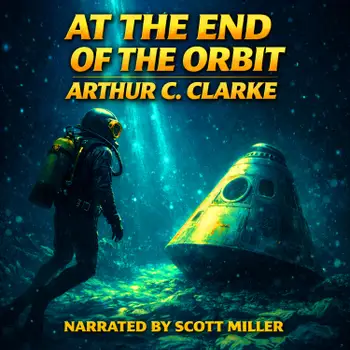
At The End Of The Orbit delivers Arthur C. Clarke at his most gripping and emotionally layered, blending adventure on the Great Barrier Reef with a moral reckoning that creeps in slowly and lands with devastating force. When a meteor blazes across the dawn sky, the crew of a pearling lugger discovers a fallen Soviet space capsule—its silent occupant waiting in the darkness below the waves. For Tibor, a diver haunted by the scars of war and betrayal, the discovery becomes an unexpected chance for vengeance. But what he finds inside the capsule will challenge everything he thinks he knows about loyalty, guilt, and the cost of hatred.
Clarke uses the claustrophobic setting of the Reef to frame a stark human drama that turns on a single, terrible decision. The story’s power comes not from spectacle, but from the quiet undoing of a man who thought he’d buried his past halfway across the world.
Arthur C. Clarke, one of the most influential voices in science fiction, was a master at merging scientific authenticity with deep human insight. Co-author of 2001: A Space Odyssey, Clarke shaped modern visions of space exploration, satellite technology, and humanity’s place in the cosmos. His short fiction—precise, imaginative, and morally incisive—remains a cornerstone of classic sci-fi.
Clarke’s work endures because he could look outward to the stars and inward to the human heart with equal clarity. At The End Of The Orbit is a perfect example: a story as intimate as it is cosmic, as emotionally resonant as it is scientifically grounded.