Over dit boek

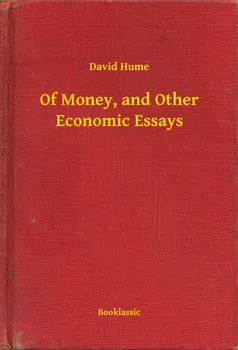
David Hume is known for his philosophical writings, but he also wrote on politics, history, and economics. This eBook contains 7 economic essays which were first published in Hume's Political Discourses (1752) and republished in Essays and Treatises on Several Subjects, Volume 1 (1758, 1777). One essay has been praised by the Nobel-Prize-winning economist, Paul Krugman, who said in his newspaper column:

"... Hume also helped found economics: his 'Of the Balance of Trade', published 34 years before The Wealth of Nations, was arguably the first example of modern economic reasoning, based on what amounts to a stylized model, albeit one without any equations or diagrams." (New York Times, 8 May 2011, "Hume Day".) ... "You could argue that modern economics really began with David Hume’s 'Of the Balance of Trade', whose core is a gloriously clear thought experiment...." (ibid., 2 Feb 2011, "Models, Plain and Fancy".)

Adam Smith (1723-1790), the author of The Wealth of Nations (1776), is commonly considered the "father of modern economics", but Hume pre-dated Smith in that regard. Both were Scottish philosophers of the Scottish Enlightenment, and although Hume was a decade older than Smith, they became lifelong friends after they met in 1750.

The essays cover Commerce, Money, Interest, Balance of Trade, Jealousy of Trade, Taxes, and Public Credit (national debt). Hume explained economic phenomena we observe even today, such as the self-correction of job migration to lower cost countries, money supply issues, the undesirable results of tariffs, military buildup in underdeveloped countries, and other topics that give insights into the happenings we read about in the news almost daily.

This eBook is available only for personal and educational uses, non-commercial, with attribution to the source www.davidhume.org.


Begin vandaag nog met dit boek voor € 0

  • Krijg volledige toegang tot alle boeken in de app tijdens de proefperiode
  • Geen verplichtingen, op elk moment annuleren
Probeer nu gratis
Meer dan 52.000 mensen hebben Nextory 5 sterren gegeven in de App store en op Google Play.

  1. 33 Human Science Masterpieces You Must Read Before You Die. Illustrated : The Art of Public Speaking, The Meditations, The Kama Sutra and other masterpieces

    Edwin A. Abbott, Aristotle, Dale Carnegie, Gilbert Chesterton, René Descartes, Epictetus, Marcus Aurelius Antoninus, Sigmund Freud, Hermann Hesse, David Hume, Lao Tzu, Confucius, Swami Abhedananda, Anonimous, David Herbert Lawrence, Niccolò Machiavelli, Benedictus de Spinoza, John Mill, Prentice Mulford, Thomas More, Friedrich Nietzsche, J. Allanson Picton, Plato, Sun Tzu, Vatsyayana, Voltaire, H.G. Wells, Frances Bacon

  2. Essays

    David Hume

  3. A Treatise of Human Nature : Illustrated

    David Hume

  4. Nieuw

    The Dark Ages Collection

    J. B. Bury, Edward Creasy, Henry Bradley, Edward Gibbon, David Hume

  5. The Dark Ages Collection

    J. B. Bury, Edward Creasy, Henry Bradley, Edward Gibbon, David Hume, Charles Oman

  6. The Dark Ages Collection

    J. B. Bury, Edward Creasy, Henry Bradley, Edward Gibbon, David Hume, Charles Oman

  7. Du luxe dans la société moderne

    Henri Baudrillart, David Hume, E. de Laveleye

  8. Ensayos morales [Selección]

    David Hume

  9. 4.0

    Comprendre David Hume

    David Hume

  10. 1800 Citations de philosophes

    Aristote, Épicure, Platon, Thalès de Milet, – Socrate, Protagoras, Anaximandre, Épictète, Héraclite, Marc Aurèle, René Descartes, Michel de Montaigne, Alexis de Tocqueville, Voltaire, Charles De Montesquieu, Jean-Jacques Rousseau, Emmanuel Kant, Hannah Arendt, Gottfried Wilhelm Leibniz, Georg Wilhelm Friedrich Hegel, Friedrich Nietzsche, Arthur Schopenhauer, David Hume, John Locke, Francis Bacon, Thomas Hobbes, Thomas More, Confucius, Érasme, Lao Tseu, Baruch Spinoza, Søren Kierkegaard, Nicolas Machiavel, Thomas d'Aquin, Henry David Thoreau

  11. 250 citations de philosophes anglais

    David Hume, John Locke, Francis Bacon, Thomas Hobbes, Thomas More

  12. 4.0

    50 citations de David Hume

    David Hume