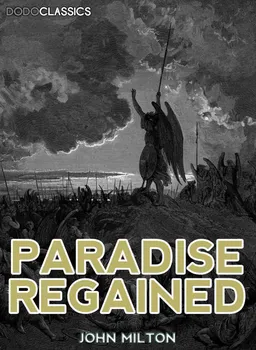
Paradise Regained

Paradise Regained is a poem by English poet John Milton, first published in 1671 by John Macock. The volume in which it appeared also contained the poet's closet drama Samson Agonistes. Paradise Regained is connected by name to his earlier and more famous epic poem Paradise Lost, with which it shares similar theological themes; indeed, its title, its use of blank verse, and its progression through Christian history recall the earlier work. However, this effort deals primarily with the temptation of Christ as recounted in the Gospel of Luke.

An interesting anecdote recounted by a Quaker named Thomas Ellwood provides some insight into Paradise Regained‍ 's development. After studying Latin with Milton and reading the poet's epic Paradise Lost, Ellwood remarked, "Thou hast said much here of Paradise lost, but what hast thou to say of Paradise found?" Hearing this, Milton at first "sat some time in a muse" before changing the subject; however, later on he showed to Ellwood a new manuscript entitled Paradise Regained. Some maintain that although he seemed to express gratitude to Ellwood in a letter, Milton in truth "passed on a friendly if impish fabrication" that made Ellwood feel like the inspiration for the poem. Milton composed Paradise Regained at his cottage in Chalfont St Giles in Buckinghamshire. The poem is four books long, in contrast with Paradise Lost‍ 's twelve. As such, Barbara K. Lewalski has labelled the work a "brief epic."

Whereas Paradise Lost is ornate in style and decorative in its verse, Paradise Regained is carried out in a fairly plain style. Specifically, Milton reduces his use of simile and deploys a simpler syntax in Paradise Regained than he does in Paradise Lost, and this is consistent with Jesus's sublime plainness in his life and teachings (in the epic, he prefers Hebrew psalms to Greek poetry). Modern editors believe the stylistics of Paradise Regained evince Milton's poetic maturity. No longer is the poet out to dazzle his readers with bombastic verse and lengthy epic similes. This is not to say that the poem bears no affinities with Milton's earlier work, but scholars continue to agree with Northrop Frye's suggestion that Paradise Regained is "practically sui generis" in its poetic execution.

One major concept emphasized throughout Paradise Regained is the idea of reversals. As implied by its title, Milton sets out to reverse the "loss" of Paradise. Thus, antonyms are often found next to each other, reinforcing the idea that everything that was lost in the first epic will be regained by the end of this "brief epic." Additionally, the work focuses on the idea of "hunger", both in a literal and in a spiritual sense. After wandering in the wilderness for forty days, Jesus is starving for food. Satan, too blind to see any non-literal meanings of the term, offers Christ food and various other temptations, but Jesus continually denies him. Although Milton's Jesus is remarkably human, an exclusive focus on this dimension of his character obscures the divine stakes of Jesus’s confrontation with Satan; Jesus emerges victorious, and Satan falls, amazed.
Over dit boek

Paradise Regained is a poem by English poet John Milton, first published in 1671 by John Macock. The volume in which it appeared also contained the poet's closet drama Samson Agonistes. Paradise Regained is connected by name to his earlier and more famous epic poem Paradise Lost, with which it shares similar theological themes; indeed, its title, its use of blank verse, and its progression through Christian history recall the earlier work. However, this effort deals primarily with the temptation of Christ as recounted in the Gospel of Luke.

An interesting anecdote recounted by a Quaker named Thomas Ellwood provides some insight into Paradise Regained‍ 's development. After studying Latin with Milton and reading the poet's epic Paradise Lost, Ellwood remarked, "Thou hast said much here of Paradise lost, but what hast thou to say of Paradise found?" Hearing this, Milton at first "sat some time in a muse" before changing the subject; however, later on he showed to Ellwood a new manuscript entitled Paradise Regained. Some maintain that although he seemed to express gratitude to Ellwood in a letter, Milton in truth "passed on a friendly if impish fabrication" that made Ellwood feel like the inspiration for the poem. Milton composed Paradise Regained at his cottage in Chalfont St Giles in Buckinghamshire. The poem is four books long, in contrast with Paradise Lost‍ 's twelve. As such, Barbara K. Lewalski has labelled the work a "brief epic."

Whereas Paradise Lost is ornate in style and decorative in its verse, Paradise Regained is carried out in a fairly plain style. Specifically, Milton reduces his use of simile and deploys a simpler syntax in Paradise Regained than he does in Paradise Lost, and this is consistent with Jesus's sublime plainness in his life and teachings (in the epic, he prefers Hebrew psalms to Greek poetry). Modern editors believe the stylistics of Paradise Regained evince Milton's poetic maturity. No longer is the poet out to dazzle his readers with bombastic verse and lengthy epic similes. This is not to say that the poem bears no affinities with Milton's earlier work, but scholars continue to agree with Northrop Frye's suggestion that Paradise Regained is "practically sui generis" in its poetic execution.

One major concept emphasized throughout Paradise Regained is the idea of reversals. As implied by its title, Milton sets out to reverse the "loss" of Paradise. Thus, antonyms are often found next to each other, reinforcing the idea that everything that was lost in the first epic will be regained by the end of this "brief epic." Additionally, the work focuses on the idea of "hunger", both in a literal and in a spiritual sense. After wandering in the wilderness for forty days, Jesus is starving for food. Satan, too blind to see any non-literal meanings of the term, offers Christ food and various other temptations, but Jesus continually denies him. Although Milton's Jesus is remarkably human, an exclusive focus on this dimension of his character obscures the divine stakes of Jesus’s confrontation with Satan; Jesus emerges victorious, and Satan falls, amazed.
Begin vandaag nog met dit boek voor € 0

  • Krijg volledige toegang tot alle boeken in de app tijdens de proefperiode
  • Geen verplichtingen, op elk moment annuleren
Probeer nu gratis
Meer dan 52.000 mensen hebben Nextory 5 sterren gegeven in de App store en op Google Play.

  1. 2.0

    Paradise Lost

    John Milton

  2. Paradise Lost : Key Insights

    John Milton

  3. Paradise Lost : John Milton's Epic Poem of Heaven, Hell, and Humanity

    John Milton

  4. Het verloren paradijs

    John Milton

  5. 2.0

    Paradise Lost

    John Milton

  6. 3.3

    Paradise Lost

    John Milton

  7. Paradise Lost : With bonus material from The Demonologist by Andrew Pyper

    John Milton

  8. The Perfect Christmas Library: A Christmas Carol, The Cricket on the Hearth, A Christmas Sermon, Twelfth Night...and Many More (200 Stories)

    Annie Roe Carr, Alice Duer Miller, Berthold Auerbach, Santa Claus, Bret Harte, Charles Dickens, L. Frank Baum, Evaleen Stein, Florence L. Barclay, Henry van Dyke, Jacob August Riis, Brothers Grimm, Laura Lee Hope, Louisa May Alcott, Martha Finley, Meredith Nicholson, Nathaniel Hawthorne, Newton Booth Tarkington, O.Henry, Robert Louis Stevenson, Theodore Parker, Thomas Hill, Washington Irving, Amy Ella Blanchard, William Shakespeare, Zona Gale, Hezekiah Butterworth, James Whitcomb Riley, John Bowring, John Greenleaf Whittier, Leo Tolstoy, Letitia Elizabeth Landon, Lewis Carroll, Lope de Vega, Mary E. Wilkins Freeman, Mary Louisa Molesworth, Francis Pharcellus Church, Montague Rhodes James, Mother Goose, W. H. Corning, Nahum Tate, Olive Thorne Miller, Richmal Crompton, Robert Browning, Robert Burns, Saki, Sara Teasdale, Stephen Leacock, Thomas Chatterton, Thomas Hardy, Thomas Nelson Page, Viktor Rydberg, William Makepeace Thackeray, H.W. Collingwood, Hans Christian Andersen, Harriet Beecher Stowe, Henry Wadsworth Longfellow, Hesba Stretton, John Masefield, John Milton, John Strange Winter, José De Pereda, Julia Schayer, Juliana Horatia Ewing, Kate Douglas Wiggin, Katharine Lee Bates, Kenneth Grahame, Lucy Maud Montgomery, M.E.S, Margaret E. Sangster, Margery Williams, Peter Christen Asbjornsen, Ralph Henry Barbour, Robert Ervin Howard, Robert Frost, Robert Ingersoll, Rose Terry Cooke, Rudyard Kipling, S. Weir Mitchell, Willa Cather, William Dean Howells, William Henry Davies, William J. Locke, A.A. Milne, Adelaide Anne Procter, Algernon Blackwood, Alice Hale Burnett, Andy Adams, Arthur Conan Doyle, Cecil Frances Alexander, Charles Edward Carryl, Don Marquis, Dylan Thomas, Edward Payson Roe, Eleanor Hallowell Abbott, Elia W. Peattie, Elizabeth Anderson, Elizabeth Margaret Chandler, Ella Wheeler Wilcox, Ellis Parker Butler, Ernest Vincent Wright, Eugene Field, G.K. Chesterton, George A. Baker, George Augustus Sala, George Robert Sims, H.P. Lovecraft, John Kendrick Bangs, Mark Twain

  9. The Greatest Christmas Stories: 120+ Authors, 250+ Magical Christmas Stories

    A.A. Milne, Santa Claus, Adelaide Anne Procter, Algernon Blackwood, Alice Duer Miller, Alice Hale Burnett, Amy Ella Blanchard, Andy Adams, Anne Hollingsworth Wharton, Annie Eliot Trumbull, Annie Roe Carr, Anonymous, Anton Chekhov, Arthur Conan Doyle, Banjo Paterson, Beatrix Potter, Berthold Auerbach, Bret Harte, Brothers Grimm, Grimm Brothers, C.H. Mead, Cecil Frances Alexander, Charles Dickens, Charles Edward Carryl, Christopher North, Clement Clarke Moore, Cornelia Redmond, Don Marquis, Dylan Thomas, Edward Payson Roe, Eleanor Hallowell Abbott, Elia W. Peattie, Elizabeth Anderson, Elizabeth Margaret Chandler, Ella Wheeler Wilcox, Ellis Parker Butler, Ernest Vincent Wright, Eugene Field, Evaleen Stein, Florence L. Barclay, Francis Pharcellus Church, Frank Stockton, Fyodor Dostoevsky, Fyodor Dostoyevsky, G.K. Chesterton, George A. Baker, George Augustus Sala, George Robert Sims, H.W. Collingwood, H.P. Lovecraft, Hans Christian Andersen, Harriet Beecher Stowe, Henry van Dyke, Henry Wadsworth Longfellow, Hesba Stretton, Hezekiah Butterworth, Jacob August Riis, James Whitcomb Riley, John Bowring, John Greenleaf Whittier, John Kendrick Bangs, John Masefield, John Milton, John Strange Winter, José María de Pereda, Julia Schayer, Juliana Horatia Ewing, Kate Douglas Wiggin, Katharine Lee Bates, Kenneth Grahame, L. Frank Baum, Lyman Frank Baum, Laura Lee Hope, Leo Tolstoy, Letitia Elizabeth Landon, Lewis Carroll, Lope de Vega, Louisa May Alcott, Lucy Maud Montgomery, L.M. Montgomery, M.E.S, Margaret E. Sangster, Margery Williams, Mark Twain, Martha Finley, Mary E. Wilkins Freeman, Mary Louisa Molesworth, Meredith Nicholson, Montague Rhodes James, Mother Goose, W. H. Corning, Nahum Tate, Nathaniel Hawthorne, Newton Booth Tarkington, O.Henry, Olive Thorne Miller, Paul Laurence Dunbar, Peter Christen Asbjornsen, Ralph Henry Barbour, Richmal Crompton, Robert Browning, Robert Burns, Robert Ervin Howard, Robert Frost, Robert Ingersoll, Robert Louis Stevenson, R.L. Stevenson, Rose Terry Cooke, Rudyard Kipling, S. Weir Mitchell, Saki, Sara Teasdale, Stephen Leacock, Theodore Parker, Thomas Chatterton, Thomas Hardy, Thomas Hill, Thomas Nelson Page, Viktor Rydberg, Washington Irving, Willa Cather, William Dean Howells, William Henry Davies, William J. Locke, William Makepeace Thackeray, William Shakespeare, Zona Gale

  10. 50 Classic Christmas Stories Maxipack: 100+ Authors, 200 Novels, Novellas, Stories, Poems & Carols (Golden Deer Classics)

    Annie Roe Carr, Alice Duer Miller, Berthold Auerbach, Santa Claus, Bret Harte, Charles Dickens, L. Frank Baum, Evaleen Stein, Florence L. Barclay, Henry van Dyke, Jacob August Riis, Brothers Grimm, Laura Lee Hope, Louisa May Alcott, Martha Finley, Meredith Nicholson, Nathaniel Hawthorne, Newton Booth Tarkington, O.Henry, Robert Louis Stevenson, Theodore Parker, Thomas Hill, Washington Irving, Amy Ella Blanchard, William Shakespeare, Zona Gale, Hezekiah Butterworth, James Whitcomb Riley, John Bowring, John Greenleaf Whittier, Leo Tolstoy, Letitia Elizabeth Landon, Lewis Carroll, Lope de Vega, Mary E. Wilkins Freeman, Mary Louisa Molesworth, Francis Pharcellus Church, Montague Rhodes James, Mother Goose, W. H. Corning, Nahum Tate, Olive Thorne Miller, Richmal Crompton, Robert Browning, Robert Burns, Saki, Sara Teasdale, Stephen Leacock, Thomas Chatterton, Thomas Hardy, Thomas Nelson Page, Viktor Rydberg, William Makepeace Thackeray, H.W. Collingwood, Hans Christian Andersen, Harriet Beecher Stowe, Henry Wadsworth Longfellow, Hesba Stretton, John Masefield, John Milton, John Strange Winter, José De Pereda, Julia Schayer, Juliana Horatia Ewing, Kate Douglas Wiggin, Katharine Lee Bates, Kenneth Grahame, Lucy Maud Montgomery, M.E.S, Margaret E. Sangster, Margery Williams, Peter Christen Asbjornsen, Ralph Henry Barbour, Robert Ervin Howard, Robert Frost, Robert Ingersoll, Rose Terry Cooke, Rudyard Kipling, S. Weir Mitchell, Willa Cather, William Dean Howells, William Henry Davies, William J. Locke, A.A. Milne, Adelaide Anne Procter, Algernon Blackwood, Alice Hale Burnett, Andy Adams, Arthur Conan Doyle, Cecil Frances Alexander, Charles Edward Carryl, Don Marquis, Dylan Thomas, Edward Payson Roe, Eleanor Hallowell Abbott, Elia W. Peattie, Elizabeth Anderson, Elizabeth Margaret Chandler, Ella Wheeler Wilcox, Ellis Parker Butler, Ernest Vincent Wright, Eugene Field, G.K. Chesterton, George A. Baker, George Augustus Sala, George Robert Sims, H.P. Lovecraft, John Kendrick Bangs, Mark Twain

  11. 3.8

    Paradise Lost

    John Milton

  12. 3.5

    Paradise Lost

    John Milton