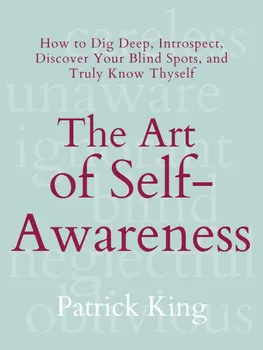
Equal parts scientific, philosophical, and practical. Become your best self by first defining it.
The Art of Self-Awareness takes you on a journey – not to an exotic destination, but inwards. It’s perilous, scary, and uncomfortable, but the end rewards will be fantastic. Self-awareness is not simply knowing your name; it’s knowing what makes you happy, what makes you sad, and the underlying beliefs and values that create those emotions.
Most people look externally for answers to their problems, but that’s like putting a band-aid on top of a pothole. Everything that makes your life good or bad comes from within and it’s time to finally learn what lies beneath.
The toughest skill of all: metacognition, which is thinking about your thinking.
Learn the keys to self-introspection and how a simple set of questions can answer your deepest problems.
The three levels of adult self-awareness and development.
Values, goals, beliefs, and how to orient yourself.
Why self-awareness is actually social awareness, and how it can help you socially
Empathy and social intelligence
The keys to avoiding self-delusion and self-sabotage.
Patrick King is an internationally bestselling author and social skills coach. His writing draws of a variety of sources, from scientific research, academic experience, coaching, and real-life experience.
Self awareness is social awareness. Know thyself and your relationships will benefit tenfold.
Self-awareness is not just a journey about yourself, it involves the people around you. Understanding how your own emotions, values, and beliefs work will finally allow you to truly empathize with your friends, family, and significant other.
To get to Point B, you must know what Point A is. Read this book to find your starting point, your end goal, and what must happen in between!
















Carlijn
10-4-2025
Ontzettend helder en compleet boek. Thus, you move from being a conventional, rule-bound and socialized member of a group, to an independent, autonomous agent who generates their values and beliefs. Jung once said, “Until you make the unconscious conscious, it will direct your life and you will call it fate.” In other words, if something is in our shadow, it will always control us and we will always be at its mercy because we are unaware of it. But if we can learn of who we are – all of who we are – then we are empowered to change it. Thus, the person who has low internal and external self-awareness may feel endlessly plagued by personal demons they can’t control and don’t understand. But when they get a grasp on themselves and shine the light of awareness onto their full experience, they can take charge and proactively make decisions. This is precisely the difference between subject and object that Kegan described. For Jung, there were always clues that the mind was hiding things from itself. Have you ever done something and not understood why you did it? Have you ever felt yourself slipping into an old pattern and habit, almost as though in a dream, powerless to stop or do anything else? Have you ever felt yourself having an extreme and seemingly disproportionate reaction to something? Your shadow is likely at work in all three cases. I can’t express my full sadness because if I did, people would find me needy and too much work, and abandon me. So I need to avoid feeling sad at all costs, or I would threaten everything.” This leads to, “I’m only worthy of love if I’m happy and pleasant and undemanding.” This leads to, “I am not enough, as I am Your conscious mind may want to jump in and tell you a narrative (“you’re an introvert, you’re a worrier, you’re XYZ”), but set these aside and give some space for your unconscious mind to come to the fore and see new possibilities. We have all been taught which values are “better” than others—we need to forget this lesson if we want to find our own values for ourselves! What makes a good day good? What makes you proud and grateful? What makes life worth living (i.e. you’d be miserable without it)? Look not only at the standards you hold for yourself, but those you hold for others. What is a deal breaker for you in your relationships? What is your idea of a person not living a meaningful and purposeful life? How would a person with my values behave in this situation For example, you could ask, “why am I so upset right now?” and respond with “because of that stupid idiot who’s always pushing my buttons!” See how nothing has changed? That no additional self-awareness is gained? If you ask instead, “what am I feeling right now? What’s going on with me?” you may have the chance to gain insight into the situation. You are now open to possibilities. You are primed to see your choice in the matter, too. There are (at least) three types of empathy, and to be as socially aware as possible, we need to learn the difference. Every experience we have has different components – the physical, the cognitive, the emotional It’s best to go sequentially: start by letting the other person know you understand intellectually. Then express sympathy so they know that you feel what they do, too. Finally, put your empathy to use and do something to help. This need not be advice, by the way. You can help someone enormously by making simple observations or suggestions, offering help, or pointing them toward something they need. But remember, it’s about what they need – not what you need or what you think they need In any conversation, try to focus on what is shared. In what ways are you aligned? What is similar? What can you agree on? It may help, especially in conflicts, to literally say, “I’m on your side!” or “let’s find the middle ground.” Often, people only appear to disagree on the surface. When you get down to it, most people are similar: they love their families, they want to do the right thing, and they’re happy to compromise if they feel they’re being heard and respected we disagree and can’t find common ground, but I still respect you and I’m still listening. One easy way to stop the habit of automatically centering yourself is to force yourself to regularly consider someone else’s perspective
Om een recensie te schrijven, moet je de app downloaden