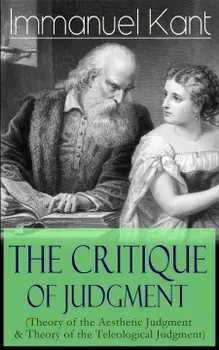
The Critique of Judgment, also translated as the Critique of the Power of Judgment and more commonly referred to as the third Critique, is a philosophical work by Immanuel Kant. Critique of Judgment completes the Critical project begun in the Critique of Pure Reason and the Critique of Practical Reason (the first and second Critiques, respectively). The book is divided into two main sections: the Critique of Aesthetic Judgment and the Critique of Teleological Judgment, and also includes a large overview of the entirety of Kant's Critical system, arranged in its final form. The end result of Kant's Critical Project is that there are certain fundamental antinomies in human Reason, most particularly that there is a complete inability to favor on the one hand the argument that all behavior and thought is determined by external causes, and on the other that there is an actual "spontaneous" causal principle at work in human behavior. Immanuel Kant (1724-1804) was a German philosopher, who, according to the Stanford Encyclopedia of Philosophy is "the central figure of modern philosophy." Kant argued that fundamental concepts of the human mind structure human experience, that reason is the source of morality, that aesthetics arises from a faculty of disinterested judgment, that space and time are forms of our understanding, and that the world as it is "in-itself" is unknowable. Kant took himself to have effected a Copernican revolution in philosophy, akin to Copernicus' reversal of the age-old belief that the sun revolved around the earth.
The Critique of Judgment (Theory of the Aesthetic Judgment & Theory of the Teleological Judgment) : Aesthetics, Teleology, and the Antinomies of Reason
Begin vandaag nog met dit boek voor € 0
- Krijg volledige toegang tot alle boeken in de app tijdens de proefperiode
- Geen verplichtingen, op elk moment annuleren
Auteur:
Taal:
Engels
Formaat:
12 Masterpieces You Have to Read Before You Die. Philosophy
Niccolo Machiavelli, Tommaso Campanella, Francis Bacon, Thomas More, John Stuart Mill, Immanuel Kant, Kahlil Gibran, Leo Tolstoy, G.K. Chesterton, Henry David Thoreau
audiobook
An Answer to the Question: What is Enlightenment?
Immanuel Kant
audiobook
2000 Final Quotations
Marcus Aurelius, Jane Austen, Buddha, Anton Chekhov, Cicero, Emil Cioran, Confucius, Albert Einstein, Anne Frank, Mahatma Gandhi, Johann Wolfgang Goethe, Carl Jung, Immanuel Kant, Friedrich Nietzsche, Marcel Proust, Arthur Schopenhauer, William Shakespeare, Baruch Spinoza, Leonardo da Vinci, Laozi
audiobook
Critique of Pure Reason
Immanuel Kant
audiobookbook
Classic Philosophical Works (Thus Spoke Zarathustra, The Apology of Socrates, Tao Te Ching...)
Plato, Friedrich Nietzsche, Herman Hesse, Leo Tolstoy, Immanuel Kant, Sun Tzu
audiobook
Crítica de la Razón Pura
Immanuel Kant
audiobookbook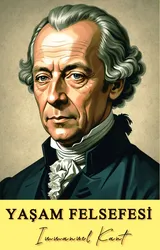
Yaşam Felsefesi
Immanuel Kant
book
La Paz Perpetua :
Immanuel Kant
audiobook
Ikuiseen rauhaan
Immanuel Kant
audiobook
Dreams of a Spirit-Seer
Immanuel Kant
audiobook
The Ethics of Immanuel Kant : Enriched edition. Exploring Kant's Deontological Ethics and the Categorical Imperative
Immanuel Kant
book
Collected Works of Immanuel Kant: Complete Critiques, Philosophical Works and Essays (Including Kant's Inaugural Dissertation)
Immanuel Kant
book