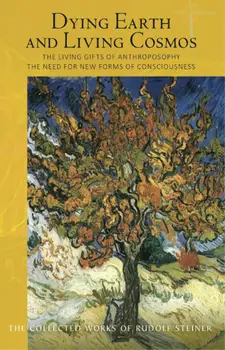
Dying Earth and Living Cosmos : The Living Gifts of Anthroposophy - The Need for New Forms of Consciousness

These authoritative lectures, delivered during a period of deep crisis and conflict in world history, present a comprehensive spiritual teaching for contemporary humanity. Despite the raging world war, Rudolf Steiner was still actively touring Central Europe whilst simultaneously completing work on his architectural masterpiece, the first Goetheanum, in neutral Switzerland.The building of the Goetheanum – undertaken by a community of people from seventeen nations at war – forms a thematic backdrop to the lectures. In speaking of the walls in the new building, for example, Rudolf Steiner describes how their forms are not confining, but rather express an openness to the surrounding cosmos. Likewise, the carved motifs on the architraves of the wooden pillars are not fixed 'symbols' but are alive and continually metamorphosing . These observations are reflected in Steiner's broader discussions. He speaks of extending and deepening our connection with the world and the cosmos, going beyond our usual narrow limits and definitions to engage in 'community with the realities of existence'. We can do this, for example, with the so-called 'dead', who find it difficult to relate to sense-bound thinking. Rudolf Steiner explains how we can connect with them, greatly enriching our lives and 'making an enormous difference to their souls'. The distinction between fixed symbols and living motifs takes us to the core of anthroposophy, striving never to rest in inert forms of thought. In the field of education, Steiner thus warns about 'external measuring' of pupils and linear models of cognitive learning.Throughout the three lecture courses included here – which together form a kind of compendium of anthroposophy at the time – Steiner touches upon a wealth of absorbing themes, including the 'discovery' of America, the contrast between East and West, the qualities of European 'folk souls', Valentin Andreae's Chymical Wedding, and Darwinism. Regardless of his topic, however, Steiner consistently makes the urgent appeal that we 'grasp reality', looking further than abstract schemes of all kinds – such as social and political 'programmes' – to participate in the cosmos as conscious and fully human co-creators.'
Über dieses Buch

These authoritative lectures, delivered during a period of deep crisis and conflict in world history, present a comprehensive spiritual teaching for contemporary humanity. Despite the raging world war, Rudolf Steiner was still actively touring Central Europe whilst simultaneously completing work on his architectural masterpiece, the first Goetheanum, in neutral Switzerland.The building of the Goetheanum – undertaken by a community of people from seventeen nations at war – forms a thematic backdrop to the lectures. In speaking of the walls in the new building, for example, Rudolf Steiner describes how their forms are not confining, but rather express an openness to the surrounding cosmos. Likewise, the carved motifs on the architraves of the wooden pillars are not fixed 'symbols' but are alive and continually metamorphosing . These observations are reflected in Steiner's broader discussions. He speaks of extending and deepening our connection with the world and the cosmos, going beyond our usual narrow limits and definitions to engage in 'community with the realities of existence'. We can do this, for example, with the so-called 'dead', who find it difficult to relate to sense-bound thinking. Rudolf Steiner explains how we can connect with them, greatly enriching our lives and 'making an enormous difference to their souls'. The distinction between fixed symbols and living motifs takes us to the core of anthroposophy, striving never to rest in inert forms of thought. In the field of education, Steiner thus warns about 'external measuring' of pupils and linear models of cognitive learning.Throughout the three lecture courses included here – which together form a kind of compendium of anthroposophy at the time – Steiner touches upon a wealth of absorbing themes, including the 'discovery' of America, the contrast between East and West, the qualities of European 'folk souls', Valentin Andreae's Chymical Wedding, and Darwinism. Regardless of his topic, however, Steiner consistently makes the urgent appeal that we 'grasp reality', looking further than abstract schemes of all kinds – such as social and political 'programmes' – to participate in the cosmos as conscious and fully human co-creators.'

Starte noch heute mit diesem Buch für 0 €

  • Hole dir während der Testphase vollen Zugriff auf alle Bücher in der App
  • Keine Verpflichtungen, jederzeit kündbar
Jetzt kostenlos testen
Mehr als 52 000 Menschen haben Nextory im App Store und auf Google Play 5 Sterne gegeben.

  1. 4. Okt.

    Wie erlangt man Erkenntnisse der höheren Welten? Ein Grundlagenwerk der Anthroposophie. : Hörbuchzeit: Klassiker der Weltliteratur

    Hörbuchzeit, Rudolf Steiner

  2. 26. Juli

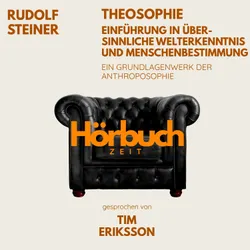
    Theosophie – Einführung in übersinnliche Welterkenntnis und Menschenbestimmung. Ein Grundlagenwerk der Anthroposophie. : Hörbuchzeit: Klassiker der Weltliteratur

    Hörbuchzeit, Rudolf Steiner

  3. Rudolf Steiner: Meisterwerke der Erzählkunst : Klassiker der Weltliteratur: Philosophisches und Pädagogisches

    Rudolf Steiner

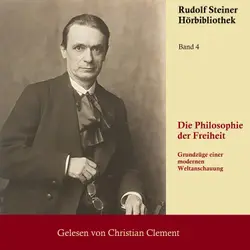
  4. Philosophie der Freiheit. Grundzüge einer modernen Weltanschauung. : Hörbuchzeit: Klassiker der Weltliteratur

    Hörbuchzeit, Rudolf Steiner

  5. Die pädagogische Grundlage der Waldorfschule. Über die Grundlagen der Waldorf-Pädagogik. : Hörbuchzeit: Klassiker der Weltliteratur

    Hörbuchzeit, Rudolf Steiner

  6. Rudolf Steiner: Die große Hörbuch Box : Philosophie, Theosophie, Waldorfpädagogik

    Rudolf Steiner

  7. Cómo Alcanzar el Conocimiento de los Mundos Superiores : Un Camino de Iniciación

    Rudolf Steiner

  8. Die große Rudolf Steiner Hörbuch Box : Philosophie der Freiheit, Theosophie, Erkenntnisse der Höheren Welten sowie Waldorf-Pädagogik

    Rudolf Steiner

  9. #1

    Goethes naturwissenschaftliche Schriften

    Rudolf Steiner

  10. 2.0

    Rudolf Steiner: Die Erziehung des Kindes vom Gesichtspunkte der Geisteswissenschaft : Ein Grundlagenwerk der Anthroposophie und der Waldorfpädagogik

    Rudolf Steiner

  11. Rudolf Steiner: Wie erlangt man Erkenntnisse der höheren Welten? : Ein Grundlagenwerk der Anthroposophie

    Rudolf Steiner

  12. Das Sprechen der Engel im Grundsteinspruch : Betrachtungen zur Anthroposophie. Auswahl und Einführung Michiel ter Horst

    Rudolf Steiner