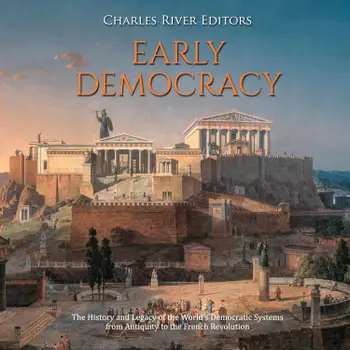
Early Democracy: The History and Legacy of the World’s Democratic Systems from Antiquity to the French Revolution

In today’s modern world every political regime, even the most authoritarian or repressive, describes itself as democracy or a Democratic People’s Republic. The concept of rule by the people, on behalf of the people, has come to be accepted as the norm, and very few would overtly espouse the cause of dictatorship, absolute monarchy or oligarchy as the most desirable political system upon which to base the government of any country.

It is also generally accepted that democracy, as a political ideology, began in Greece, specifically in Athens, in the 7th century BCE and reached its zenith in the 5th century under the leadership of Pericles. Dating an exact starting point is impossible, but at the beginning of the 7th century BCE, Solon inaugurated a series of reforms that began the movement away from rule by individuals, or tyrants, and by the end of that century the reforms of Cleisthenes provided the basis of the Athenian democratic system that culminated in the radical institutions introduced by Ephialtes and Pericles in the 5th century. The result was the first, and possibly only, truly participative democratic state.

Of course, not every inhabitant of Athens enjoyed the right to vote. Only full citizens could do that, and they represented approximately 30% of Athens’s male population, numbering between 30,000 and 60,000 during Athens’ Golden Age and declining rapidly throughout the Peoloponnesian War. The remainder was made up of metics and slaves, who vastly outnumbered free citizens and, indeed, almost all other slave populations in Hellas, a fact which the Athenians often conveniently chose to forget when singing the praises of their democracy.


Über dieses Buch

In today’s modern world every political regime, even the most authoritarian or repressive, describes itself as democracy or a Democratic People’s Republic. The concept of rule by the people, on behalf of the people, has come to be accepted as the norm, and very few would overtly espouse the cause of dictatorship, absolute monarchy or oligarchy as the most desirable political system upon which to base the government of any country.

It is also generally accepted that democracy, as a political ideology, began in Greece, specifically in Athens, in the 7th century BCE and reached its zenith in the 5th century under the leadership of Pericles. Dating an exact starting point is impossible, but at the beginning of the 7th century BCE, Solon inaugurated a series of reforms that began the movement away from rule by individuals, or tyrants, and by the end of that century the reforms of Cleisthenes provided the basis of the Athenian democratic system that culminated in the radical institutions introduced by Ephialtes and Pericles in the 5th century. The result was the first, and possibly only, truly participative democratic state.

Of course, not every inhabitant of Athens enjoyed the right to vote. Only full citizens could do that, and they represented approximately 30% of Athens’s male population, numbering between 30,000 and 60,000 during Athens’ Golden Age and declining rapidly throughout the Peoloponnesian War. The remainder was made up of metics and slaves, who vastly outnumbered free citizens and, indeed, almost all other slave populations in Hellas, a fact which the Athenians often conveniently chose to forget when singing the praises of their democracy.

Starte noch heute mit diesem Buch für 0 €

  • Hole dir während der Testphase vollen Zugriff auf alle Bücher in der App
  • Keine Verpflichtungen, jederzeit kündbar
Jetzt kostenlos testen
Mehr als 52 000 Menschen haben Nextory im App Store und auf Google Play 5 Sterne gegeben.

  1. 2.0

    Die Panzer: Die Geschichte und das Vermächtnis von Nazideutschlands berühmtesten Panzern des Zweiten Weltkriegs

    Charles River Editors

  2. The Iranian Revolution and Iran Hostage Crisis: The History of the Events that Broke American Relations with Iran

    Charles River Editors

  3. Die Han-Dynastie: Geschichte und Erbe des einflussreichsten Reiches des alten China

    Charles River Editors

  4. Japan in the World Wars: The History of the Imperial Japanese Empire during World War I and World War II

    Charles River Editors

  5. Ada Lovelace: The Life and Legacy of the Math Prodigy Who Pioneered Computer Science

    Charles River Editors

  6. Das mittelalterliche Russland: Die Geschichte und das Erbe der Gruppen, die den russischen Staat im Mittelalter entwickelten

    Charles River Editors

  7. The Texas Revolution and Mexican-American War: The History and Legacy of the Conflicts that Led to Mexico’s Cession of the American Southwest

    Charles River Editors

  8. The Spanish Empire in the Americas: The History of Spain’s Colonization across Central America and South America

    Charles River Editors

  9. The Ancient Kingdoms of Africa: The History and Legacy of the African Continent’s Most Prominent Kingdoms in Antiquity

    Charles River Editors

  10. Imperial Germany’s Colonization in Africa: The History of the German Efforts and Conflicts to Colonize Parts of Africa

    Charles River Editors

  11. The Carlist Wars and the Spanish Civil War: The History of the Conflicts that Divided Spain in the Last 200 Years

    Charles River Editors

  12. 3.9

    Hans-Ulrich Rudel: The Life and Legacy of the Luftwaffe’s Deadliest Stuka Pilot

    Charles River Editors