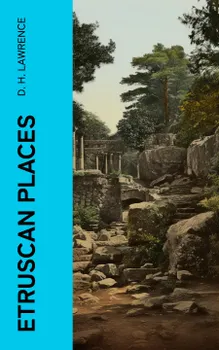
Etruscan Places (Annotated) : Enriched Edition. A Modernist Journey Through Pre-Roman Italy, Painted Tombs, and the Living Ruins of an Ancient Civilization

Etruscan Places is D. H. Lawrence's luminous late travel book, a sequence of essays drawn from his 1927 journey through the ancient sites of Cerveteri, Tarquinia, Vulci, and Volterra. Part archaeology, part prose poem, part cultural polemic, it evokes painted tombs, ruined cities, and museum fragments with sensuous immediacy. Lawrence sets the vital, death-accepting Etruscan imagination against what he saw as the abstract severity of Rome and the spiritual exhaustion of modern Europe. Lawrence, already famous for Sons and Lovers, Women in Love, and Lady Chatterley's Lover, wrote from a life of exile, illness, and restless searching. His distrust of industrial modernity, his fascination with bodily consciousness, and his attraction to pre-Christian cultures all inform this book. Near the end of his life, the Etruscans offered him not merely a historical subject but an alternative vision of human wholeness, intimacy, and reverence for natural forces. This book is recommended to readers interested in modernist travel writing, classical antiquity, and Lawrence's mature thought. It is less a guidebook than an imaginative encounter with a vanished civilization, rewarding anyone willing to read ruins as living presences.

This enriched edition has been carefully crafted to add value to your reading experience.

- A succinct Introduction situates the work's timeless appeal and themes.

- The Synopsis outlines the central plot, highlighting key developments without spoiling critical twists.

- A detailed Historical Context immerses you in the era's events and influences that shaped the writing.

- An Author Biography reveals milestones in the author's life, illuminating the personal insights behind the text.

- A thorough Analysis dissects symbols, motifs, and character arcs to unearth underlying meanings.

- Reflection questions prompt you to engage personally with the work's messages, connecting them to modern life.

- Hand‐picked Memorable Quotes shine a spotlight on moments of literary brilliance.

- Interactive footnotes clarify unusual references, historical allusions, and archaic phrases for an effortless, more informed read.
Über dieses Buch

Etruscan Places is D. H. Lawrence's luminous late travel book, a sequence of essays drawn from his 1927 journey through the ancient sites of Cerveteri, Tarquinia, Vulci, and Volterra. Part archaeology, part prose poem, part cultural polemic, it evokes painted tombs, ruined cities, and museum fragments with sensuous immediacy. Lawrence sets the vital, death-accepting Etruscan imagination against what he saw as the abstract severity of Rome and the spiritual exhaustion of modern Europe. Lawrence, already famous for Sons and Lovers, Women in Love, and Lady Chatterley's Lover, wrote from a life of exile, illness, and restless searching. His distrust of industrial modernity, his fascination with bodily consciousness, and his attraction to pre-Christian cultures all inform this book. Near the end of his life, the Etruscans offered him not merely a historical subject but an alternative vision of human wholeness, intimacy, and reverence for natural forces. This book is recommended to readers interested in modernist travel writing, classical antiquity, and Lawrence's mature thought. It is less a guidebook than an imaginative encounter with a vanished civilization, rewarding anyone willing to read ruins as living presences.

This enriched edition has been carefully crafted to add value to your reading experience.

- A succinct Introduction situates the work's timeless appeal and themes.

- The Synopsis outlines the central plot, highlighting key developments without spoiling critical twists.

- A detailed Historical Context immerses you in the era's events and influences that shaped the writing.

- An Author Biography reveals milestones in the author's life, illuminating the personal insights behind the text.

- A thorough Analysis dissects symbols, motifs, and character arcs to unearth underlying meanings.

- Reflection questions prompt you to engage personally with the work's messages, connecting them to modern life.

- Hand‐picked Memorable Quotes shine a spotlight on moments of literary brilliance.

- Interactive footnotes clarify unusual references, historical allusions, and archaic phrases for an effortless, more informed read.

Starte noch heute mit diesem Buch für 0 €

  • Hole dir während der Testphase vollen Zugriff auf alle Bücher in der App
  • Keine Verpflichtungen, jederzeit kündbar
Jetzt kostenlos testen
Mehr als 52 000 Menschen haben Nextory im App Store und auf Google Play 5 Sterne gegeben.

  1. 100 Klassiker der Romantik - Meisterwerke, die man kennen muss : Epische Liebesdramen und große Erwartungen in zeitlosen Geschichten

    Jane Austen, Louisa May Alcott, D. H. Lawrence, Fjodor Dostojewski, William Shakespeare, Hedwig Courths-Mahler, Frances Burney, Charlotte Brontë, Alexandre Dumas, Margaret Mitchell, Charles Dickens, L.M. Montgomery, Eugenie Marlitt, Wilhelmine Heimburg, Elisabeth Bürstenbinder, Stendhal, Johann Wolfgang Goethe, Walter Scott, Guy De Maupassant, Victor Hugo, George Sand, Leo Tolstoi, Gabriele D’Annunzio, Rudyard Kipling, Gustave Flaubert, Nathaniel Hawthorne, Jean-Jacques Rousseau, Bernardin de Saint-Pierre, F. Scott Fitzgerald, Prosper Mérimée, Edith Wharton, Lena Christ, François-René de Chateaubriand, Stefan Zweig, Alexander Sergejewitsch Puschkin, Ida Boy-Ed, Arthur Schnitzler, Anatole France, Johanna Spyri, George Eliot, Gaston Leroux, Nataly von Eschstruth, Gottfried von Straßburg, Sophie Mereau, Caroline von Wolzogen, Benedikte Naubert, Henry De Stacpoole, Levin Schücking

  2. 100 Meisterwerke der englischen Literatur - Klassiker, die man kennen muss (Kommentiert) : Erweiterte Ausgabe. Hamlet, 1984, Ulysses...

    George Orwell, Charles Dickens, Jane Austen, Katherine Mansfield, H.P. Lovecraft, William Wordsworth, John Keats, Percy Bysshe Shelley, Robert Burns, John Milton, William Shakespeare, Christopher Marlowe, Geoffrey Chaucer, Laurence Sterne, Henry Fielding, Mary Shelley, Emily Brontë, Charlotte Brontë, Anne Brontë, William Makepeace Thackeray, George Eliot, D. H. Lawrence, Herman Melville, Thomas Wolfe, Virginia Woolf, Joseph Conrad, Sinclair Lewis, Walt Whitman, Edgar Allan Poe, Oscar Wilde, Jerome K Jerome, Washington Irving, Bram Stoker, H.G. Wells, Daniel Defoe, Lew Wallace, James Fenimore Cooper, Jonathan Swift, Robert Louis Stevenson, Mark Twain, Lewis Carrol, Edward Bulwer-Lytton, F. Scott Fitzgerald, Arthur Conan Doyle, Jack London, Henry David Thoreau, G.K. Chesterton, Edith Wharton, Henry James, Thomas Hardy, Margaret Mitchell, Kate Chopin, Willa Cather, Charlotte Perkins Gilman, James Joyce, John Galsworthy, Francis Hodgson Burnett, Lucy Maud Montgomery, Louisa May Alcott, Rudyard Kipling

  3. 3.0

    200 Meisterwerke der Literaturgeschichte (Kommentiert) : Erweiterte Ausgabe. Die größten Klassiker der Weltliteratur

    Franz Kafka, Victor Hugo, Fjodor Michailowitsch Dostojewski, Lord Byron, Giacomo Leopardi, Marcel Proust, Henrik Ibsen, Percy Bysshe Shelley, Charles Dickens, Jane Austen, Mary Shelley, Emily Brontë, Charlotte Brontë, Anne Brontë, William Makepeace Thackeray, Bram Stoker, Henry Fielding, George Eliot, William Shakespeare, D. H. Lawrence, Walt Whitman, Herman Melville, Thomas Wolfe, Virginia Woolf, Joseph Conrad, Sinclair Lewis, Lewis Carrol, Edgar Allan Poe, Edward Bulwer-Lytton, Oscar Wilde, H.G. Wells, Daniel Defoe, James Fenimore Cooper, Lew Wallace, Jonathan Swift, Mark Twain, Walter Scott, Nathaniel Hawthorne, Harriet Beecher Stowe, Laurence Sterne, Frances Hodgson Burnett, Arthur Conan Doyle, Wilkie Collins, Edgar Wallace, Robert Louis Stevenson, Jack London, Henry David Thoreau, John Galsworthy, F. Scott Fitzgerald, Rudyard Kipling, G.K. Chesterton, Washington Irvin, O.Henry, Ambrose Bierce, Alexander Sergejewitsch Puschkin, Michail Lermontow, Iwan Sergejewitsch Turgenew, Leo Tolstoi, Nikolai Gogol, Iwan Gontscharow, Nikolai Leskow, Anton Pawlowitsch Tschechow, Maxim Gorki, François Rabelais, Jean De Fontaine, Blaise Pascal, Pierre Corneille, Moliere, Jean Baptiste Racine, Charles Perrault, Voltaire, Denis Diderot, Jean-Jacques Rousseau, Pierre Ambroise Laclos, Antoine-François Prévost, Marquis De Sade, François René Chateaubriand, Stendhal, Honoré de Balzac, Alexandre Dumas, Alphonse de Lamartine, George Sand, Gustave Flaubert, Emile Zola, Guy De Maupassant, Alphonse Daudet, Jules Verne, Joris-Karl Huysmans, Prosper Mérimée, Charles Baudelaire, Stéphane Mallarmé, Arthur Rimbaud, André Gide, Arthur Schopenhauer, Heinrich Heine, Friedrich Schiller, Johann Wolfgang Goethe, Jacob Grimm, Gottfried von Straßburg, Wolfram von Eschenbach, E. T. Hoffmann, Annette von Droste-Hülshoff, Heinrich von Kleist, Friedrich Hölderlin, Theodor Fontane, Gustav Freytag, Gottfried Keller, Theodor Storm, Stefan Zweig, Joseph von Eichendorff, Klaus Mann, Rainer Maria Rilke, Johanna Spyri, Joseph Roth, Karl May, Robert Musil, Heinrich Mann, Sigmund Freud, Friedrich Nietzsche, Dante Alighieri, Giovanni Boccaccio, Giacomo Casanova, Luigi Pirandello, Giosuè Carducci, Gabriele D’Annunzio, Niccolo Machiavelli, Miguel Cervantes Saavedra, Pedro Calderón Barca, Vicente Blasco Ibañez, Knut Hamsun, Homer, Äsop, Herodot, Thukydides, Xenophon, Platon, - Aristoteles, - Sophokles, Euripides, - Aristophanes, Lao Tse, - Konfuzius, Siddhartha Gautama Buddha, Titus Livius, Tacitus, Marcus Tullius Cicero, Vergil, Ovid, Lukian, Petronius, Apuleius, Longos von Lesbos, Mark Aurel, Aurelius Augustinus

  4. Einige Titelbilder sind nur für angemeldete Benutzer sichtbar
    2.5

    Lady Chatterley's Lover

    D. H. Lawrence

  5. 2.0

    Lady Chatterley's Lover - Audiobook

    D. H. Lawrence, Classic Audiobooks

  6. Söhne und Liebhaber - Hörbuch Klassiker

    D. H. Lawrence, Hörbuch Klassiker

  7. Die größten Heldinnen der Literatur (50 Romane in einem Band) : Jane Eyre, Tess von den d'Urbervilles, Anne auf Green Gables, Johanna D'Arc, Klein-Dorrit, Lelia, Maria Stuart, Effi Briest, Kleine Frauen

    Charlotte Brontë, Jane Austen, Louisa May Alcott, Leo Tolstoi, Virginia Woolf, Thomas Hardy, Sinclair Lewis, Hedwig Dohm, Charlotte Perkins Gilman, Elizabeth Burgoyne Corbett, Daniel Defoe, Anne Brontë, L.M. Montgomery, Victor Hugo, Wilhelmine von Hillern, Adalbert Stifter, Luise Ahlborn, George Eliot, Lou Andreas-Salomé, Stefan Zweig, D. H. Lawrence, Henry James, Margaret Mitchell, Edith Wharton, Miles Franklin, Willa Cather, Elizabeth Gaskell, Nikolai Semjonowitsch Leskow, Theodore Dreiser, Elizabeth von Arnim, Colette, Honoré de Balzac, William Makepeace Thackeray, Gustave Flaubert, Emile Zola, Theodor Fontane, Ada Langworthy Collier, Joseph Sheridan Fanu, Johanna Schopenhauer, Nathaniel Hawthorne, Charles Dickens

  8. Die größten Liebesgeschichten der britischen Literatur (Kommentiert) : Erweiterte Ausgabe. Romeo und Julia, Stolz und Vorurteil, Emma, Cecilia, Überredung, Jane Eyre, Große Erwartungen, Die Braut von Lammermoor

    Jane Austen, Charlotte Brontë, William Shakespeare, Walter Scott, Frances Burney, Emily Brontë, Anne Brontë, Charles Dickens, Rudyard Kipling, George Eliot, Nathaniel Hawthorne, D. H. Lawrence, Daniel Defoe, Lew Wallace, F. Scott Fitzgerald

  9. Die größten weiblichen Bildungsromane : Moll Flanders, Gabriele, Jane Eyre, Heidi, Brigitta, Netotschka Njeswanowa, Aus guter Familie, Emma

    Charlotte Brontë, Johanna Schopenhauer, Johanna Spyri, Jane Austen, Marianne Ehrmann, Caroline von Wolzogen, Gabriele Reuter, Charles Dickens, Fjodor Michailowitsch Dostojewski, Daniel Defoe, Lou Andreas-Salomé, John Cleland, Adalbert Stifter, Charles-Louis Philippe, D. H. Lawrence

  10. Die größten Meisterwerke der Weltliteratur (Kommentiert) : Erweiterte Ausgabe. 200 Klassiker die man kennen muss

    Fjodor Michailowitsch Dostojewski, Lord Byron, Franz Kafka, Victor Hugo, Giacomo Leopardi, Marcel Proust, Henrik Ibsen, Percy Bysshe Shelley, Charles Dickens, Jane Austen, Mary Shelley, Emily Brontë, Charlotte Brontë, Anne Brontë, William Makepeace Thackeray, Bram Stoker, Henry Fielding, George Eliot, William Shakespeare, D. H. Lawrence, Walt Whitman, Herman Melville, Thomas Wolfe, Virginia Woolf, Joseph Conrad, Sinclair Lewis, Lewis Carrol, Edgar Allan Poe, Edward Bulwer-Lytton, Oscar Wilde, H.G. Wells, Daniel Defoe, James Fenimore Cooper, Lew Wallace, Jonathan Swift, Robert Louis Stevenson, Mark Twain, Walter Scott, Nathaniel Hawthorne, Harriet Beecher Stowe, Laurence Sterne, Frances Hodgson Burnett, Arthur Conan Doyle, Washington Irving, O.Henry, Ambrose Bierce, Alexander Sergejewitsch Puschkin, Michail Lermontow, Iwan Sergejewitsch Turgenew, Leo Tolstoi, Nikolai Gogol, Iwan Gontscharow, Nikolai Leskow, Anton Pawlowitsch Tschechow, Maxim Gorki, François Rabelais, Jean De Fontaine, Blaise Pascal, Pierre Corneille, Moliere, Pierre Ambroise Laclos, Antoine-François Prévost, Marquis De Sade

  11. Twilight in Italy

    D. H. Lawrence

  12. The Essential Feminist Collection – 60 Powerful Classics in One Volume : Including 100+ Biographies & Memoirs of the Most Influential Women in History

    Jane Austen, Charlotte Brontë, Fanny Burney, Mary Wollstonecraft, Nathaniel Hawthorne, Rebecca Harding Davis, Louisa May Alcott, Henry James, Leo Tolstoy, Thomas Hardy, Elizabeth Gaskell, Charlotte Perkins Gilman, Henrik Ibsen, Kate Chopin, Grant Allen, Elizabeth Burgoyne Corbett, H.G. Wells, Gene Stratton-Porter, Willa Cather, Edith Wharton, Theodore Dreiser, Ada Cambridge, Mary Johnston, Marietta Holley, Elia Wilkinson Peattie, Virginia Woolf, Zona Gale, Elizabeth von Arnim, D. H. Lawrence, Margaret Oliphant, Lucy Maud Montgomery, Margaret Mitchell, Harriet Martineau, Nikolai Leskov, Margaret Deland, Sojourner Truth, Mary Ware Dennett, John Stuart Mill, Sarah H. Bradford, Julia Ward Howe, Elizabeth Cady Stanton, Margaret Fuller