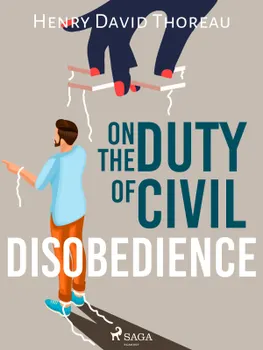
On the Duty of Civil Disobedience

‘Civil Disobedience’ (1849) is an essay by American poet, essayist, and philosopher, Henry David Thoreau, who is best known for his book ‘Walden’ (1854).

In this classic essay, Thoreau famously argues that citizens should not allow their government to overrule their consciences, arguing that their compliance enables governments to make them the agents of injustice.

A lifelong abolitionist, Thoreau was motivated to write this essay by his contempt for slavery and the plight of John Brown. His work went on to influence the political thoughts and actions of both Gandhi and Martin Luther King Jr.

This pioneering, thought-provoking classic, remains as relevant today as when it was first written.

Henry David Thoreau (1817 – 1862) was an American naturalist, poet, essayist and philosopher. A leading transcendentalist, he is best known for his book ‘Walden’ (1854), a deliberation on simple living in natural surroundings, and his advocation of civil liberties in the essay ‘Civil Disobedience’ (1849).

A lifelong abolitionist he praised the writings of Wendell Phillips and defended the abolitionist John Brown, most notably with his works, ‘A Plea for Captain John Brown’ (1859), ‘Remarks After the Hanging of John Brown’ (1859), and ‘The Last Days of John Brown (1860)’.

Thoreau's philosophy of civil disobedience went on to influence writers and leading political figures across the world, including Tolstoy, Gandhi, and Martin Luther King Jr. His pioneering works continue to resonate with people to this day.


Über dieses Buch

‘Civil Disobedience’ (1849) is an essay by American poet, essayist, and philosopher, Henry David Thoreau, who is best known for his book ‘Walden’ (1854).

In this classic essay, Thoreau famously argues that citizens should not allow their government to overrule their consciences, arguing that their compliance enables governments to make them the agents of injustice.

A lifelong abolitionist, Thoreau was motivated to write this essay by his contempt for slavery and the plight of John Brown. His work went on to influence the political thoughts and actions of both Gandhi and Martin Luther King Jr.

This pioneering, thought-provoking classic, remains as relevant today as when it was first written.

Henry David Thoreau (1817 – 1862) was an American naturalist, poet, essayist and philosopher. A leading transcendentalist, he is best known for his book ‘Walden’ (1854), a deliberation on simple living in natural surroundings, and his advocation of civil liberties in the essay ‘Civil Disobedience’ (1849).

A lifelong abolitionist he praised the writings of Wendell Phillips and defended the abolitionist John Brown, most notably with his works, ‘A Plea for Captain John Brown’ (1859), ‘Remarks After the Hanging of John Brown’ (1859), and ‘The Last Days of John Brown (1860)’.

Thoreau's philosophy of civil disobedience went on to influence writers and leading political figures across the world, including Tolstoy, Gandhi, and Martin Luther King Jr. His pioneering works continue to resonate with people to this day.

Starte noch heute mit diesem Buch für 0 €

  • Hole dir während der Testphase vollen Zugriff auf alle Bücher in der App
  • Keine Verpflichtungen, jederzeit kündbar
Jetzt kostenlos testen
Mehr als 52 000 Menschen haben Nextory im App Store und auf Google Play 5 Sterne gegeben.

  1. Sparsamkeit. Aus: Walden oder Leben in den Wäldern. : Hörbuchzeit: Klassiker der Weltliteratur

    Hörbuchzeit, Henry David Thoreau

  2. 100 Meisterwerke der englischen Literatur - Klassiker, die man kennen muss : Hamlet, 1984, Ulysses...

    George Orwell, Charles Dickens, Jane Austen, Katherine Mansfield, H.P. Lovecraft, William Wordsworth, John Keats, Percy Bysshe Shelley, Robert Burns, John Milton, William Shakespeare, Christopher Marlowe, Geoffrey Chaucer, Laurence Sterne, Henry Fielding, Mary Shelley, Emily Brontë, Charlotte Brontë, Anne Brontë, William Makepeace Thackeray, George Eliot, D. H. Lawrence, Herman Melville, Thomas Wolfe, Virginia Woolf, Joseph Conrad, Sinclair Lewis, Walt Whitman, Edgar Allan Poe, Oscar Wilde, Jerome K Jerome, Washington Irving, Bram Stoker, H.G. Wells, Daniel Defoe, Lew Wallace, James Fenimore Cooper, Jonathan Swift, Robert Louis Stevenson, Mark Twain, Lewis Carrol, Edward Bulwer-Lytton, F. Scott Fitzgerald, Arthur Conan Doyle, Jack London, Henry David Thoreau, G.K. Chesterton, Edith Wharton, Henry James, Thomas Hardy, Margaret Mitchell, Kate Chopin, Willa Cather, Charlotte Perkins Gilman, James Joyce, John Galsworthy, Francis Hodgson Burnett, Lucy Maud Montgomery, Louisa May Alcott, Rudyard Kipling

  3. 3.0

    200 Meisterwerke der Literaturgeschichte : Die größten Klassiker der Weltliteratur

    Franz Kafka, Victor Hugo, Fjodor Michailowitsch Dostojewski, Lord Byron, Giacomo Leopardi, Marcel Proust, Henrik Ibsen, Percy Bysshe Shelley, Charles Dickens, Jane Austen, Mary Shelley, Emily Brontë, Charlotte Brontë, Anne Brontë, William Makepeace Thackeray, Bram Stoker, Henry Fielding, George Eliot, William Shakespeare, D. H. Lawrence, Walt Whitman, Herman Melville, Thomas Wolfe, Virginia Woolf, Joseph Conrad, Sinclair Lewis, Lewis Carrol, Edgar Allan Poe, Edward Bulwer-Lytton, Oscar Wilde, H.G. Wells, Daniel Defoe, James Fenimore Cooper, Lew Wallace, Jonathan Swift, Robert Louis Stevenson, Mark Twain, Walter Scott, Nathaniel Hawthorne, Harriet Beecher Stowe, Laurence Sterne, Frances Hodgson Burnett, Arthur Conan Doyle, Wilkie Collins, Edgar Wallace, Jack London, Henry David Thoreau, John Galsworthy, F. Scott Fitzgerald, Rudyard Kipling, G.K. Chesterton, Washington Irvin, O.Henry, Ambrose Bierce, Alexander Sergejewitsch Puschkin, Michail Lermontow, Iwan Sergejewitsch Turgenew, Leo Tolstoi, Nikolai Gogol, Iwan Gontscharow, Nikolai Leskow, Anton Pawlowitsch Tschechow, Maxim Gorki, François Rabelais, Jean De Fontaine, Blaise Pascal, Pierre Corneille, Moliere, Jean Baptiste Racine, Charles Perrault, Voltaire, Denis Diderot, Jean-Jacques Rousseau, Pierre Ambroise Laclos, Antoine-François Prévost, Marquis De Sade, François René Chateaubriand, Stendhal, Honoré de Balzac, Alexandre Dumas, Alphonse de Lamartine, George Sand, Gustave Flaubert, Emile Zola, Guy De Maupassant, Alphonse Daudet, Jules Verne, Joris-Karl Huysmans, Prosper Mérimée, Charles Baudelaire, Stéphane Mallarmé, Arthur Rimbaud, André Gide, Arthur Schopenhauer, Heinrich Heine, Friedrich Schiller, Johann Wolfgang Goethe, Jacob Grimm, Gottfried von Straßburg, Wolfram von Eschenbach, E. T. Hoffmann, Annette von Droste-Hülshoff, Heinrich von Kleist, Friedrich Hölderlin, Theodor Fontane, Gustav Freytag, Gottfried Keller, Theodor Storm, Stefan Zweig, Joseph von Eichendorff, Klaus Mann, Rainer Maria Rilke, Johanna Spyri, Joseph Roth, Karl May, Robert Musil, Heinrich Mann, Sigmund Freud, Friedrich Nietzsche, Dante Alighieri, Giovanni Boccaccio, Giacomo Casanova, Luigi Pirandello, Giosuè Carducci, Gabriele D’Annunzio, Niccolo Machiavelli, Miguel Cervantes Saavedra, Pedro Calderón Barca, Vicente Blasco Ibañez, Knut Hamsun, Homer, Äsop, Herodot, Thukydides, Xenophon, Platon, - Aristoteles, - Sophokles, Euripides, - Aristophanes, Lao Tse, - Konfuzius, Siddhartha Gautama Buddha, Titus Livius, Tacitus, Marcus Tullius Cicero, Vergil, Ovid, Lukian, Petronius, Apuleius, Longos von Lesbos, Mark Aurel, Aurelius Augustinus

  4. 1. Nov.

    Der Teich im Winter. Aus: Walden oder Leben in den Wäldern. : Hörbuchzeit: Klassiker der Weltliteratur

    Hörbuchzeit, Henry David Thoreau

  5. Frühling. Aus: Walden oder Leben in den Wäldern. : Hörbuchzeit: Klassiker der Weltliteratur

    Hörbuchzeit, Henry David Thoreau

  6. Das Bohnenfeld. Aus: Walden oder Leben in den Wäldern. : Hörbuchzeit: Klassiker der Weltliteratur

    Hörbuchzeit, Henry David Thoreau

  7. Wo ich lebte und wofür ich lebte. Aus: Walden oder Leben in den Wäldern. : Hörbuchzeit: Klassiker der Weltliteratur

    Hörbuchzeit, Henry David Thoreau

  8. Über die Pflicht zum Ungehorsam gegen den Staat. Ein Essay. : Hörbuchzeit: Klassiker der Weltliteratur

    Hörbuchzeit, Henry David Thoreau

  9. 100 Amerikanische Klassiker - Meisterwerke, die man kennen muss : Der große Gatsby, Die Abenteuer Tom Sawyers, Kleine Frauen, Zeit der Unschuld, Porträt einer Dame, Der Rabe, Moby-Dick, Wolfsblut...

    Mark Twain, Louisa May Alcott, Jack London, Stephen Crane, L. Frank Baum, Walt Whitman, Herman Melville, Henry David Thoreau, Elbert Hubbard, Ralph Waldo Emerson, Ambrose Bierce, Frances Hodgson Burnett, Lew Wallace, Nathaniel Hawthorne, James Norman Hall, Edgar Allan Poe, O.Henry, H.P. Lovecraft, James Fenimore Cooper, Edward Bellamy, Bret Harte, Max Brand, Zane Grey, Willa Cather, F. Scott Fitzgerald, Kate Chopin, Charlotte Perkins Gilman, Edith Wharton, Margaret Mitchell, Henry James, Theodor Dreiser, Gertrude Stein, Sinclair Lewis, Warwick Deeping, Thomas Wolfe, Harriet Beecher Stowe

  10. Auf dem Weg zum stärkeren Ich : Selbständigkeit, Selbsthilfe, Der Charakter, Menschenkenntnis, Walden, Das Ich und das Es

    Sigmund Freud, Alfred Adler, Ralph Waldo Emerson, Henry David Thoreau, Samuel Smiles

  11. Positive Individualpsychologie : Klassiker der Psychologie und Selbsterkenntnis: Selbsthilfe, Der Charakter, Individualpsychologie

    Ralph Waldo Emerson, Alfred Adler, Sigmund Freud, Samuel Smiles, Henry David Thoreau

  12. Die größten amerikanischen Philosophen der Selbständigkeit : Die wichtigsten Werke von Ralph Waldo Emerson, Henry David Thoreau und Walt Whitman

    Ralph Waldo Emerson, Henry David Thoreau, Walt Whitman