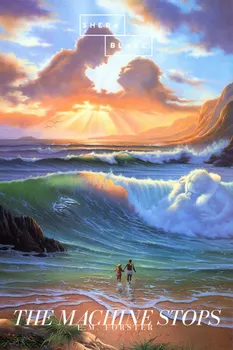
The Machine Stops

The Machine Stops is a science fiction short story by E. M. Forster. After initial publication in The Oxford and Cambridge Review (November 1909), the story was republished in Forster's The Eternal Moment and Other Stories in 1928. After being voted one of the best novellas up to 1965, it was included that same year in the populist anthology Modern Short Stories. In 1973 it was also included in The Science Fiction Hall of Fame, Volume Two. The story, set in a world where humanity lives underground and relies on a giant machine to provide their needs, predicted technologies such as instant messaging and the Internet. The story describes a world in which most of the human population has lost the ability to live on the surface of the Earth. Each individual now lives in isolation below ground in a standard room, with all bodily and spiritual needs met by the omnipotent, global Machine. Travel is permitted, but is unpopular and rarely necessary. Communication is made via a kind of instant messaging/video conferencing machine with which people conduct their only activity: the sharing of ideas and what passes for knowledge. The two main characters, Vashti and her son Kuno, live on opposite sides of the world. Vashti is content with her life, which, like most inhabitants of the world, she spends producing and endlessly discussing secondhand 'ideas'. Kuno, however, is a sensualist and a rebel. He persuades a reluctant Vashti to endure the journey (and the resultant unwelcome personal interaction) to his room. There, he tells her of his disenchantment with the sanitised, mechanical world. He confides to her that he has visited the surface of the Earth without permission, and that he saw other humans living outside the world of the Machine. However, the Machine recaptured him, and he has been threatened with 'Homelessness', that is, expulsion from the underground environment and presumed death.
Über dieses Buch

The Machine Stops is a science fiction short story by E. M. Forster. After initial publication in The Oxford and Cambridge Review (November 1909), the story was republished in Forster's The Eternal Moment and Other Stories in 1928. After being voted one of the best novellas up to 1965, it was included that same year in the populist anthology Modern Short Stories. In 1973 it was also included in The Science Fiction Hall of Fame, Volume Two. The story, set in a world where humanity lives underground and relies on a giant machine to provide their needs, predicted technologies such as instant messaging and the Internet. The story describes a world in which most of the human population has lost the ability to live on the surface of the Earth. Each individual now lives in isolation below ground in a standard room, with all bodily and spiritual needs met by the omnipotent, global Machine. Travel is permitted, but is unpopular and rarely necessary. Communication is made via a kind of instant messaging/video conferencing machine with which people conduct their only activity: the sharing of ideas and what passes for knowledge. The two main characters, Vashti and her son Kuno, live on opposite sides of the world. Vashti is content with her life, which, like most inhabitants of the world, she spends producing and endlessly discussing secondhand 'ideas'. Kuno, however, is a sensualist and a rebel. He persuades a reluctant Vashti to endure the journey (and the resultant unwelcome personal interaction) to his room. There, he tells her of his disenchantment with the sanitised, mechanical world. He confides to her that he has visited the surface of the Earth without permission, and that he saw other humans living outside the world of the Machine. However, the Machine recaptured him, and he has been threatened with 'Homelessness', that is, expulsion from the underground environment and presumed death.
Starte noch heute mit diesem Buch für 0 €

  • Hole dir während der Testphase vollen Zugriff auf alle Bücher in der App
  • Keine Verpflichtungen, jederzeit kündbar
Jetzt kostenlos testen
Mehr als 52 000 Menschen haben Nextory im App Store und auf Google Play 5 Sterne gegeben.

  1. 2.0

    Maurice

    E. M. Forster

  2. 16. Okt.

    Howards End

    E. M. Forster

  3. Neu

    Fallen Worlds 3 : Timeless Stories of Survival, Collapse, and Hope

    E. M. Forster, Robert Silverberg, Morrison Colladay, Frank Lillie Pollock, Paul Macnamara, William Brittain

  4. 1900 - 1939 Science Fiction 3 - 13 Classic Science Fiction Short Stories by Jack London, H. P. Lovecraft, EE Doc Smith, Clark Ashton Smith, Paul Ernst and many more : Cosmic Horrors, Mechanical Men, and Doomed Inventions from 1900–1939

    Jack London, Arthur C. Clarke, H.P. Lovecraft, E. E. "doc" Smith, Clark Ashton Smith, E. M. Forster, Henry Kuttner, G. Peyton Wertenbaker, Harl Vincent, Clare Winger Harris, Edwin Baird, Paul Ernst

  5. Apocalypse Then : 6 Early Tales of Humanities End

    E. M. Forster, Jack London, Arthur Conan Doyle, M.P. Shiel, H.P. Lovecraft, Mary Shelley

  6. En färd till Indien

    E. M. Forster

  7. Aspects Of The Novel

    E. M. Forster

  8. 4.4

    A Room with a View

    E. M. Forster

  9. Fallen Worlds : Timeless Stories of Survival, Collapse, and Hope

    Ben Bova, Frederik Pohl, Robert Abernathy, Alan E. Nourse, Jack Sharkey, Philip K Dick, Herbert D. Kastle, Alfred Bester, G. Peyton Wertenbaker, Harlan Ellison, William F. Nolan, Lynn Venable, Edward W. Ludwig, Miguel Hidalgo, Robert Sheckley, H.G. Wells, Dean Evans, Donald E. Westlake, William Oberfield, Fritz Leiber, E. M. Forster, William Brittain, Robert Silverberg, Paul Macnamara, Morrison Colladay, Frank Lillie Pollock, John W. Campbell, Lester del Rey

  10. 11 Tales of the Unknown Before Lovecraft : Early Science Fiction, Weird Tales & Speculative Fiction

    Algernon Blackwood, William Hope Hodgson, E. M. Forster, Ambrose Bierce, Jack London, H.G. Wells, Arthur Machen, Nathaniel Hawthorne

  11. Aspects of the Novel

    E. M. Forster

  12. 3.6

    The Machine Stops

    E. M. Forster