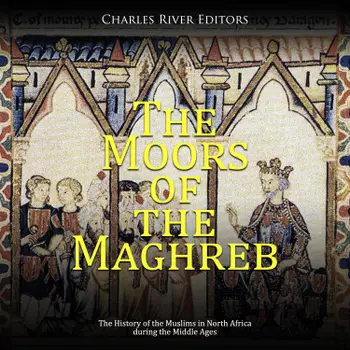
The Moors of the Maghreb: The History of the Muslims in North Africa during the Middle Ages

The term Moor is a historical rather than an ethnic name. It is an invention of European Christians for the Islamic inhabitants of Maghreb (North Africa), Andalusia (Spain), Sicily and Malta, and was sometimes use to designate all Muslims. It is derived from Mauri, the Latin name for the Berbers who lived in the Roman province of Mauretania, which ranged across modern Algeria and Morocco. Saracen was another European term used to designate Muslims, though it usually referred to the Arabic peoples of the Middle East and derives from an ancient name for the Arabs, Sarakenoi. The Muslims of those regions no more refer to themselves by that term than those of North Africa call themselves Moors. Maghreb, or al-Maghreb, is a historical term used by Arabic Muslims for the territory of coastal North Africa from Alexandria to the Atlantic Coast. It means “The West” and is used in opposition to Mashrek, “The East,” used to refer to the lands of Islam in the Middle East and north-eastern Africa. The Berbers refer to the region in their own language as Tamazgha. In a limited, precise sense it can also refer to the Kingdom of Morocco, the proper name of which is al-Mamlakah al-Maghribiyyah, “Kingdom of the West.”

Ethnically the people of North Africa are mostly of mixed Arab-Berber descent, and the Berbers are a proud and noble group of peoples dating from ancient times. The term Berber is again a foreign designation, coming from the Greek barbaroi, meaning stranger. By implication, as far as the Greeks and Romans were concerned, the word indicated the people were uncivilized. From this comes the archaic English name Barbary, used to designate the north coast of Africa and still used in “Barbary ape” and the breed of horse known as the Barb. The Berbers call themselves Imazighen, though in truth they are a grouping of different tribes rather than a strictly homogenous group.
Starte noch heute mit diesem Buch für 0 €

  • Hole dir während der Testphase vollen Zugriff auf alle Bücher in der App
  • Keine Verpflichtungen, jederzeit kündbar
Jetzt kostenlos testen
Mehr als 52 000 Menschen haben Nextory im App Store und auf Google Play 5 Sterne gegeben.

  1. 1.0

    Die Panzer: Die Geschichte und das Vermächtnis von Nazideutschlands berühmtesten Panzern des Zweiten Weltkriegs

    Charles River Editors

  2. 4.0

    The Empires of India: The History of the Dynasties that Ruled India Before the British

    Charles River Editors

  3. The Spanish Empire in the Americas: The History of Spain’s Colonization across Central America and South America

    Charles River Editors

  4. 2.0

    Göbekli Tepe: The History and Mystery of One of the World’s Oldest Neolithic Sites

    Charles River Editors

  5. 3.8

    Hans-Ulrich Rudel: The Life and Legacy of the Luftwaffe’s Deadliest Stuka Pilot

    Charles River Editors

  6. 4.0

    The Philippines Campaigns of World War II: The History of the Japanese Invasion in 1941-1942 and the Allied Liberation in 1944-1945

    Charles River Editors

  7. The Rise and Fall of the Third Reich: The History and Legacy of Nazi Germany under Adolf Hitler

    Charles River Editors

  8. Chiang Kai-Shek: The Life and Legacy of the Republic of China’s Revolutionary Leader

    Charles River Editors

  9. The Disappearance of the USS Thresher: The History of the American Nuclear Submarine that Sank at the Height of the Cold War

    Charles River Editors

  10. Spain and the American Revolution: The History of the Spanish Empire’s Participation in the Revolutionary War

    Charles River Editors

  11. J. Edgar Hoover and Allen Dulles: The History of 20th Century America’s Most Controversial FBI and CIA Directors

    Charles River Editors

  12. Das mittelalterliche Russland: Die Geschichte und das Erbe der Gruppen, die den russischen Staat im Mittelalter entwickelten

    Charles River Editors