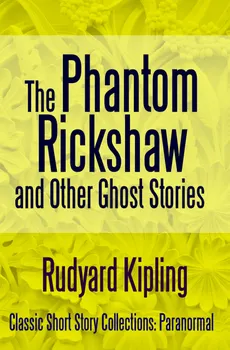
The Phantom Rickshaw and Other Ghost Stories

The Phantom 'Rickshaw and Other Tales, also known as The Phantom 'Rickshaw & other Eerie Tales, is a collection of short stories by Rudyard Kipling, first published in 1888.

The Phantom 'Rickshaw

After an affair with a Mrs. Agnes Keith-Wessington in Simla,

the narrator, Jack, repudiates her and eventually becomes engaged to

Miss Kitty Mannering. Yet Mrs. Wessington continually reappears in

Jack's life, begging him to reconsider, insisting that it was all just a

mistake. But Jack wants nothing to do with her and continues to spurn

her. Eventually Mrs. Wessington dies, much to Jack's relief. However,

some time thereafter he sees her old rickshaw

and assumes that someone has bought it. Then, to his astonishment, the

rickshaw and the men pulling it pass through a horse, revealing

themselves to be phantoms, bearing the departed ghost of Mrs.

Wessington. This leads Jack into increasingly erratic behavior which he

tries to cover up by concocting increasingly elaborate lies to assuage

Kitty's suspicions. Eventually a Dr. Heatherlegh takes him in, supposing

the visions to be the result of disease or madness. Despite their

efforts, Kitty and her family become increasingly suspicious and

eventually call off the engagement. Jack loses hope and begins wandering

the city aimlessly, accompanied by the ghost of Mrs. Wessington.

My Own True Ghost Story

The narrator, while staying at a dâk-bungalow in Katmal, India,

hears someone in the next room playing billiards. He assumes that it is

a group of doolie-bearers who've just arrived. The next morning he

complains, only to learn that there were no coolies in the dâk-bungalow

the night before. The owner then tells him that ten years ago it was a

billiard-hall. An engineer who'd been fond of the billiard hall had died

somewhere far from it and they suspected that it was his ghost that

occasionally came to visit it.

The Strange Ride of Morrowbie Jukes

One

evening Morrowbie Jukes, an Englishman, is feeling a bit feverish and

the barking of the dogs outside his tent is upsetting him. So he mounts

his horse in order to pursue them. The horse bolts and they eventually

fall into a sandy ravine on the edge of a river. He awakens the next

morning to find himself in a village of the living dead, where people

who appear to have died of, for instance, cholera, but who revived when

their bodies were about to be burned, are imprisoned. He quickly learns

that it is impossible to climb out because of the sandy slope. And the

river is doubly treacherous with quicksand and a rifleman who will try

to pick them off. He recognizes one man there, a Brahmin named Gunga Dass. Gunga has become ruthless, but he does feed Jukes with dead crow.

Eventually Jukes discovered that another Englishman had been there and

died. On his corpse Jukes finds a note explaining how to safely get

through the quicksand. After Jukes explains it to Gunga, Gunga confesses

to murdering the Englishman for fear of being left behind. They plan

their escape for that evening, when the rifleman will be unable to see

them in the dark. When the time to escape arrives, Gunga knocks Jukes

unconscious and escapes alone. When Jukes awakes he is found by the boy

who kept his dogs and is helped to escape by means of a rope.

The Man Who Would Be King

The narrator, a journalist, meets two colorful characters, Daniel Dravot and Peachey Carnahan, while on a train. Later they seek him out at his printing press in Lahore, for books or maps of Kafiristan.

He then plays witness to their vow to each other to become kings of

Kafiristan, a venture which he sees as ill-advised. Two years later

Peachey returns and informs the narrator that they indeed reached

Kafiristan. While there, were seen as gods and eventually Daniel is made

king. They taught the Kafiristanis how to use rifles and military

tactics. Eventually Dravot decides to take a Kafiristani woman to wife.

In her terror she bites him. Upon seeing him bleed, the priests declare

him not to be a god and the Kafiristanis immediately seek their deaths.

One clan chief, whom they call "Billy Fish" helps them to escape but

eventually they are caught and Daniel is thrown into a gorge to his

death. They crucified Peachey but then let him go when he survived. The

narrator puts Peachey in an asylum where he dies soon thereafter.

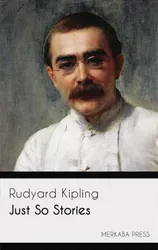
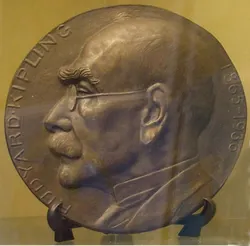
Joseph Rudyard Kipling (30 December 1865 – 18 January 1936) was an English journalist, short-story writer, poet, and novelist.

Kipling's works of fiction include The Jungle Book (1894), Kim (1901), and many short stories, including "The Man Who Would Be King" (1888). His poems include "Mandalay" (1890), "Gunga Din" (1890), "The Gods of the Copybook Headings" (1919), "The White Man's Burden" (1899), and "If—" (1910). He is regarded as a major innovator in the art of the short story; his children's books are classics of children's literature, and one

critic described his work as exhibiting "a versatile and luminous

narrative gift".

Kipling was one of the most popular writers in the United Kingdom, in

both prose and verse, in the late 19th and early 20th centuries. Henry James

said: "Kipling strikes me personally as the most complete man of

genius, as distinct from fine intelligence, that I have ever known."In 1907, at the age of 42, he was awarded the Nobel Prize in Literature, making him the first English-language writer to receive the prize and its youngest recipient to date. He was also sounded out for the British Poet Laureateship and on several occasions for a knighthood, both of which he declined.

Starten Sie noch heute mit diesem Buch für 0 €

  • Hole dir während der Testphase vollen Zugriff auf alle Bücher in der App
  • Keine Verpflichtungen, jederzeit kündbar
Jetzt kostenlos testen
Mehr als 52 000 Menschen haben Nextory im App Store und auf Google Play 5 Sterne gegeben.

  1. 100 Meisterwerke der englischen Literatur - Klassiker, die man kennen muss

    George Orwell, Charles Dickens, Jane Austen, Katherine Mansfield, H.P. Lovecraft, William Wordsworth, John Keats, Percy Bysshe Shelley, Robert Burns, John Milton, William Shakespeare, Christopher Marlowe, Geoffrey Chaucer, Laurence Sterne, Henry Fielding, Mary Shelley, Emily Brontë, Charlotte Brontë, Anne Brontë, William Makepeace Thackeray, George Eliot, D. H. Lawrence, Herman Melville, Thomas Wolfe, Virginia Woolf, Joseph Conrad, Sinclair Lewis, Walt Whitman, Edgar Allan Poe, Oscar Wilde, Jerome K Jerome, Washington Irving, Bram Stoker, H.G. Wells, Daniel Defoe, Lew Wallace, James Fenimore Cooper, Jonathan Swift, Robert Louis Stevenson, Mark Twain, Lewis Carrol, Edward Bulwer-Lytton, F. Scott Fitzgerald, Arthur Conan Doyle, Jack London, Henry David Thoreau, G.K. Chesterton, Edith Wharton, Henry James, Thomas Hardy, Margaret Mitchell, Kate Chopin, Willa Cather, Charlotte Perkins Gilman, James Joyce, John Galsworthy, Francis Hodgson Burnett, Lucy Maud Montgomery, Louisa May Alcott, Rudyard Kipling

    book
  2. 200 Literarische Meisterwerke der Weltgeschichte : Die größten Klassiker aus Deutschland, England, den USA, Russland und Frankreich

    Lew Tolstoi, Virginia Woolf, Henrik Ibsen, Franz Kafka, Fjodor Michailowitsch Dostojewski, Lord Byron, Victor Hugo, Giacomo Leopardi, Marcel Proust, Percy Bysshe Shelley, Charles Dickens, Jane Austen, Mary Shelley, Emily Brontë, Charlotte Brontë, Anne Brontë, William Makepeace Thackeray, Bram Stoker, Henry Fielding, George Eliot, William Shakespeare, D. H. Lawrence, Walt Whitman, Herman Melville, Thomas Wolfe, Joseph Conrad, Sinclair Lewis, Lewis Carrol, Edgar Allan Poe, Edward Bulwer-Lytton, Oscar Wilde, H.G. Wells, Daniel Defoe, James Fenimore Cooper, Lew Wallace, Jonathan Swift, Robert Louis Stevenson, Mark Twain, Walter Scott, Nathaniel Hawthorne, Harriet Beecher Stowe, Laurence Sterne, Frances Hodgson Burnett, Arthur Conan Doyle, Wilkie Collins, Edgar Wallace, Jack London, Henry David Thoreau, John Galsworthy, F. Scott Fitzgerald, Rudyard Kipling, G.K. Chesterton, Alexander Sergejewitsch Puschkin, Leo Tolstoi, Nikolai Gogol, Charles Baudelaire, Arthur Rimbaud, Edmond Rostand, Jean Giraudoux, André Gide, Arthur Schopenhauer, Heinrich Heine, Friedrich Schiller, Johann Wolfgang von Goethe, Jacob Grimm, Wilhelm Grimm, Gottfried von Straßburg, Wolfram von Eschenbach, E. T. Hoffmann, Annette von Droste-Hülshoff, Dante Alighieri, Giovanni Boccaccio, Luigi Pirandello, Niccolo Machiavelli, Miguel Cervantes de Saavedra, Pedro Calderón de la Barca, Vicente Blasco Ibañez, Knut Hamsun, Friedrich Nietzsche, Homer, Äsop, Herodot, Thukydides, Xenophon, Platon, - Aristoteles, Tacitus, - Konfuzius, Siddhartha Gautama Buddha, Marcus Tullius Cicero, Vergil, Ovid, Mark Aurel, Aurelius Augustinus

    book
  3. 1.0

    100 Meisterwerke der Weltliteratur - Klassiker die man kennen muss : Bereicherte Ausgabe. Ein literarisches Panorama: Meisterwerke, Klassiker und Autoren der Weltliteratur

    Johann Wolfgang von Goethe, Jules Verne, Gustave Flaubert, Franz Kafka, Lewis Carroll, Selma Lagerlöf, Sigmund Freud, Johanna Spyri, Theodor Storm, Rainer Maria Rilke, Charles Dickens, Stefan Zweig, Heinrich Heine, Honoré de Balzac, Theodor Fontane, Karl May, Gottfried Keller, Mark Twain, Heinrich Mann, Else Lasker-Schüler, Robert Musil, Walt Whitman, Oscar Wilde, Annette von Droste-Hülshoff, Arthur Schopenhauer, Robert Louis Stevenson, Gustav Freytag, James Fenimore Cooper, Edgar Allan Poe, Heinrich von Kleist, William Shakespeare, Dante Alighieri, Charlotte Brontë, Emily Brontë, Jack London, Arthur Conan Doyle, Joseph Conrad, Jane Austen, Herman Melville, Guy De Maupassant, Walter Scott, Jonathan Swift, Jacob Grimm, Wilhelm Grimm, Alexandre Dumas, Rudyard Kipling, Nathaniel Hawthorne, Homer, O.Henry, Voltaire, Lew Wallace, John Galsworthy, E T A Hoffmann, Marcus Aurelius, Hans Christian Andersen, Anton Pawlowitsch Tschechow, Platon, Friedrich Nietzsche, Iwan Sergejewitsch Turgenew, Tacitus, Nikolai Gogol, Miguel de Cervantes, Mary Shelley, Thomas Wolfe, Emile Zola, Fjodor Michailowitsch Dostojewski, Leo Tolstoi, Joseph Roth, Joseph von Eichendorff, Kurt Tucholsky, Iwan Alexandrowitsch Gontscharow, Oswald Spengler, Moliere, Alfred Adler, Sophie von La Roche, Klaus Mann, Rumi

    book
  4. 1.0

    200 Meisterwerke der Literaturgeschichte : Die größten Klassiker der Weltliteratur

    Franz Kafka, Victor Hugo, Fjodor Michailowitsch Dostojewski, Lord Byron, Giacomo Leopardi, Marcel Proust, Henrik Ibsen, Percy Bysshe Shelley, Charles Dickens, Jane Austen, Mary Shelley, Emily Brontë, Charlotte Brontë, Anne Brontë, William Makepeace Thackeray, Bram Stoker, Henry Fielding, George Eliot, William Shakespeare, D. H. Lawrence, Walt Whitman, Herman Melville, Thomas Wolfe, Virginia Woolf, Joseph Conrad, Sinclair Lewis, Lewis Carrol, Edgar Allan Poe, Edward Bulwer-Lytton, Oscar Wilde, H.G. Wells, Daniel Defoe, James Fenimore Cooper, Lew Wallace, Jonathan Swift, Robert Louis Stevenson, Mark Twain, Walter Scott, Nathaniel Hawthorne, Harriet Beecher Stowe, Laurence Sterne, Frances Hodgson Burnett, Arthur Conan Doyle, Wilkie Collins, Edgar Wallace, Jack London, Henry David Thoreau, John Galsworthy, F. Scott Fitzgerald, Rudyard Kipling, G.K. Chesterton, Washington Irvin, O.Henry, Ambrose Bierce, Alexander Sergejewitsch Puschkin, Michail Lermontow, Iwan Sergejewitsch Turgenew, Leo Tolstoi, Nikolai Gogol, Iwan Gontscharow, Nikolai Leskow, Anton Pawlowitsch Tschechow, Maxim Gorki, François Rabelais, Jean de la Fontaine, Blaise Pascal, Pierre Corneille, Moliere, Jean Baptiste Racine, Charles Perrault, Voltaire, Denis Diderot, Jean-Jacques Rousseau, Pierre Ambroise de Laclos, Antoine-François Prévost, Marquis De Sade, François René Chateaubriand, Stendhal, Honoré de Balzac, Alexandre Dumas, Alphonse de Lamartine, George Sand, Gustave Flaubert, Emile Zola, Guy De Maupassant, Alphonse Daudet, Jules Verne, Joris-Karl Huysmans, Prosper Mérimée, Charles Baudelaire, Stéphane Mallarmé, Arthur Rimbaud, André Gide, Arthur Schopenhauer, Heinrich Heine, Friedrich Schiller, Johann Wolfgang von Goethe, Jacob Grimm, Gottfried von Straßburg, Wolfram von Eschenbach, E. T. Hoffmann, Annette von Droste-Hülshoff, Heinrich von Kleist, Friedrich Hölderlin, Theodor Fontane, Gustav Freytag, Gottfried Keller, Theodor Storm, Stefan Zweig, Joseph von Eichendorff, Klaus Mann, Rainer Maria Rilke, Johanna Spyri, Joseph Roth, Karl May, Robert Musil, Heinrich Mann, Sigmund Freud, Friedrich Nietzsche, Dante Alighieri, Giovanni Boccaccio, Giacomo Casanova, Luigi Pirandello, Giosuè Carducci, Gabriele D’Annunzio, Niccolo Machiavelli, Miguel Cervantes de Saavedra, Pedro Calderón de la Barca, Vicente Blasco Ibañez, Knut Hamsun, Homer, Äsop, Herodot, Thukydides, Xenophon, Platon, - Aristoteles, - Sophokles, Euripides, - Aristophanes, Lao Tse, - Konfuzius, Siddhartha Gautama Buddha, Titus Livius, Tacitus, Marcus Tullius Cicero, Vergil, Ovid, Lukian, Petronius, Apuleius, Longos von Lesbos, Mark Aurel, Aurelius Augustinus

    book
  5. 5.0

    Das Dschungelbuch (Hörbuch)

    Rudyard Kipling, Hörbücher für Kinder

    audiobook
  6. 100 Klassiker der Romantik - Meisterwerke, die man kennen muss : Epische Liebesdramen und große Erwartungen in zeitlosen Geschichten

    Jane Austen, Louisa May Alcott, D. H. Lawrence, Fjodor Dostojewski, William Shakespeare, Hedwig Courths-Mahler, Frances Burney, Charlotte Brontë, Alexandre Dumas, Margaret Mitchell, Charles Dickens, L.M. Montgomery, Eugenie Marlitt, Wilhelmine Heimburg, Elisabeth Bürstenbinder, Stendhal, Johann Wolfgang von Goethe, Walter Scott, Guy De Maupassant, Victor Hugo, George Sand, Leo Tolstoi, Gabriele D’Annunzio, Rudyard Kipling, Gustave Flaubert, Nathaniel Hawthorne, Jean-Jacques Rousseau, Bernardin de Saint-Pierre, F. Scott Fitzgerald, Prosper Mérimée, Edith Wharton, Lena Christ, François-René de Chateaubriand, Stefan Zweig, Alexander Sergejewitsch Puschkin, Ida Boy-Ed, Arthur Schnitzler, Anatole France, Johanna Spyri, George Eliot, Gaston Leroux, Nataly von Eschstruth, Gottfried von Straßburg, Sophie Mereau, Caroline von Wolzogen, Benedikte Naubert, Henry De Vere Stacpoole, Levin Schücking

    book
  7. #SlowBurn Classics Collection : The Light that Failed, Emma, The Story of Anne with an E & Gilbert Blythe, Great Expectations, Jane Eyre, Evelina, Middlemarch

    Elizabeth Gaskell, Charles Dickens, Charlotte Brontë, Jane Austen, George Eliot, Thomas Hardy, George Sand, Fanny Burney, Rudyard Kipling, Lucy Maud Montgomery

    book
  8. Unvergessliche Liebesromane der britischen Literatur : Jane Eyre, Große Erwartungen, Die Braut von Lammermoor, Stolz und Vorurteil, Emma, Sturmhöhe, Erloschenes Licht

    Jane Austen, Charlotte Brontë, William Shakespeare, Walter Scott, Frances Burney, Emily Brontë, Anne Brontë, Charles Dickens, Rudyard Kipling, George Eliot, Nathaniel Hawthorne, D. H. Lawrence, Daniel Defoe, Lew Wallace, F. Scott Fitzgerald

    book
  9. Die beliebtesten Gute-Nacht-Geschichten für kleine Träumer : Däumelinchen, Rothkäppchen, Das hässliche Entlein, Rapunzel, Die zwölf Brüder, Dornröschen, Schneewittchen, Die drei Schweinchen, Die Prinzessin auf der Erbse

    Hans Christian Andersen, Jacob Grimm, Wilhelm Grimm, Beatrix Potter, Selma Lagerlöf, Peter Christen Asbjørnsen, Alexander Sergejewitsch Puschkin, Ludwig Tieck, Thomas Crofton Croker, Anton Dietrich, Clemens Brentano, Josef Wenzig, Karl Albrecht Heise, Richard Wilhelm, Gustav Weil, Wilhelm Ruland, Wilhelm Hauff, Benedikte Naubert, Carl Einstein, Alois Essigmann, Luise Büchner, Gerdt von Bassewitz, Lothar Meggendorfer, Oscar Wilde, Ludwig Bechstein, Heinrich Pröhle, Heinrich Seidel, Richard von Volkmann, Waldemar Bonsels, Felix Salten, Rudyard Kipling, ETA Hoffman, Wilhelm Busch, Carlo Collodi, Hermann Löns, Elsbeth Montzheimer, Walter Scott, Rosalie Koch, Julius Wolff

    book
  10. Kinderabenteuer Klassiker : Ein Kapitän von 15 Jahren, Alice im Wunderland, Die Abenteuer von Tom Sawyer und Huckleberry Finn, Die Turnachkinder im Sommer, Pinocchio, Heidi

    Jules Verne, Mark Twain, Robert Louis Stevenson, Lewis Carroll, Carlo Collodi, James Fenimore Cooper, Ida Bindschedler, Selma Lagerlöf, Kapitän Frederick Marryat, Frances Hodgson Burnett, Rudyard Kipling, Johann David Wyss, Daniel Defoe, Karl May, Wilhelm Hauff, Johanna Spyri, Alexandre Dumas, Amalie Schoppe, Alois Theodor Sonnleitner, Charles Dickens

    book
  11. Die beliebtesten Kinder-Abenteuerromane : Die Abenteuer von Tom Sawyer und Huckleberry Finn, Alice im Wunderland, Die Turnachkinder im Sommer, Pinocchio

    Mark Twain, Robert Louis Stevenson, Lewis Carroll, Carlo Collodi, James Fenimore Cooper, Ida Bindschedler, Selma Lagerlöf, Kapitän Frederick Marryat, Frances Hodgson Burnett, Rudyard Kipling, Johann David Wyss, Daniel Defoe, Karl May, Wilhelm Hauff, Johanna Spyri, Alexandre Dumas, Amalie Schoppe, Alois Theodor Sonnleitner, Charles Dickens, Jules Verne

    book
  12. Meisternovellen der Literatur - Klassiker, die man kennen muss : Psychologische Realismen und gesellschaftliche Satiren aus europäischen Klassikern

    Franz Kafka, Nikolai Gogol, Guy De Maupassant, Rainer Maria Rilke, Stefan Zweig, Alexander Sergejewitsch Puschkin, Robert Louis Stevenson, Fjodor M Dostojewski, Edgar Allan Poe, O.Henry, E T A Hoffmann, Oscar Wilde, Anton Tschechow, Mark Twain, Heinrich von Kleist, Jean Paul, Iwan Sergejewitsch Turgenew, Johann Wolfgang von Goethe, Friedrich Schiller, Eduard Mörike, Joseph Roth, Lew Tolstoi, Gustave Flaubert, Arthur Schnitzler, George Sand, Honoré de Balzac, Achim von Arnim, Joseph Conrad, Jakob Wassermann, Alexei Konstantinowitsch Tolstoi, Charles Baudelaire, Prosper Mérimée, Washington Irving, Theodor Storm, Rudyard Kipling, Stendhal, Ambrose Bierce, Jack London, André Gide

    book