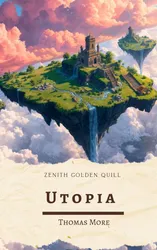
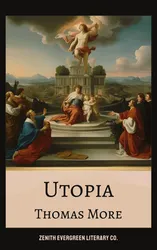
Utopia

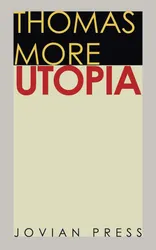
De Optimo Republicae Statu deque Nova Insula Utopia (translated On the Best State of a Republic and on the New Island of Utopia) or more simply Utopia is a 1516 book by Sir (Saint) Thomas More.

The book, written in Latin, is a frame narrative primarily depicting a fictional island society and its religious, social and political customs. The name of the place is derived from the Greek words οὐ u ("not") and τόπος tópos ("place"), with the topographical suffix -εία eía, hence Οὐτοπεία outopeía (Latinized as Utopia), “no-place land.” It also contains a pun, however, because “Utopia” could also be the Latinization of Εὐτοπεία eutopeía, “good-place land,” which uses the Greek prefix ευ eu, “good,” instead of οὐ. One interpretation holds that this suggests that while Utopia might be some sort of perfected society, it is ultimately unreachable. Despite modern connotations of the word "utopia," it is widely accepted that the society More describes in this work was not actually his own "perfect society." Rather he wished to use the contrast between the imaginary land's unusual political ideas and the chaotic politics of his own day as a platform from which to discuss social issues in Europe.

Über dieses Buch

De Optimo Republicae Statu deque Nova Insula Utopia (translated On the Best State of a Republic and on the New Island of Utopia) or more simply Utopia is a 1516 book by Sir (Saint) Thomas More.

The book, written in Latin, is a frame narrative primarily depicting a fictional island society and its religious, social and political customs. The name of the place is derived from the Greek words οὐ u ("not") and τόπος tópos ("place"), with the topographical suffix -εία eía, hence Οὐτοπεία outopeía (Latinized as Utopia), “no-place land.” It also contains a pun, however, because “Utopia” could also be the Latinization of Εὐτοπεία eutopeía, “good-place land,” which uses the Greek prefix ευ eu, “good,” instead of οὐ. One interpretation holds that this suggests that while Utopia might be some sort of perfected society, it is ultimately unreachable. Despite modern connotations of the word "utopia," it is widely accepted that the society More describes in this work was not actually his own "perfect society." Rather he wished to use the contrast between the imaginary land's unusual political ideas and the chaotic politics of his own day as a platform from which to discuss social issues in Europe.
Starte noch heute mit diesem Buch für 0 €

  • Hole dir während der Testphase vollen Zugriff auf alle Bücher in der App
  • Keine Verpflichtungen, jederzeit kündbar
Jetzt kostenlos testen
Mehr als 52 000 Menschen haben Nextory im App Store und auf Google Play 5 Sterne gegeben.

  1. 33 Human Science Masterpieces You Must Read Before You Die. Illustrated : The Art of Public Speaking, The Meditations, The Kama Sutra and other masterpieces

    Edwin A. Abbott, Aristotle, Dale Carnegie, Gilbert Chesterton, René Descartes, Epictetus, Marcus Aurelius Antoninus, Sigmund Freud, Hermann Hesse, David Hume, Lao Tzu, Confucius, Swami Abhedananda, Anonimous, David Herbert Lawrence, Niccolò Machiavelli, Benedictus de Spinoza, John Mill, Prentice Mulford, Thomas More, Friedrich Nietzsche, J. Allanson Picton, Plato, Sun Tzu, Vatsyayana, Voltaire, H.G. Wells, Frances Bacon

  2. 33 Masterpieces of Philosophy and Science to Read Before You Die (Illustrated) : Utopia, The Meditations, The Art of War, The Kama Sutra, Candide

    Thomas More, Marcus Aurelius Antoninus, Sun Tzu, Vatsyayana, Voltaire, Edwin A. Abbott, Aristotle, Dale Carnegie, Gilbert Keith Chesterton, René Descartes, Epictetus, Sigmund Freud, Hermann Hesse, David Hume, Lao Tzu, David Herbert Lawrence, Niccolò Machiavelli, John Mill, Prentice Mulford, Friedrich Nietzsche, Plato, Bertrand Russell, H.G. Wells, Frances Bacon

  3. 3.3

    Utopia

    Thomas More

  4. Utopia

    Thomas More

  5. 3.0

    Utopia

    Thomas More

  6. Utopia : A Visionary Blueprint for Ideal Society

    Thomas More

  7. 1800 Citations de philosophes

    Aristote, Épicure, Platon, Thalès de Milet, – Socrate, Protagoras, Anaximandre, Épictète, Héraclite, Marc Aurèle, René Descartes, Michel de Montaigne, Alexis de Tocqueville, Voltaire, Charles De Montesquieu, Jean-Jacques Rousseau, Emmanuel Kant, Hannah Arendt, Gottfried Wilhelm Leibniz, Georg Wilhelm Friedrich Hegel, Friedrich Nietzsche, Arthur Schopenhauer, David Hume, John Locke, Francis Bacon, Thomas Hobbes, Thomas More, Confucius, Érasme, Lao Tseu, Baruch Spinoza, Søren Kierkegaard, Nicolas Machiavel, Thomas d'Aquin, Henry David Thoreau

  8. Comprendre Thomas More

    Thomas More

  9. 50 citations de Thomas More

    Thomas More

  10. 250 citations de philosophes anglais

    David Hume, John Locke, Francis Bacon, Thomas Hobbes, Thomas More

  11. Utopia : Thomas More's Visionary Blueprint for an Ideal Society

    Thomas More

  12. Utopia : The Original Blueprint for Ideal Society and Political Philosophy

    Thomas More