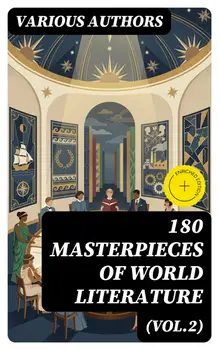





180 Masterpieces of World Literature (Vol. 2) assembles an ambitious transnational canon, tracing literature's enduring concerns with love, power, faith, social injustice, exploration, crime, memory, and the formation of the self. Its range is striking: epic and philosophical reflection stand beside Gothic sensation, realist social observation, romance, satire, adventure, detective fiction, drama, and modernist experimentation. The volume's most compelling juxtapositions emerge where mythic imagination meets psychological depth and where intimate domestic narratives illuminate vast historical change. The contributors span classical antiquity, East Asian intellectual traditions, the European Enlightenment and Romanticism, nineteenth-century realism and naturalism, colonial and postcolonial encounter, and early twentieth-century modernism. Philosophers, poets, dramatists, and novelists from Europe, Asia, and the Americas bring distinct cultural inheritances to shared questions of morality, authority, desire, and social responsibility. Collectively, these voices reveal world literature not as a fixed hierarchy but as an evolving conversation among forms, languages, and historical experiences. This volume is especially recommended for readers seeking both breadth and serious literary encounter in a single book. It offers an educational gateway to major traditions while inviting comparison across genres and eras. Read consecutively or selectively, the collection rewards attention to the productive dialogue—sometimes harmonious, sometimes unsettling—among its many perspectives.
This enriched edition has been carefully crafted to add value to your reading experience.
- An Introduction draws the threads together, discussing why these diverse authors and texts belong in one collection.
- Historical Context explores the cultural and intellectual currents that shaped these works, offering insight into the shared (or contrasting) eras that influenced each writer.
- A combined Synopsis (Selection) briefly outlines the key plots or arguments of the included pieces, helping readers grasp the anthology's overall scope without giving away essential twists.
- A collective Analysis highlights common themes, stylistic variations, and significant crossovers in tone and technique, tying together writers from different backgrounds.
- Reflection questions encourage readers to compare the different voices and perspectives within the collection, fostering a richer understanding of the overarching conversation.