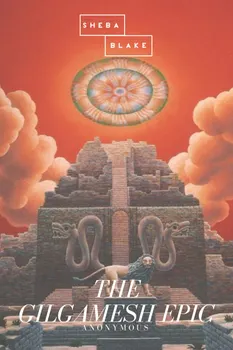
The Gilgamesh Epic

The Gilgamesh Epic is an epic poem from ancient Mesopotamia that is often regarded as the earliest surviving great work of literature. The literary history of Gilgamesh begins with five Sumerian poems about 'Bilgamesh' (Sumerian for 'Gilgamesh'), king of Uruk, dating from the Third Dynasty of Ur (circa 2100 BC). These independent stories were later used as source material for a combined epic. The first surviving version of this combined epic, known as the "Old Babylonian" version, dates to the 18th century BC and is titled after its incipit, Shūtur eli sharrī ("Surpassing All Other Kings"). Only a few tablets of it have survived. The later "Standard" version dates from the 13th to the 10th centuries BC and bears the incipit Sha naqba īmuru ("He who Saw the Deep", in modern terms: "He who Sees the Unknown"). Approximately two thirds of this longer, twelve-tablet version have been recovered. Some of the best copies were discovered in the library ruins of the 7th-century BC Assyrian king Ashurbanipal. The first half of the story discusses Gilgamesh, king of Uruk, and Enkidu, a wild man created by the gods to stop Gilgamesh from oppressing the people of Uruk. After an initial fight, Gilgamesh and Enkidu become close friends. Together, they journey to the Cedar Mountain and defeat Humbaba, its monstrous guardian. Later they kill the Bull of Heaven, which the goddess Ishtar sends to punish Gilgamesh for spurning her advances. As a punishment for these actions, the gods sentence Enkidu to death. In the second half of the epic, distress about Enkidu's death causes Gilgamesh to undertake a long and perilous journey to discover the secret of eternal life. He eventually learns that "Life, which you look for, you will never find. For when the gods created man, they let death be his share, and life withheld in their own hands".

Over dit boek

The Gilgamesh Epic is an epic poem from ancient Mesopotamia that is often regarded as the earliest surviving great work of literature. The literary history of Gilgamesh begins with five Sumerian poems about 'Bilgamesh' (Sumerian for 'Gilgamesh'), king of Uruk, dating from the Third Dynasty of Ur (circa 2100 BC). These independent stories were later used as source material for a combined epic. The first surviving version of this combined epic, known as the "Old Babylonian" version, dates to the 18th century BC and is titled after its incipit, Shūtur eli sharrī ("Surpassing All Other Kings"). Only a few tablets of it have survived. The later "Standard" version dates from the 13th to the 10th centuries BC and bears the incipit Sha naqba īmuru ("He who Saw the Deep", in modern terms: "He who Sees the Unknown"). Approximately two thirds of this longer, twelve-tablet version have been recovered. Some of the best copies were discovered in the library ruins of the 7th-century BC Assyrian king Ashurbanipal. The first half of the story discusses Gilgamesh, king of Uruk, and Enkidu, a wild man created by the gods to stop Gilgamesh from oppressing the people of Uruk. After an initial fight, Gilgamesh and Enkidu become close friends. Together, they journey to the Cedar Mountain and defeat Humbaba, its monstrous guardian. Later they kill the Bull of Heaven, which the goddess Ishtar sends to punish Gilgamesh for spurning her advances. As a punishment for these actions, the gods sentence Enkidu to death. In the second half of the epic, distress about Enkidu's death causes Gilgamesh to undertake a long and perilous journey to discover the secret of eternal life. He eventually learns that "Life, which you look for, you will never find. For when the gods created man, they let death be his share, and life withheld in their own hands".

Begin vandaag nog met dit boek voor € 0

  • Krijg volledige toegang tot alle boeken in de app tijdens de proefperiode
  • Geen verplichtingen, op elk moment annuleren
Probeer nu gratis
Meer dan 52.000 mensen hebben Nextory 5 sterren gegeven in de App store en op Google Play.

  1. The Rig Veda

    Anonymous

  2. 1.0

    The Holy Bible — Volume I: The Old Testament - Audiobook

    Anonymous, Classic Audiobooks

  3. Pistis Sophia (The Message of Resurrected Jesus)

    Anonymous

  4. Sommige omslagen zie je alleen als je bent ingelogd
    2.0

    The Romance of Lust: A Classic Victorian erotic novel

    Anonymous

  5. Russian Fairy Tales: A Choice Collection of Muscovite Folk-lore : Enriched edition. Enchanting Muscovite Folklore of Magic, Morality, and Old Russia

    Anonymous

  6. One Thousand and One Nights : Complete tales of 1001 Arabian Nights in One volume. Illustrated

    Anonymous

  7. Pistis Sophia (The Message of Resurrected Jesus)

    Anonymous

  8. Pistis Sophia : The Teachings of Resurrected Jesus

    Anonymous

  9. Mahanirvana Tantra : Tantra of the Great Liberation

    Anonymous

  10. 5.0
    #40

    Harvard Classics Volume 40 : English Poetry 1: Chaucer To Gray

    Geoffrey Chaucer, Golden Deer Classics, Anonymous, Thomas Wyatt, Henry Howard, George Gascoigne, Edward Dyer, John Lyly, Thomas Lodge, George Peele, Robert Southwell, Samuel Daniel, Michael Drayton, Henry Constable, Edmund Spenser, William Habington, Christopher Marlowe, Richard Rowlands, Thomas Nashe, William Shakespeare, Robert Greene, Richard Barnfield, Thomas Campion, Robert Devereux, Henry Wotton, Edward de Vere, Ben Jonson, John Donne, Joshua Sylvester, William Alexander, Richard Corbet, Thomas Heywood, Thomas Dekker, Francis Beaumont, John Fletcher, John Webster, William Drummond, George Wither, William Browne, Robert Herrick, Francis Quarles, George Herbert, Henry Vaughan, Francis Bacon, James Shirley, Thomas Carew, John Suckling, William D'Avenant, Richard Lovelace, Edmund Waller, William Cartwright, James Graham, Richard Crashaw, Thomas Jordan, Abraham Cowley, Alexander Brome, Andrew Marvell, Earl of Rochester, Charles Sedley, John Dryden, Matthew Prior, Isaac Watts, Lady Grisel Baillie, Joseph Addison, Allan Ramsay, John Gay, Henry Carey, Alexander Pope, Ambrose Philips, Colley Cibber, James Thomson, Thomas Gray, George Bubb Dodington

  11. The Book of Wisdom : From The Holy Bible

    Anonymous

  12. The Book of Enoch

    Anonymous