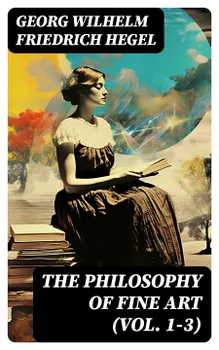
The Philosophy of Fine Art (Vol. 1-3) : Complete Edition

Georg Wilhelm Friedrich Hegel's seminal work, "The Philosophy of Fine Art" (Volumes 1-3), offers a profound exploration of the interplay between art, culture, and philosophy. Hegel employs a dialectical method to analyze the evolution of artistic expression, asserting that art serves as a manifestation of the Absolute Spirit. Through detailed examinations of various art forms—visual arts, music, and literature—Hegel delves into their aesthetic qualities while situating them within historical contexts. His dense yet poetic prose invites readers to reflect on the nature of beauty and the role of the artist in society, ultimately positing that art reveals the underlying rationality of the world itself. Hegel, a pivotal figure in German Idealism, draws on his background in philosophy, history, and aesthetics to enrich his arguments. His engagement with contemporary thinkers and the socio-political landscape of 19th-century Europe profoundly influenced his reflections on art. Hegel's belief in the power of human creativity is underscored by his conviction that art not only reflects but also shapes human consciousness, making it a vital element of cultural development. This remarkable scholarly work is essential for those seeking to comprehend the complexities of art through a philosophical lens. It appeals to art historians, philosophers, and anyone fascinated by the intersections of creativity and intellectual thought. Hegel's insights invite readers to reconsider their understanding of art's role in cultivating the human experience.
Over dit boek

Georg Wilhelm Friedrich Hegel's seminal work, "The Philosophy of Fine Art" (Volumes 1-3), offers a profound exploration of the interplay between art, culture, and philosophy. Hegel employs a dialectical method to analyze the evolution of artistic expression, asserting that art serves as a manifestation of the Absolute Spirit. Through detailed examinations of various art forms—visual arts, music, and literature—Hegel delves into their aesthetic qualities while situating them within historical contexts. His dense yet poetic prose invites readers to reflect on the nature of beauty and the role of the artist in society, ultimately positing that art reveals the underlying rationality of the world itself. Hegel, a pivotal figure in German Idealism, draws on his background in philosophy, history, and aesthetics to enrich his arguments. His engagement with contemporary thinkers and the socio-political landscape of 19th-century Europe profoundly influenced his reflections on art. Hegel's belief in the power of human creativity is underscored by his conviction that art not only reflects but also shapes human consciousness, making it a vital element of cultural development. This remarkable scholarly work is essential for those seeking to comprehend the complexities of art through a philosophical lens. It appeals to art historians, philosophers, and anyone fascinated by the intersections of creativity and intellectual thought. Hegel's insights invite readers to reconsider their understanding of art's role in cultivating the human experience.

Begin vandaag nog met dit boek voor € 0

  • Krijg volledige toegang tot alle boeken in de app tijdens de proefperiode
  • Geen verplichtingen, op elk moment annuleren
Probeer nu gratis
Meer dan 52.000 mensen hebben Nextory 5 sterren gegeven in de App store en op Google Play.

  1. Fenomenología del espíritu

    Georg Wilhelm Friedrich Hegel

  2. 2.0

    50 citations de Hegel

    Georg Wilhelm Friedrich Hegel

  3. 1800 Citations de philosophes

    Aristote, Épicure, Platon, Thalès de Milet, – Socrate, Protagoras, Anaximandre, Épictète, Héraclite, Marc Aurèle, René Descartes, Michel de Montaigne, Alexis de Tocqueville, Voltaire, Charles De Montesquieu, Jean-Jacques Rousseau, Emmanuel Kant, Hannah Arendt, Gottfried Wilhelm Leibniz, Georg Wilhelm Friedrich Hegel, Friedrich Nietzsche, Arthur Schopenhauer, David Hume, John Locke, Francis Bacon, Thomas Hobbes, Thomas More, Confucius, Érasme, Lao Tseu, Baruch Spinoza, Søren Kierkegaard, Nicolas Machiavel, Thomas d'Aquin, Henry David Thoreau

  4. 300 citations de philosophes allemands

    Emmanuel Kant, Hannah Arendt, Gottfried Wilhelm Leibniz, Georg Wilhelm Friedrich Hegel, Friedrich Nietzsche, Arthur Schopenhauer

  5. 4.0

    Comprendre Hegel

    Georg Wilhelm Friedrich Hegel

  6. Líneas fundamentales de la filosofía del derecho : o compendio de derecho natural y ciencia del Estado

    Georg Wilhelm Friedrich Hegel

  7. Hegel: Lectures on Philosophy : Enriched edition. The Philosophy of History, The History of Philosophy, The Proofs of the Existence of God

    Georg Wilhelm Friedrich Hegel

  8. The Collected Works of Georg Wilhelm Friedrich Hegel : Enriched edition.

    Georg Wilhelm Friedrich Hegel

  9. Hegel's Phenomenology of Mind : System of Science

    Georg Wilhelm Friedrich Hegel

  10. Hegel - Premium Collection : The Science of Logic, The Philosophy of Mind, The Philosophy of Right, The Philosophy of Law…

    Georg Wilhelm Friedrich Hegel

  11. The Essential Works of Georg Wilhelm Friedrich Hegel : Phenomenology of Mind, Philosophy of Mind, Aesthetics, The Criticism of Hegle's Work…

    Georg Wilhelm Friedrich Hegel

  12. Hegel's Phenomenology of Mind : System of Science

    Georg Wilhelm Friedrich Hegel