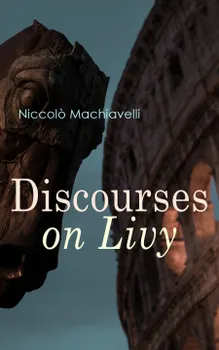
Discourses on Livy

Machiavelli saw history in general as a way to learn useful lessons from the past for the present, and also as a type of analysis which could be built upon, as long as each generation did not forget the works of the past. In "Discourses on Livy" Machiavelli discusses what can be learned from roman period and many other eras as well, including the politics of his lifetime. This is a work of political history and philosophy written in the early 16th. The title identifies the work's subject as the first ten books of Livy's Ab urbe condita, which relate the expansion of Rome through the end of the Third Samnite War in 293 BC.

Niccolò di Bernardo dei Machiavelli (1469 – 1527) was an Italian diplomat, politician, historian, philosopher, humanist, and writer. He has often been called the father of modern political science. He was for many years a senior official in the Florentine Republic, with responsibilities in diplomatic and military affairs. He served as a secretary to the Second Chancery of the Republic of Florence from 1498 to 1512, when the Medici were out of power.He wrote his most well-known work The Prince in 1513, having been exiled from city affairs.

Über dieses Buch

Machiavelli saw history in general as a way to learn useful lessons from the past for the present, and also as a type of analysis which could be built upon, as long as each generation did not forget the works of the past. In "Discourses on Livy" Machiavelli discusses what can be learned from roman period and many other eras as well, including the politics of his lifetime. This is a work of political history and philosophy written in the early 16th. The title identifies the work's subject as the first ten books of Livy's Ab urbe condita, which relate the expansion of Rome through the end of the Third Samnite War in 293 BC.

Niccolò di Bernardo dei Machiavelli (1469 – 1527) was an Italian diplomat, politician, historian, philosopher, humanist, and writer. He has often been called the father of modern political science. He was for many years a senior official in the Florentine Republic, with responsibilities in diplomatic and military affairs. He served as a secretary to the Second Chancery of the Republic of Florence from 1498 to 1512, when the Medici were out of power.He wrote his most well-known work The Prince in 1513, having been exiled from city affairs.

Starte noch heute mit diesem Buch für 0 €

  • Hole dir während der Testphase vollen Zugriff auf alle Bücher in der App
  • Keine Verpflichtungen, jederzeit kündbar
Jetzt kostenlos testen
Mehr als 52 000 Menschen haben Nextory im App Store und auf Google Play 5 Sterne gegeben.

  1. 50 Meisterwerke der Philosophie : Metaphysik, Das Gastmahl, Bhagavadgita, Tractatus logico-philosophicus, Kritik der reinen Vernunft, Also sprach Zarathustra, Selbstbetrachtungen von Marcus Aurelius

    Ludwig Wittgenstein, Edmund Husserl, Karl Marx, Søren Kierkegaard, Friedrich Nietzsche, Ralph Waldo Emerson, John Stuart Mill, Georg Wilhelm Friedrich Hegel, Friedrich Schelling, Johann Gottlieb Fichte, Immanuel Kant, John Locke, Montesquieu, Jean-Jacques Rousseau, David Hume, Gottfried Wilhelm Leibniz, Baruch Spinoza, - Konfuzius, Lao Tse, Platon, Xenophon, - Aristoteles, Marcus Tullius Cicero, Seneca, Epiktet, Marc Aurel, Plotin, Thomas von Aquin, Nicolaus von Cues, - Erasmus von Rotterdam, Niccolò Machiavelli, Tommaso Campanella, Martin Luther, Giordano Bruno, Samuel von Pufendorf, Abbé Castel de Saint-Pierre, Michel de Montaigne, René Descartes, Francis Bacon, Blaise Pascal

  2. Essenzielle Klassiker der politischen Philosophie : Der Staat, Der Gesellschaftsvertrag, Der Fürst, Utopia, Manifest der Kommunistischen Partei, Geschichte der Socialdemokratie

    Niccolò Machiavelli, Montesquieu, Friedrich der Große, Platon, - Aristoteles, Marcus Tullius Cicero, Tommaso Campanella, Thomas Morus, Samuel von Pufendorf, Abbé Castel de Saint-Pierre, Jean-Jacques Rousseau, Immanuel Kant, Johann Gottlieb Fichte, Karl Marx, Friedrich Engels, Wilhelm von Humboldt, Friedrich Christoph Dahlmann, Franz Mehring, Johann Most, John Henry Mackay, Rosa Luxemburg, Erich Mühsam

  3. 3.9

    Niccolò Machiavelli: The Prince : A philosophical treatise on the gaining and keeping of power

    Niccolò Machiavelli

  4. 33 Human Science Masterpieces You Must Read Before You Die. Illustrated : The Art of Public Speaking, The Meditations, The Kama Sutra and other masterpieces

    Edwin A. Abbott, Aristotle, Dale Carnegie, Gilbert Chesterton, René Descartes, Epictetus, Marcus Aurelius Antoninus, Sigmund Freud, Hermann Hesse, David Hume, Lao Tzu, Confucius, Swami Abhedananda, Anonimous, David Herbert Lawrence, Niccolò Machiavelli, Benedictus de Spinoza, John Mill, Prentice Mulford, Thomas More, Friedrich Nietzsche, J. Allanson Picton, Plato, Sun Tzu, Vatsyayana, Voltaire, H.G. Wells, Frances Bacon

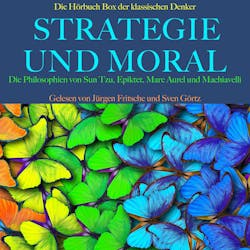
  5. Strategie und Moral: Die Hörbuch Box der klassischen Denker : Die Philosophien von Sun Tzu, Epiktet, Marc Aurel und Machiavelli

    Sun Tzu, Epiktet, Marc Aurel, Niccolò Machiavelli

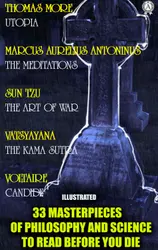
  6. 33 Masterpieces of Philosophy and Science to Read Before You Die (Illustrated) : Utopia, The Meditations, The Art of War, The Kama Sutra, Candide

    Thomas More, Marcus Aurelius Antoninus, Sun Tzu, Vatsyayana, Voltaire, Edwin A. Abbott, Aristotle, Dale Carnegie, Gilbert Keith Chesterton, René Descartes, Epictetus, Sigmund Freud, Hermann Hesse, David Hume, Lao Tzu, David Herbert Lawrence, Niccolò Machiavelli, John Mill, Prentice Mulford, Friedrich Nietzsche, Plato, Bertrand Russell, H.G. Wells, Frances Bacon

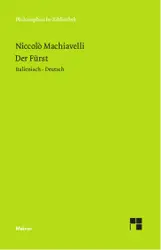
  7. Der Fürst : Zweisprachige Ausgabe

    Niccolò Machiavelli

  8. 4.6

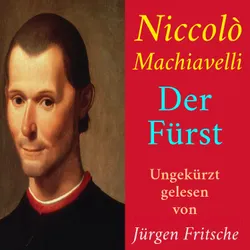
    Niccolò Machiavelli: Der Fürst : Ungekürzte Lesung

    Niccolò Machiavelli

  9. 4.0

    Der Fürst

    Niccolò Machiavelli

  10. Die Discorsi: Das Wesen einer starken Republik : Gedanken zur Politik, zum Krieg und zur politischen Führung (Politische Betrachtungen über die alte und die italienische Geschichte)

    Niccolò Machiavelli

  11. Neu

    The Prince : A guide to understanding power. With detailed chapter-by-chapter insights.

    Niccolò Machiavelli

  12. 3.1

    The Prince

    Niccolò Machiavelli