Living Space : Infinite Earths, Infinite Possibilities—And One Fatal Flaw

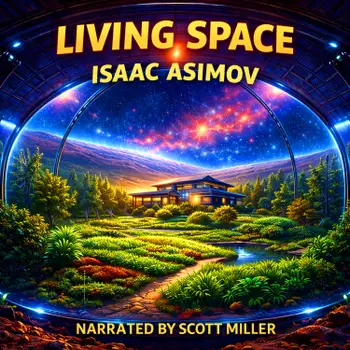
Humanity has solved overpopulation at last. Instead of crowding together, families now live in perfect isolation, each on their own version of Earth—vast, silent, and seemingly lifeless. In Living Space, that elegant solution is taken for granted, until a single disturbance raises an impossible question: what if the system isn’t as flawless as everyone believes?

Isaac Asimov builds a calm, orderly future and then quietly introduces doubt. The story unfolds with methodical precision, blending domestic normalcy with mounting unease. Beneath the comfort of advanced technology lies a deeper tension—about ownership, entitlement, and the dangers of assuming humanity is always alone. What begins as a bureaucratic inconvenience grows into something far more unsettling, forcing characters to confront the limits of logic in an infinite universe.

This is classic Asimov: clear-eyed, idea-driven, and relentlessly thoughtful. Living Space doesn’t rely on spectacle or action, but on the slow realization that even perfect systems carry hidden risks. It’s a story about unintended consequences, cultural blind spots, and how small anomalies can expose vast truths.

Isaac Asimov was one of the most influential science fiction writers of the twentieth century, known for combining scientific rigor with sharp social insight. Across hundreds of stories and essays, he explored how human institutions respond to technology, power, and change. Living Space reflects his talent for turning abstract concepts into intimate, unsettling human drama—proof that the biggest dangers often arrive quietly.
Über dieses Buch

Humanity has solved overpopulation at last. Instead of crowding together, families now live in perfect isolation, each on their own version of Earth—vast, silent, and seemingly lifeless. In Living Space, that elegant solution is taken for granted, until a single disturbance raises an impossible question: what if the system isn’t as flawless as everyone believes?

Isaac Asimov builds a calm, orderly future and then quietly introduces doubt. The story unfolds with methodical precision, blending domestic normalcy with mounting unease. Beneath the comfort of advanced technology lies a deeper tension—about ownership, entitlement, and the dangers of assuming humanity is always alone. What begins as a bureaucratic inconvenience grows into something far more unsettling, forcing characters to confront the limits of logic in an infinite universe.

This is classic Asimov: clear-eyed, idea-driven, and relentlessly thoughtful. Living Space doesn’t rely on spectacle or action, but on the slow realization that even perfect systems carry hidden risks. It’s a story about unintended consequences, cultural blind spots, and how small anomalies can expose vast truths.

Isaac Asimov was one of the most influential science fiction writers of the twentieth century, known for combining scientific rigor with sharp social insight. Across hundreds of stories and essays, he explored how human institutions respond to technology, power, and change. Living Space reflects his talent for turning abstract concepts into intimate, unsettling human drama—proof that the biggest dangers often arrive quietly.
Starte noch heute mit diesem Buch für 0 €

  • Hole dir während der Testphase vollen Zugriff auf alle Bücher in der App
  • Keine Verpflichtungen, jederzeit kündbar
Jetzt kostenlos testen
Mehr als 52 000 Menschen haben Nextory im App Store und auf Google Play 5 Sterne gegeben.

  1. 1950s Science Fiction 8 - 29 Classic Science Fiction Short Stories from the 1950s

    Robert Silverberg, Isaac Asimov, Ray Bradbury, Frank Herbert, lord Dunsany, Walter M. Jr., Bryce Walton, Mike Curry, Edward W. Ludwig, Charles Einstein, Miguel Hidalgo, Dean Evans, Robert Sheckley, Charles E. Fritch, William Oberfield, Frank M. Robinson, Evelyn E. Smith, C. M. Kornbluth, Lynn Venable, Fritz Leiber, Alfred Bester, Donald E. Westlake, J. F. Bone, Roger D. Aycock, Joseph Slotkin, David Mason

  2. Vintage Sci-Fi 7 - 19 Classic Science Fiction Short Stories from Philip K. Dick, Isaac Asimov, Arthur C. Clarke, H. G. Wells and many more

    Lester del Rey, Algis Budrys, Fredric Brown, Frederik Pohl, Robert Sheckley, Isaac Asimov, Poul Anderson, Edward W. Ludwig, Philip K Dick, Harry Harrison, Clifford D. Simak, Arthur C. Clarke, H.G. Wells, I. M. Bukstein, Jack Vance, Fritz Leiber

  3. 5.0
    #133

    Christmas on Ganymede

    Isaac Asimov

  4. The Selected Short Stories of Isaac Asimov : Let's Get Together, The Magnificent Possession and Youth

    Isaac Asimov

  5. 4.4

    The Robots of Dawn

    Isaac Asimov

  6. 4.3
    #2

    Foundation and Empire

    Isaac Asimov

  7. 4.0

    I, Robot

    Isaac Asimov

  8. 4.1
    #1

    Foundation

    Isaac Asimov

  9. 4.3

    Worlds Within Worlds - The Story of Nuclear Energy

    Isaac Asimov

  10. Neu

    Vintage Sci-Fi 16 - 22 Classic Science Fiction Short Stories from Philip K. Dick, Isaac Asimov, Harlan Ellison, Arthur C. Clarke, Ray Bradbury, Harry Harrison and more : Chronicles of Tomorrow: Voices That Shaped Science Fiction

    Philip K Dick, Arthur C. Clarke, Harlan Ellison, Ray Bradbury, Harry Harrison, Isaac Asimov, Clifford D. Simak, J. F. Bone, Alan E. Nourse, H.P. Lovecraft, Dick Purcell, Murray Leinster, Hugh B. Cave, Frank Lillie Pollock, Charles E. Fritch, Don Mark Lemon, Kenneth Sterling, Ron Cocking

  11. Neu

    Nebula Award Winning Authors - 22 Science Fiction Classics by Arthur C. Clarke, Robert Silverberg, Clifford D. Simak, Nelson S. Bond, Jack Vance and more : Classic Science Fiction By Nebula Award-Winning Science Fiction Authors

    Arthur C. Clarke, Isaac Asimov, Fritz Leiber, Clifford D. Simak, Robert Silverberg, Gordon R. Dickson, Nelson S. Bond, Theodore Sturgeon, Katherine MacLean, Randall Garrett, Jack Vance

  12. Neu

    Nebula Award Winning Authors 2 : 18 Classic Science Fiction Stories by the Writers Who Earned the Nebula Award

    Theodore Sturgeon, Robert Silverberg, Isaac Asimov, Brian W. Aldiss, Nelson S. Bond, Harlan Ellison, Fritz Leiber, Clifford D. Simak, Poul Anderson