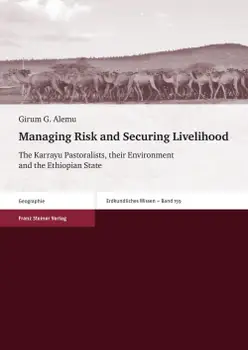
The hegemonic perspective on adaptation solely focuses on climate stimuli as the driving force behind people's adaptation. Such a perspective underestimates the role played by historical trajectories of political and social forces of change in shaping current adaptation practices. In doing so, it also separates the environment from processes of social change. This work challenges this dominant view by arguing that adaptation practices pursued by pastoral communities need to be seen at the intersection of state-environment-pastoralists-interactions. In other words, the understanding of pastoralists' risk management and livelihood practices requires a perspective that situates local actors into their broader socio-political and environmental contexts. By using a political ecology approach that emphasizes on the agency of pastoral actors, this work demonstrates how the Karrayyu pastoral groups of upper Awash valley develop and use various risk management and livelihood practices under the influence of both socio-political and ecological sources of change.
Starte noch heute mit diesem Buch für 0 €
- Hole dir während der Testphase vollen Zugriff auf alle Bücher in der App
- Keine Verpflichtungen, jederzeit kündbar
Autor*in:
Reihe:
Band 159 in Erdkundliches WissenSprache:
Englisch
Format:
Living Translocality : Space, Culture and Economy in Contemporary Swahili Trade
Performing Politics, Making Space : A Visual Ethnography of Political Change in Ecuador
Living with floods : Social practices and transformations of flood management in Chiapas, Mexico
Identity, Commodification and Revolution : Tourism and the Transformation of Society, Politics and Space in Cuba
Reframing Restoration : Rwanda Re-photographed 100 Years Later or the Reconstruction of Landscape Memory