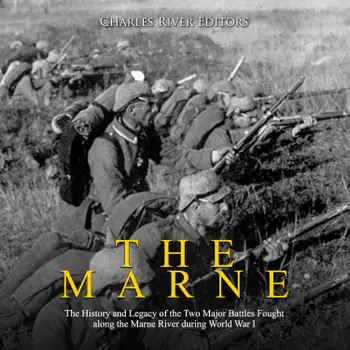
The Marne: The History and Legacy of the Two Major Battles Fought along the Marne River during World War I

If trench warfare was an inevitability during the war, it is only because the events leading up to the First Battle of the Marne were quite different. The armies at the beginning of the war moved quickly through the land, but the First Battle of the Marne devolved into a bloody pitched battle that led to the construction of trenches after the Germans retreated, blocked in their pursuit of Paris. When the aftermath disintegrated into a war between trenches, some Germans thought they had the upper hand since they were occupying French territory, but with fewer soldiers than the combined Allied nations and fewer resources and supplies, it was possibly only a matter of time before they were ultimately defeated. The commander of the German armies, General Helmuth von Moltke, allegedly said to Kaiser Wilhelm II immediately after the First Battle of the Marne, "Your Majesty, we have lost the war." Winston Churchill himself would later reference that anecdote, writing, “Whether General von Moltke actually said to the Emperor, ‘Majesty, we have lost the war,’ we do not know. We know anyhow that with a prescience greater in political than in military affairs, he wrote to his wife on the night of the 9th, ‘Things have not gone well. The fighting east of Paris has not gone in our favour, and we shall have to pay for the damage we have done.’"

When the United States joined the war in April 1917, it began mobilizing 4 million soldiers to join the war. The Central Powers knew that it would take months before the United States could land a substantial number of troops in Europe to join the fighting, and the Germans hoped to force the Allied powers to quit before the United States could make a difference. Thus, the Germans’ Spring Offensive began in March 1918, using new infantry tactics to move on the most lightly defended points of the Allied trenches.


Starte noch heute mit diesem Buch für 0 €

  • Hole dir während der Testphase vollen Zugriff auf alle Bücher in der App
  • Keine Verpflichtungen, jederzeit kündbar
Jetzt kostenlos testen
Mehr als 52 000 Menschen haben Nextory im App Store und auf Google Play 5 Sterne gegeben.

  1. Neu
    3.5

    Sigmund Freud and Carl Jung: The Pioneering Lives and Works of History’s Most Influential Psychologists

    Charles River Editors

  2. Neu
    3.8

    Hans-Ulrich Rudel: The Life and Legacy of the Luftwaffe’s Deadliest Stuka Pilot

    Charles River Editors

  3. Neu

    World War II in the Arctic: The History of the Aleutian Islands Campaign and Nazi Germany’s Arctic Invasion of the Soviet Union

    Charles River Editors

  4. Neu

    The Assassinated Presidents: The Lives and Deaths of Abraham Lincoln, James Garfield, William McKinley, and John F. Kennedy

    Charles River Editors

  5. Neu

    Das mittelalterliche Russland: Die Geschichte und das Erbe der Gruppen, die den russischen Staat im Mittelalter entwickelten

    Charles River Editors

  6. Neu

    The Biggest Tank Battles of the World Wars: Tank Warfare in History’s Deadliest Conflicts

    Charles River Editors

  7. Neu

    The Disappearance of the USS Thresher: The History of the American Nuclear Submarine that Sank at the Height of the Cold War

    Charles River Editors

  8. Neu

    Die Panzer: Die Geschichte und das Vermächtnis von Nazideutschlands berühmtesten Panzern des Zweiten Weltkriegs

    Charles River Editors

  9. Neu

    Winston Churchill’s Great Escapes: The Story of the British Bulldog’s Death-Defying Life Before He Became Prime Minister

    Charles River Editors

  10. Neu
    4.0

    The Islamic Empires of India: The History of the Muslim Dynasties that Ruled India Before the British

    Charles River Editors

  11. Neu

    The Modernization of American Guns: The History of the Gunsmiths and Weapons that Revolutionized the Country’s Firearms

    Charles River Editors

  12. Neu

    The Legends of the West Point Class of 1846

    Charles River Editors