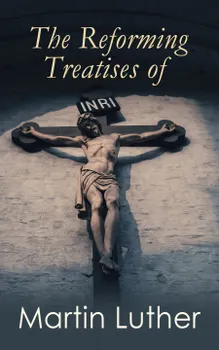
The Reforming Treatises of Martin Luther : Three 1520 Tracts on Church Reform: Priesthood of Believers, Sacraments Reformed, and Christian Liberty by Faith

"Address to the Christian Nobility of the German Nation" is the first of the three tracts written by Martin Luther in 1520. In this work, he defined for the first time the signature doctrines of the priesthood of all believers and the two kingdoms. After the church made a strong attempt at drawing distinct lines on saying who had authority in the spiritual sphere and its matters. This division of Christians into spheres motivated Luther to write on the "three walls" the "Romanists" created to protect themselves from reform.

"Prelude on the Babylonian Captivity of the Church" is a theological treatise, the second of the three major tracts from 1520. In this work Luther examines the seven sacraments of the Catholic Church in the light of his interpretation of the Bible. With regard to the Eucharist, he advocates restoring the cup to the laity, dismisses the Catholic doctrine of Transubstantiation but affirms the real presence of the body and blood of Christ in the Eucharist, and rejects the teaching that the Mass is a sacrifice offered to God.

"A Treatise on Christian Liberty" is the third of Luther's major reforming treatises of 1520. It developed the concept that as fully forgiven children of God, Christians are no longer compelled to keep God's law; however, they freely and willingly serve God and their neighbors. Luther also further develops the concept of justification by faith. In the treatise, Luther stated, "A Christian is a perfectly free lord of all, subject to none. A Christian is a perfectly dutiful servant of all, subject to all."

Über dieses Buch

"Address to the Christian Nobility of the German Nation" is the first of the three tracts written by Martin Luther in 1520. In this work, he defined for the first time the signature doctrines of the priesthood of all believers and the two kingdoms. After the church made a strong attempt at drawing distinct lines on saying who had authority in the spiritual sphere and its matters. This division of Christians into spheres motivated Luther to write on the "three walls" the "Romanists" created to protect themselves from reform.

"Prelude on the Babylonian Captivity of the Church" is a theological treatise, the second of the three major tracts from 1520. In this work Luther examines the seven sacraments of the Catholic Church in the light of his interpretation of the Bible. With regard to the Eucharist, he advocates restoring the cup to the laity, dismisses the Catholic doctrine of Transubstantiation but affirms the real presence of the body and blood of Christ in the Eucharist, and rejects the teaching that the Mass is a sacrifice offered to God.

"A Treatise on Christian Liberty" is the third of Luther's major reforming treatises of 1520. It developed the concept that as fully forgiven children of God, Christians are no longer compelled to keep God's law; however, they freely and willingly serve God and their neighbors. Luther also further develops the concept of justification by faith. In the treatise, Luther stated, "A Christian is a perfectly free lord of all, subject to none. A Christian is a perfectly dutiful servant of all, subject to all."
Starte noch heute mit diesem Buch für 0 €

  • Hole dir während der Testphase vollen Zugriff auf alle Bücher in der App
  • Keine Verpflichtungen, jederzeit kündbar
Jetzt kostenlos testen
Mehr als 52 000 Menschen haben Nextory im App Store und auf Google Play 5 Sterne gegeben.

  1. Die Bibel - Hörbuch Klassiker

    Martin Luther, Hörbuch Klassiker

  2. 50 Meisterwerke der Philosophie : Metaphysik, Das Gastmahl, Bhagavadgita, Tractatus logico-philosophicus, Kritik der reinen Vernunft, Also sprach Zarathustra, Selbstbetrachtungen von Marcus Aurelius

    Ludwig Wittgenstein, Edmund Husserl, Karl Marx, Søren Kierkegaard, Friedrich Nietzsche, Ralph Waldo Emerson, John Stuart Mill, Georg Wilhelm Friedrich Hegel, Friedrich Schelling, Johann Gottlieb Fichte, Immanuel Kant, John Locke, Montesquieu, Jean-Jacques Rousseau, David Hume, Gottfried Wilhelm Leibniz, Baruch Spinoza, - Konfuzius, Lao Tse, Platon, Xenophon, - Aristoteles, Marcus Tullius Cicero, Seneca, Epiktet, Marc Aurel, Plotin, Thomas von Aquin, Nicolaus von Cues, - Erasmus von Rotterdam, Niccolò Machiavelli, Tommaso Campanella, Martin Luther, Giordano Bruno, Samuel von Pufendorf, Abbé Castel de Saint-Pierre, Michel de Montaigne, René Descartes, Francis Bacon, Blaise Pascal

  3. 2.0

    Liebe Liebe, ... : Eine Auseinandersetzung mit der Liebe

    Khalil Gibran, Erich Kästner, Eva Illouz, Virginia Woolf, Adele Schopenhauer, Clara Wieck, Else Lasker-Schüler, Erich Fromm, Franz Grillparzer, Franz Kafka, Friedrich Nietzsche, Friedrich Schiller, G. W. F. Hegel, Gabriele Reuter, Helene Stöcker, Hermann Jaitner, James Krüss, Kathinka Zitz, Mascha Kaléko, Nikolai Gogol, Novalis, Paula Becker, Platon, Rainer Maria Rilke, Ricarda Huch, Sigmund Freud, Ute Richter, Elke Heinrich, Martin Luther, G. Science

  4. #231

    Deutsch Deutsch Bibel

    TruthBeTold Ministry, Joern Andre Halseth, Martin Luther, Hermann Menge

  5. #95

    Deutsch Schwedisch Bibel

    TruthBeTold Ministry, Joern Andre Halseth, Martin Luther, Kong Gustav V

  6. #182

    English German Bible

    TruthBeTold Ministry, Joern Andre Halseth, Robert Young, Martin Luther

  7. Der Kleine Katechismus

    Martin Luther

  8. Die beliebtesten Weihnachtsklassiker : Romane, Geschichten und Gedichte

    Charles Dickens, Selma Lagerlöf, Goethe, Johanna Spyri, Agnes Sapper, Arthur Conan Doyle, Karl May, Theodor Fontane, Oscar Wilde, Hans Christian Andersen, Frances Hodgson Burnett, Brüder Grimm, Martin Luther, Theodor Storm, Heinrich Heine, Peter Rosegger, E T A Hoffmann, O.Henry, Ludwig Thoma, Manfred Kyber, Heinrich Seidel, Luise Büchner, Hermann Löns, Wilhelm Raabe, Georg Ebers, Adalbert Stifter, Paula Dehmel, Kurt Tucholsky, Walter Benjamin, Ludwig Bechstein, Rainer Maria Rilke, Clemens Brentano

  9. Die Bibel nach Martin Luther : Mit Apokryphen; EPUB-Ausgabe für E-Book-Reader

    Martin Luther

  10. 7. Aug.

    Der Prediger Salomo (Kohelet)

    Martin Luther

  11. 24. Juli

    2. Brief des Paulus an die Korinther

    Martin Luther

  12. 10. Juli

    Der Brief des Paulus an die Römer

    Martin Luther