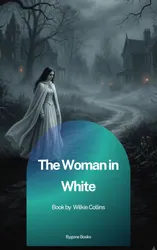
The Woman In White

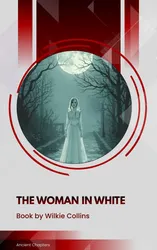
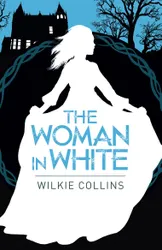
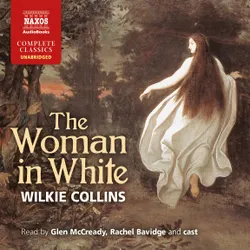
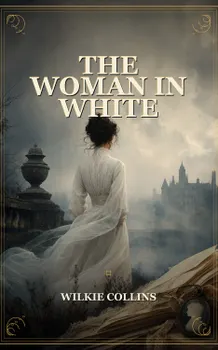
The Woman in White tells the story of Walter Hartright, a young and impoverished drawing teacher who falls in love with his aristocratic pupil, Laura Fairlie. He cannot hope to marry her, however, and she is married off against her will to a baronet, Sir Percival Glyde, who is seeking her fortune. The terms of her marriage settlement prevent Glyde accessing her money while she lives, so together with his deceptively charming and cunning friend, Count Fosco, they hatch an unscrupulous deception to do so nonetheless. In an early 19th Century version of "identity theft," they contrive to fake Laura's death and confine her to a mental asylum. Their plot is eventually uncovered and exposed by Hartright with the help of Laura's resourceful half-sister, Marian Halcombe. The Woman in White was the most popular of Wilkie Collins' novels in the genre then known as "sensation fiction." It has never been out of print and is frequently included in lists of the best novels of all time. Published initially in serial form in 1859–60, it achieved an early and remarkable following, probably because of the strength of its characters, in particular the smooth and charming but utterly wicked villain Count Fosco, and the intelligent and steadfast Marian Halcombe opposed to him. Wilkie Collins (died 1889) was one of the most distinguished authors of the Victorian age. Their work has endured across generations and continues to be read and studied worldwide. As a work of classic literary fiction, The Woman In White exemplifies the narrative craft and social insight that defined great storytelling of its era. Literary fiction of this period was characterized by careful attention to character psychology, social milieu, and the moral questions that animated public discourse.
Über dieses Buch

The Woman in White tells the story of Walter Hartright, a young and impoverished drawing teacher who falls in love with his aristocratic pupil, Laura Fairlie. He cannot hope to marry her, however, and she is married off against her will to a baronet, Sir Percival Glyde, who is seeking her fortune. The terms of her marriage settlement prevent Glyde accessing her money while she lives, so together with his deceptively charming and cunning friend, Count Fosco, they hatch an unscrupulous deception to do so nonetheless. In an early 19th Century version of "identity theft," they contrive to fake Laura's death and confine her to a mental asylum. Their plot is eventually uncovered and exposed by Hartright with the help of Laura's resourceful half-sister, Marian Halcombe. The Woman in White was the most popular of Wilkie Collins' novels in the genre then known as "sensation fiction." It has never been out of print and is frequently included in lists of the best novels of all time. Published initially in serial form in 1859–60, it achieved an early and remarkable following, probably because of the strength of its characters, in particular the smooth and charming but utterly wicked villain Count Fosco, and the intelligent and steadfast Marian Halcombe opposed to him. Wilkie Collins (died 1889) was one of the most distinguished authors of the Victorian age. Their work has endured across generations and continues to be read and studied worldwide. As a work of classic literary fiction, The Woman In White exemplifies the narrative craft and social insight that defined great storytelling of its era. Literary fiction of this period was characterized by careful attention to character psychology, social milieu, and the moral questions that animated public discourse.
Starte noch heute mit diesem Buch für 0 €

  • Hole dir während der Testphase vollen Zugriff auf alle Bücher in der App
  • Keine Verpflichtungen, jederzeit kündbar
Jetzt kostenlos testen
Mehr als 52 000 Menschen haben Nextory im App Store und auf Google Play 5 Sterne gegeben.

  1. 3.0

    200 Meisterwerke der Literaturgeschichte (Kommentiert) : Erweiterte Ausgabe. Die größten Klassiker der Weltliteratur

    Franz Kafka, Victor Hugo, Fjodor Michailowitsch Dostojewski, Lord Byron, Giacomo Leopardi, Marcel Proust, Henrik Ibsen, Percy Bysshe Shelley, Charles Dickens, Jane Austen, Mary Shelley, Emily Brontë, Charlotte Brontë, Anne Brontë, William Makepeace Thackeray, Bram Stoker, Henry Fielding, George Eliot, William Shakespeare, D. H. Lawrence, Walt Whitman, Herman Melville, Thomas Wolfe, Virginia Woolf, Joseph Conrad, Sinclair Lewis, Lewis Carrol, Edgar Allan Poe, Edward Bulwer-Lytton, Oscar Wilde, H.G. Wells, Daniel Defoe, James Fenimore Cooper, Lew Wallace, Jonathan Swift, Mark Twain, Walter Scott, Nathaniel Hawthorne, Harriet Beecher Stowe, Laurence Sterne, Frances Hodgson Burnett, Arthur Conan Doyle, Wilkie Collins, Edgar Wallace, Robert Louis Stevenson, Jack London, Henry David Thoreau, John Galsworthy, F. Scott Fitzgerald, Rudyard Kipling, G.K. Chesterton, Washington Irvin, O.Henry, Ambrose Bierce, Alexander Sergejewitsch Puschkin, Michail Lermontow, Iwan Sergejewitsch Turgenew, Leo Tolstoi, Nikolai Gogol, Iwan Gontscharow, Nikolai Leskow, Anton Pawlowitsch Tschechow, Maxim Gorki, François Rabelais, Jean De Fontaine, Blaise Pascal, Pierre Corneille, Moliere, Jean Baptiste Racine, Charles Perrault, Voltaire, Denis Diderot, Jean-Jacques Rousseau, Pierre Ambroise Laclos, Antoine-François Prévost, Marquis De Sade, François René Chateaubriand, Stendhal, Honoré de Balzac, Alexandre Dumas, Alphonse de Lamartine, George Sand, Gustave Flaubert, Emile Zola, Guy De Maupassant, Alphonse Daudet, Jules Verne, Joris-Karl Huysmans, Prosper Mérimée, Charles Baudelaire, Stéphane Mallarmé, Arthur Rimbaud, André Gide, Arthur Schopenhauer, Heinrich Heine, Friedrich Schiller, Johann Wolfgang Goethe, Jacob Grimm, Gottfried von Straßburg, Wolfram von Eschenbach, E. T. Hoffmann, Annette von Droste-Hülshoff, Heinrich von Kleist, Friedrich Hölderlin, Theodor Fontane, Gustav Freytag, Gottfried Keller, Theodor Storm, Stefan Zweig, Joseph von Eichendorff, Klaus Mann, Rainer Maria Rilke, Johanna Spyri, Joseph Roth, Karl May, Robert Musil, Heinrich Mann, Sigmund Freud, Friedrich Nietzsche, Dante Alighieri, Giovanni Boccaccio, Giacomo Casanova, Luigi Pirandello, Giosuè Carducci, Gabriele D’Annunzio, Niccolo Machiavelli, Miguel Cervantes Saavedra, Pedro Calderón Barca, Vicente Blasco Ibañez, Knut Hamsun, Homer, Äsop, Herodot, Thukydides, Xenophon, Platon, - Aristoteles, - Sophokles, Euripides, - Aristophanes, Lao Tse, - Konfuzius, Siddhartha Gautama Buddha, Titus Livius, Tacitus, Marcus Tullius Cicero, Vergil, Ovid, Lukian, Petronius, Apuleius, Longos von Lesbos, Mark Aurel, Aurelius Augustinus

  2. Die Frau in Weiß - Hörbuch Klassiker

    Wilkie Collins, Hörbuch Klassiker

  3. HALLOWEEN Ultimate Collection: 200+ Mysteries, Horror Classics & Supernatural Tales

    Wilhelm Hauff, Charles Dickens, Mark Twain, Harriet Beecher Stowe, Edgar Allan Poe, William Hope Hodgson, John Buchan, George MacDonald, Bram Stoker, Anatole France, Jack London, Henry James, Théophile Gautier, Arthur Conan Doyle, Richard Le Gallienne, Ralph Adams Cram, Guy De Maupassant, Thomas Hardy, William Archer, Daniel Defoe, Brander Matthews, Lafcadio Hearn, Ambrose Bierce, Ellis Parker Butler, Washington Irving, Nathaniel Hawthorne, Grant Allen, Arthur Machen, Wilkie Collins, Thomas Peckett Prest, James Malcolm Rymer, Fergus Hume, Walter Hubbell, Leopold Kompert, Florence Marryat, John William Polidori, Vincent O'Sullivan, W. W. Jacobs, M.P. Shiel, E F Benson, M. R. James, H.P. Lovecraft, Francis Marion Crawford, Mary Shelley, Margaret Oliphant, Frank R. Stockton, A. T. Quiller-Couch, Leonard Kip, Katherine Rickford, Bithia Mary Croker, Catherine L. Pirkis, Pedro De Alarçon, Pliny the Younger, Helena Blavatsky, Villiers de Adam, William F. Harvey, Fiona Macleod, William T. Stead, Gambier Bolton, Andrew Jackson Davis, Nizida, Walter F. Prince, Chester Bailey Fernando

  4. Die großen Klassiker der englischen Literatur (40+ Titel in einem Buch) : Bereicherte Ausgabe. Literarische Vielfalt von Romantik bis Sozialkritik erleben

    Charles Dickens, Mark Twain, Harriet Beecher Stowe, Oscar Wilde, Robert Louis Stevenson, Edgar Allan Poe, Charlotte Brontë, Emily Brontë, Henry David Thoreau, Arthur Conan Doyle, Frances Hodgson Burnett, Joseph Conrad, Jane Austen, Herman Melville, George Eliot, Walter Scott, Laurence Sterne, Jonathan Swift, Daniel Defoe, Henry Fielding, Rudyard Kipling, Bret Harte, Ambrose Bierce, Washington Irving, Nathaniel Hawthorne, Wilkie Collins, O.Henry, William Makepeace Thackeray, Edgar Wallace, G.K. Chesterton, Thomas Wolfe, T. E. Lawrence, Lewis Carrol

  5. Der Mondstein

    Wilkie Collins

  6. Jezebel's Daughter

    Wilkie Collins

  7. Blinde Liebe

    Wilkie Collins

  8. Fräulein oder Frau?

    Wilkie Collins, Golden Deer Classics

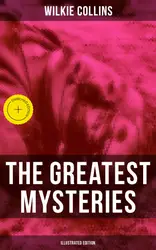
  9. The Greatest Mysteries of Wilkie Collins (Illustrated Edition) : Enriched edition. The Woman in White, No Name, Armadale, The Haunted Hotel, The Dead Secret, Miss or Mrs…

    Wilkie Collins

  10. Blinde Liebe : historischer Kriminalroman

    Wilkie Collins

  11. Große Klassiker der englischen Literatur : Ein Blick auf Humanismus und Gesellschaft im Wandel des 19. Jahrhunderts

    Charles Dickens, Jane Austen, Emily Brontë, Joseph Conrad, Arthur Conan Doyle, Robert Louis Stevenson, Charlotte Brontë, Lewis Carrol, Henry Fielding, William Makepeace Thackeray, George Eliot, Daniel Defoe, Mark Twain, Frances Hodgson Burnett, Walter Scott, Oscar Wilde, Nathaniel Hawthorne, Jonathan Swift, Laurence Sterne, Wilkie Collins, Henry David Thoreau, Herman Melville, Harriet Beecher Stowe, Rudyard Kipling, G.K. Chesterton, Thomas Wolfe, T. E. Lawrence, Edgar Wallace, Washington Irving, Edgar Allan Poe, O.Henry, Ambrose Bierce, Bret Harte

  12. Neu

    100 obras maestras que debes leer antes de morir

    Francis Scott Fitzgerald, Mary Shelley, Lyman Frank Baum, Edith Nesbit, Dante Alighieri, Jane Austen, Ambrose Bierce, Emily Brontë, Edgar Rice Burroughs, Lewis Carroll, Wilkie Collins, René Descartes, Charles Dickens, Emily Dickinson, Alexandre Dumas, Gustave Flaubert, Benito Pérez Galdós, Johann Wolfgang Goethe, Thomas Hardy, E. T. Hoffmann, Washington Irving, Henry James, James Joyce, Franz Kafka, Gaston Leroux, Federico García Lorca, H.P. Lovecraft, Publio Virgilio Marón, Lucy Maud Montgomery, John William Polidori, Marco Polo, Antoine de Saint-Exupéry, Emilio Salgari, Walter Scott, Mark Twain, Jules Verne