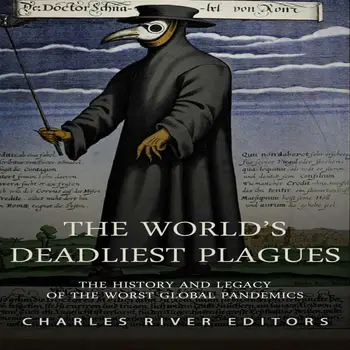
The World’s Deadliest Plagues: The History and Legacy of the Worst Global Pandemics

Human beings seem to have a particular fascination for microbiological threats. They are invisible, unpredictable and mysterious, and it is only in the past 150 years or so that scientists have begun to understand microorganisms and the maladies they can cause. Modern society has long been horrified and enthralled by accounts of such pestilences as the Black Death, which exterminated up to 60% of the population of Europe from 1347-1351. Less known is the Plague of Justinian which was even more deadly in that it carried away a quarter of the world’s population within the space of one year (542 CE). The Great Plague of London, which killed 100,000 in 1666, is another infamous pestilence, as is the Spanish Flu of 1918, which took the lives of as many as one million worldwide, making that epidemic even deadlier than the medieval Black Death.

Such virulent outbreaks of disease are by no means distant historical events. While scientific and technological advances have limited and in many places eradicated such community-devastating diseases as cholera, smallpox, bubonic plague, typhus, Salmonella and yellow fever, new microscopic threats have arisen, including Ebola, SARS, bird flu, and most recently Coronavirus 2.

The terror associated with pestilence speaks to people’s insecurities concerning the unknown and invisible. The ancients had no knowledge of microorganisms that caused disease-instead they postulated that pestilence was caused by miasma, air fouled by decomposing matter. That said, modern awareness of microscopic viruses and bacteria does nothing to lessen humanity’s insecurity. If anything, it is terrifying that such tiny creatures have the capacity to overthrow powerful and vibrant societies. This is one of the themes of H. G. Wells’ famous War of the Worlds (1897).

Starte noch heute mit diesem Buch für 0 €

  • Hole dir während der Testphase vollen Zugriff auf alle Bücher in der App
  • Keine Verpflichtungen, jederzeit kündbar
Jetzt kostenlos testen
Mehr als 52 000 Menschen haben Nextory im App Store und auf Google Play 5 Sterne gegeben.

  1. 1.0

    Die Panzer: Die Geschichte und das Vermächtnis von Nazideutschlands berühmtesten Panzern des Zweiten Weltkriegs

    Charles River Editors

  2. 2.0

    Göbekli Tepe: The History and Mystery of One of the World’s Oldest Neolithic Sites

    Charles River Editors

  3. The Kings of Babylon: The History of the Different Dynasties that Ruled Ancient Mesopotamia’s Greatest City

    Charles River Editors

  4. Das mittelalterliche Russland: Die Geschichte und das Erbe der Gruppen, die den russischen Staat im Mittelalter entwickelten

    Charles River Editors

  5. The Texas Revolution and Mexican-American War: The History and Legacy of the Conflicts that Led to Mexico’s Cession of the American Southwest

    Charles River Editors

  6. The Underworld in Ancient Mesoamerica: The History and Legacy of Mesoamerican Concepts of Death

    Charles River Editors

  7. The Myths of India: The History and Legacy of Mythology across the Indian Subcontinent

    Charles River Editors

  8. The Disappearance of the USS Thresher: The History of the American Nuclear Submarine that Sank at the Height of the Cold War

    Charles River Editors

  9. Spain and the American Revolution: The History of the Spanish Empire’s Participation in the Revolutionary War

    Charles River Editors

  10. 3.5

    Sigmund Freud and Carl Jung: The Pioneering Lives and Works of History’s Most Influential Psychologists

    Charles River Editors

  11. Imperial Germany’s Colonization in Africa: The History of the German Efforts and Conflicts to Colonize Parts of Africa

    Charles River Editors

  12. 4.0

    The Empires of India: The History of the Dynasties that Ruled India Before the British

    Charles River Editors