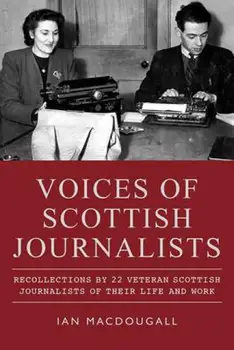
Voices of Scottish Journalists: Recollections of 22 Scottish Journalists of Their Life and Work

Newspaper journalism is a romantic profession. The men and women who wrote for newspapers in the twentieth century started work in a 'Hold the front page!' atmosphere: hot metal, clicking typewriters and inky fingers.

In this fascinating collection, the latest in the Scottish Working People's History Trust series, Ian MacDougall has captured the memories of 22 veteran journalists from a wide range of newspapers all over Scotland, some local, some national. The earliest entrant started work in 1929, just before the Great Depression, the latest in the mid 1950s. Their accounts, like so much of oral history, describe a physical world we have almost lost sight of since the computer revolution. But it was a different social world too: it would be unusual for school leavers today to start work as 'copy-boys' running out for cigarettes or filling gluepots for their scary older colleagues. Journalists had to turn their hands to anything from flower shows to air raids, from Hess's landing near Eaglesham to royal visits; and women often had to fight their corner to get started as young reporters.

As journalist Neal Ascherson says in his foreword, the book contains 'a swathe of Scottish social history': virtually all these journalists made their way from humble backgrounds, drawn by the desire for an exciting rather than a safe job - and above all one full of human interest.
Über dieses Buch

Newspaper journalism is a romantic profession. The men and women who wrote for newspapers in the twentieth century started work in a 'Hold the front page!' atmosphere: hot metal, clicking typewriters and inky fingers.

In this fascinating collection, the latest in the Scottish Working People's History Trust series, Ian MacDougall has captured the memories of 22 veteran journalists from a wide range of newspapers all over Scotland, some local, some national. The earliest entrant started work in 1929, just before the Great Depression, the latest in the mid 1950s. Their accounts, like so much of oral history, describe a physical world we have almost lost sight of since the computer revolution. But it was a different social world too: it would be unusual for school leavers today to start work as 'copy-boys' running out for cigarettes or filling gluepots for their scary older colleagues. Journalists had to turn their hands to anything from flower shows to air raids, from Hess's landing near Eaglesham to royal visits; and women often had to fight their corner to get started as young reporters.

As journalist Neal Ascherson says in his foreword, the book contains 'a swathe of Scottish social history': virtually all these journalists made their way from humble backgrounds, drawn by the desire for an exciting rather than a safe job - and above all one full of human interest.

Starte noch heute mit diesem Buch für 0 €

  • Hole dir während der Testphase vollen Zugriff auf alle Bücher in der App
  • Keine Verpflichtungen, jederzeit kündbar
Jetzt kostenlos testen
Mehr als 52 000 Menschen haben Nextory im App Store und auf Google Play 5 Sterne gegeben.